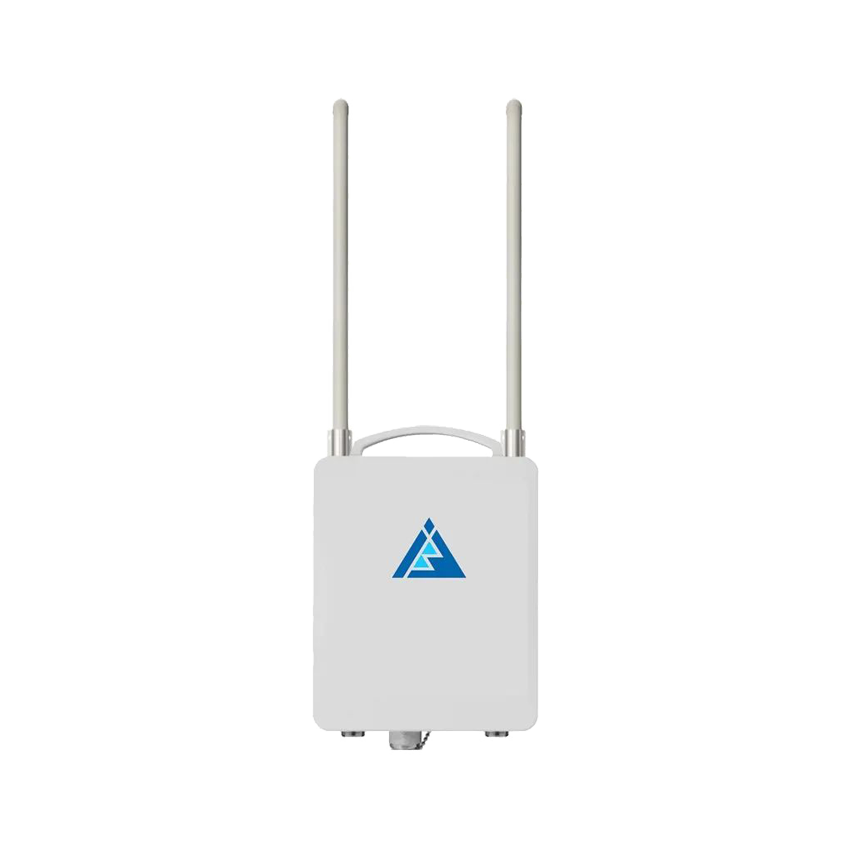
Optical fibers and network cables are ideal for the backbone networks of large-scale warehousing bases, while iMAX Wireless Metropolitan Area Network solutions are better suited for branch networks—especially mobile networking scenarios. Compared to standard WLAN WiFi technology, the iMAX wireless private network not only effectively reduces the overall project construction cost (primarily due to fewer devices required) and enables easier capacity expansion but also enhances overall availability, security, and reliability.
The iMAX broadband wireless network system supports multiple networking modes, including point-to-multipoint, MESH, and ring network topologies. It is suitable for connecting warehouses to other warehouses, as well as linking scattered monitoring points and information nodes in surrounding areas. iMAX offers a diverse product lineup: for example, the high-performance iMAX-8000H series for demanding scenarios, and the iMAX-8000AI series tailored for robots or AGV applications. Customized solutions can be developed based on specific user requirements.
As a “private network” communication system, the iMAX wireless communication system enables independent networking without relying on telecom operators’ infrastructure. Designed to build wireless cities, it excels at ultra-long-distance network interconnection in outdoor environments, making it highly applicable in warehousing private network construction. The iMAX system supports metropolitan area networking technologies such as VLAN, bridging, routing, and firewalls, and can seamlessly integrate with fiber-optic networks. It is also well-suited for high-reliability system networking of large mechanical equipment (e.g., overhead cranes, gantry cranes) in warehousing areas. Among its product range, the iMAX-6000 series and FibeAIR microwave system serve as backbone network solutions, while the iMAX-8000S and iMAX-8000H series are designed for edge access networks.
- Communication Distance: Under line-of-sight conditions, even the smallest iMAX5G dedicated communication system with an integrated antenna can easily achieve a coverage radius of 10 kilometers in point-to-multipoint mode. In point-to-point mode, the maximum distance can reach 100 kilometers, making it ideal for ultra-long-distance outdoor communication and networking.
- Transmission Bandwidth: The iMAX-8000H is a 600Mbps point-to-multipoint communication system, the iMAX-8000S is a 100Mbps point-to-multipoint system, the iMAX-6000 supports point-to-point transmission at 150/300/600Mbps, and the iMAX-9000 offers point-to-point transmission speeds exceeding 1000Mbps.
- Multi-Service & Reliability Features: The iMAX WMAN system can be integrated with metropolitan backbone networks and fully supports the mixed transmission of multiple media types, including data, video, and voice. Rich network features such as RSTP, VLAN, VPN, QoS, software firewalls, and dynamic routing protocols enable “multi-network convergence” for diverse user services. Its wide frequency range and high bandwidth ensure reliable support for bandwidth-intensive applications, especially video services (e.g., security monitoring, video conferencing). Equipped with reliability-enhancing technologies such as VRRP, multi-link data mirroring, and Ethernet ring networks, the system supports hot standby redundancy and high-speed mobile roaming—making it ideal for warehousing users requiring system control and high reliability. Due to its excellent quality and robust communication stability, the iMAX system is also highly suitable for autonomous scenarios such as AGVs and robots.
The iMAX wireless communication system is a true wireless private network solution designed specifically for building wireless metropolitan area networks. Its reliability and stability have earned widespread user acclaim, making it the most suitable communication method for solving networking challenges in indoor, outdoor, and yard areas of the warehousing industry.
For centralized networking of multiple warehouses (especially remotely managed warehouses in different locations), traditional solutions such as dedicated data lines or leased optical fibers would incur extremely high operational costs. Such networking scenarios are ideally suited for WAN (public Internet broadband) or WWAN (4G/5G) based solutions. These solutions significantly reduce the cost of leased links while ensuring system security and reliability, enabling more convenient and flexible deployment.
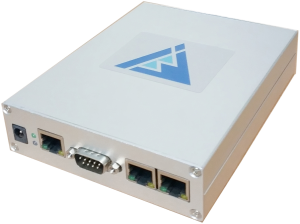
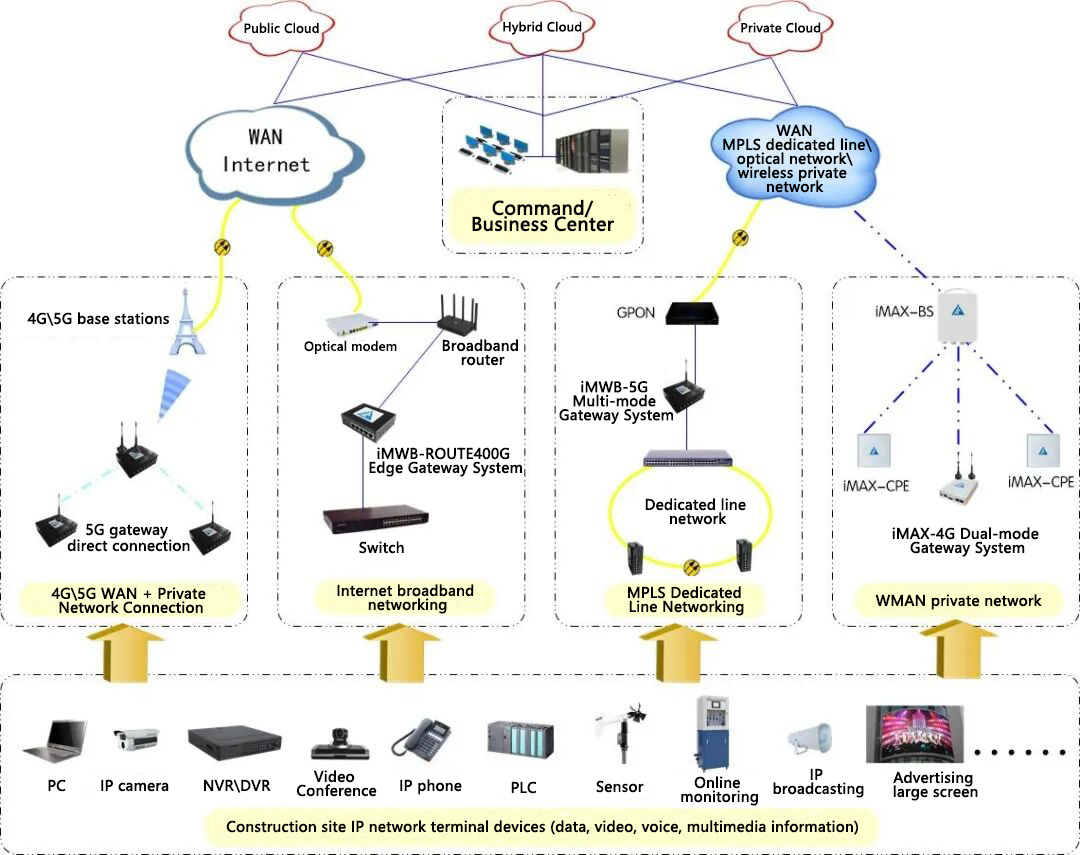
This plan takes Guoxin Longxin’s iMAX-4GW300 product with cloud interconnection SD-CX (SDN-based Cloud Exchange) technology as an example to introduce the corresponding solution—hailed as a game-changer for “Internet + management” applications of multiple remote warehouses. By using the iMAX-4GW300 to build a WAN-based “private network” system, warehouse management and operation data, video surveillance information, and even remote control systems can be accessed via Internet broadband, dedicated lines, or 4G LTE networks—enabling convenient centralized management and scientific operations.
The iMAX-4GW300 is the first iMAX Wireless Metropolitan Area Network (WMAN) and 4G LTE dual-mode wireless gateway system under the iMWB brand. It can serve as an integrated switching gateway platform supporting multiple access methods, including fiber optic access (requires configuration of Guoxin Longxin’s FiberDC-IDU), local area network (LAN) interconnection, MPLS dedicated line access, Internet broadband access, iMAX WMAN private network access, and 4G Internet access.
This solution is a cloud platform-based Internet solution. Users can choose private cloud, public cloud, or hybrid cloud deployment, and integrate scattered warehouse networks into a private network over the wide area network (WAN) through VPN tunnel encryption technology. Furthermore, Guoxin Longxin’s solution is constructed with a hardware VPN device-centric architecture (“VPN server + VPN gateway”), which undoubtedly offers superior reliability and security.
The schematic diagram of the network architecture for the smart warehouse Wireless Wide Area Network (WWAN) solution is as follows:
In summary, Guoxin Longxin’s wireless products based on various technologies have broad application scenarios in the smart warehousing field. They can address key challenges such as difficult and costly networking, while meeting the demands for high-security and high-reliability connectivity in smart warehousing applications. Specifically, which services or scenarios are suited to which products?
Smart warehousing relies on wireless networks to support numerous specific business systems, covering a wide range of scenarios including but not limited to the following applications:
Security IP video surveillance systems consist of front-end video monitoring points and back-end hardware/software platforms (e.g., video walls). Designed to monitor key warehouse areas (such as critical material storage locations, crowded areas, and entrances/exits), these systems deter uncivilized behavior and can even serve as evidence for penalties. Meanwhile, video surveillance acts as a “pair of eyes” to promptly identify potential safety hazards and issues. Many video surveillance systems are equipped with AI video analysis capabilities, enabling automatic event detection, real-time alerts, and disposal—an integral part of smart warehousing.
- For large-scale warehouse parks with high video capacity and wide coverage requirements: The iMAX Wireless Metropolitan Area Network (WMAN) system is recommended.
- For shared construction with existing WiFi systems: The iMAX-ACG600 dual-mode gateway is an optimal choice.
- For scenarios with fewer video channels and short communication distances: WiFi systems (including wireless bridges) can be considered.
Intelligent forklifts, logistics stacking robots, and AGVs (Automated Guided Vehicles) are common operational equipment in smart warehousing systems, with increasingly widespread applications.
Given the requirements for wireless link stability, reliability, and roaming performance in autonomous operation systems, the iMAX-8000AI series 5G iMAX wireless private network system is the best choice. Featuring compact size, low power consumption, high bandwidth, and 5G wide-frequency support, this series achieves mobile communication distances of 1–3 kilometers under line-of-sight conditions. Its intelligent antenna technology and roaming capabilities easily meet diverse robot networking needs. Supporting multiple topologies (point-to-point, point-to-multipoint, centerless mesh, and hot-standby ring networks), it is particularly suitable for high-reliability robotic operation systems.
- For robots/AGVs already equipped with WiFi interfaces, featuring high intelligence, no remote control requirements, and low roaming demands: Customized solutions using Guoxin Longxin’s special WiFi base stations are available.
Some smart logistics parks are gradually adopting autonomous vehicles to improve transportation efficiency and reduce labor costs, primarily enabled by remote control and autonomous driving technologies. Smart tallying and sorting systems also require real-time network connectivity for numerous mobile devices.
- Both the iMAX5G WMAN system and special WiFi base station system are applicable, depending on the user’s requirements for link reliability.
- For broader-area vehicle networking needs: The iMAX-4GW300 WWAN device is a more suitable option.
4. WiFi Smart Terminal and Sensor AccessSmart warehousing is inseparable from various intelligent terminals (e.g., RFID scanners, barcode/QR code readers, tablets, laptops) and numerous sensors (temperature, humidity, specific gas detection, infrared detection, etc.). These data collection terminals require WiFi connectivity, necessitating the construction of a campus-wide WiFi coverage system to meet real-time networking demands.
- WiFi coverage in warehouse areas can be implemented using the iMAX-ACG600 dual-mode gateway system or special WiFi base station system. By significantly reducing the number of devices used, these solutions not only eliminate system self-interference and improve performance but also substantially lower the total system cost.
- The iMAX-ACG600 dual-mode gateway system perfectly integrates WiFi coverage with backbone network backhaul, reducing deployment complexity in warehouse areas. It is particularly suitable for WiFi system upgrades in already operational warehouses.
Integrated with automatic identification technology (RFID), WMS enables intelligent management of warehousing processes such as receiving, quality inspection, warehousing, outbound, inventory checking, transfer, warehouse relocation, and consignment. It supports refined management and control of key component/batch material tracking, inbound/outbound operations, material flow, inventory counting, and warehousing distribution—helping to accelerate goods turnover, reduce obsolete inventory, improve warehousing efficiency, reduce labor intensity, and lower management costs.
In WMS construction,both the iMAX 5G WMAN system and special WiFi base station system can be deployed. They not only reduce network construction costs but also provide network “elasticity,” facilitating mobility, relocation, renovation, capacity expansion, and upgrades.
In conclusion, the wireless networking system serves as the underlying foundation of smart warehousing—analogous to “roads.” The various business systems and functional modules built on top (e.g., HD video, AGVs, stacking robots, digital twins, AR/VR) are like “vehicles” on these roads. No matter how advanced the vehicles are, they cannot operate effectively on poor roads. This is especially true for smart warehousing pursuing unmanned and intelligent automatic operations, which have extremely high requirements for network reliability and stability. Therefore, a high-reliability wireless networking system is the most critical component of smart warehousing or warehouse IoT.
For specific product inquiries or customized solutions, please contact Guoxin Longxin’s Technical Department for further support. Based on the specific project requirements of smart warehousing, Guoxin Longxin can collaborate with integrator partners to provide full-lifecycle services—including planning and design, on-site surveys and testing, installation and commissioning, and after-sales support—by leveraging our practical experience and understanding of warehouse operations.