
Wireless Private Network Solution for Smart Ports
I. Demand Overview
With the rapid development of China’s economy, port operations have experienced swift growth. Given the continuous increase in port throughput, there is an urgent need to improve operational efficiency. Meanwhile, as China’s demographic dividend gradually fades, the traditional extensive, labor-intensive port operation and management methods can hardly meet the industry’s development goals of reducing staff and increasing efficiency. Both container terminals and bulk cargo terminals are putting forward increasingly higher requirements for the digitalization of port infrastructure construction. Digital and intelligent ports represent the development direction of production and management in the port industry, and remote control and unmanned driving technologies will be increasingly adopted on a large scale.
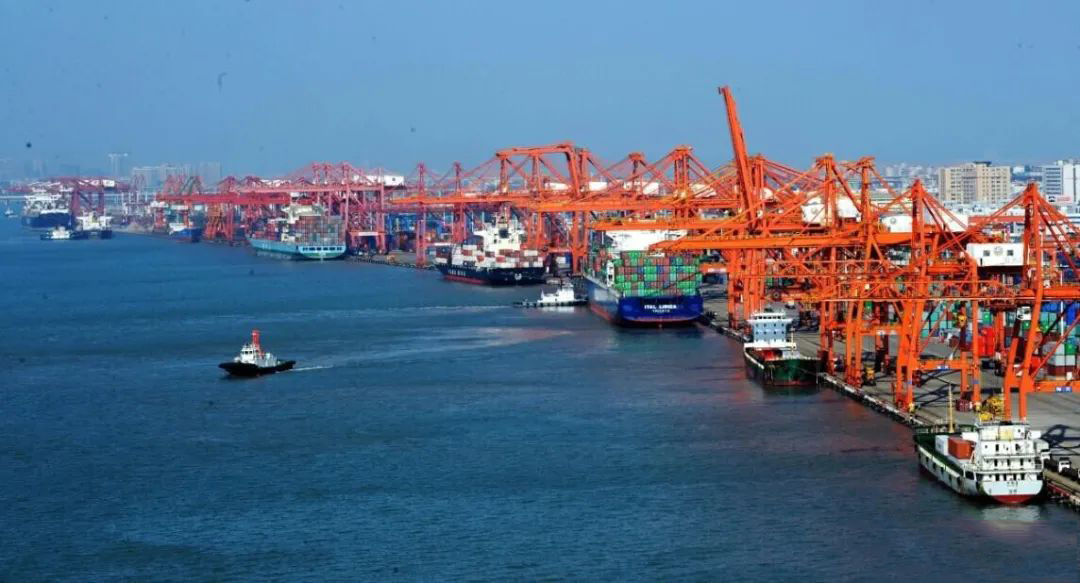
Taking a certain terminal as an example, heavy-duty operating cranes (referred to as “heavy machinery” for short) — including ship loaders, unloaders, rubber-tyred gantry cranes (RTGs), gantry cranes, and portal jib cranes — are often deployed intensively in quantities of dozens or even hundreds. How to manage port machinery scientifically and reasonably has become an extremely urgent issue. Meanwhile, the operational efficiency and intelligent level of port operations are crucial factors determining the future competitiveness and economic benefits of ports. Many port companies have recognized that only by adopting the latest technologies and scientific and technological achievements to build smart ports can they meet the needs of further port development. Guoxin Longxin’s series of wireless private network solutions for port intelligence are proposed precisely to address the requirements of wireless networking and communication in ports.
Guoxin Longxin’s wireless systems have been applied in the domestic port industry across nearly all major ports in China, covering scenarios such as Remote Crane Monitoring Systems (RCMS), video surveillance, remote control/unmanned driving of port machinery, load limitation & lifting control, anti-collision, and WiFi coverage. Our in-depth understanding of wireless networking applications in ports enables us to help users better develop relevant intelligent systems. This series of solutions is proposed based on Guoxin Longxin’s years of practical experience in port projects, targeting the wireless private network connectivity needs of port logistics yards, terminals, and other environments.
II. Advantageous Products
Guoxin Longxin is one of the few professional wireless product and system manufacturers in China that has product lines and practical applications spanning Wireless Local Area Networks (WLAN), Wireless Metropolitan Area Networks (WMAN), and Wireless Wide Area Networks (WWAN). With a broader portfolio of wireless technologies covered in our products, we possess a deeper understanding of the wireless industry and its technologies. Having undertaken projects across diverse industries and scenarios — especially in the port sector, where we have fulfilled a wide range of application requirements for ports and terminals nationwide — we have gained thorough insights into the practical application conditions and related technologies of the port industry (e.g., high-definition video, remote control, and unmanned operations).
Port wiring is often inconvenient, with a large number of large-scale mobile mechanical equipment in operation. Various IT systems have stringent requirements for reliability and stability, while the working environment is also extremely harsh (extreme temperatures, frequent rain and snow, high corrosion, etc.). All these factors make the port industry one of the sectors with the most extensive adoption of wireless technologies. Our company’s WLAN, WMAN, and WWAN technologies are widely applied in the port industry. Below is a brief overview of the features of several product categories.
1. Wireless Local Area Network (WLAN) — WiFi Coverage and WiFi Terminal Access
To meet the needs of port industry users for mobile office work and broadband Internet access, various WiFi terminals for data, voice, and video communication (e.g., operation machinery information collection sensors, RFID handheld terminals, laptops, and smartphones) need to be connected to the local area network, which necessitates comprehensive WiFi coverage in ports. However, ports and terminals usually cover a vast area. Implementing conventional WiFi solutions requires deploying dozens or even hundreds of WiFi AP devices, which not only incurs high costs and cumbersome construction and wiring work but also leads to severe system self-interference, resulting in suboptimal system performance.
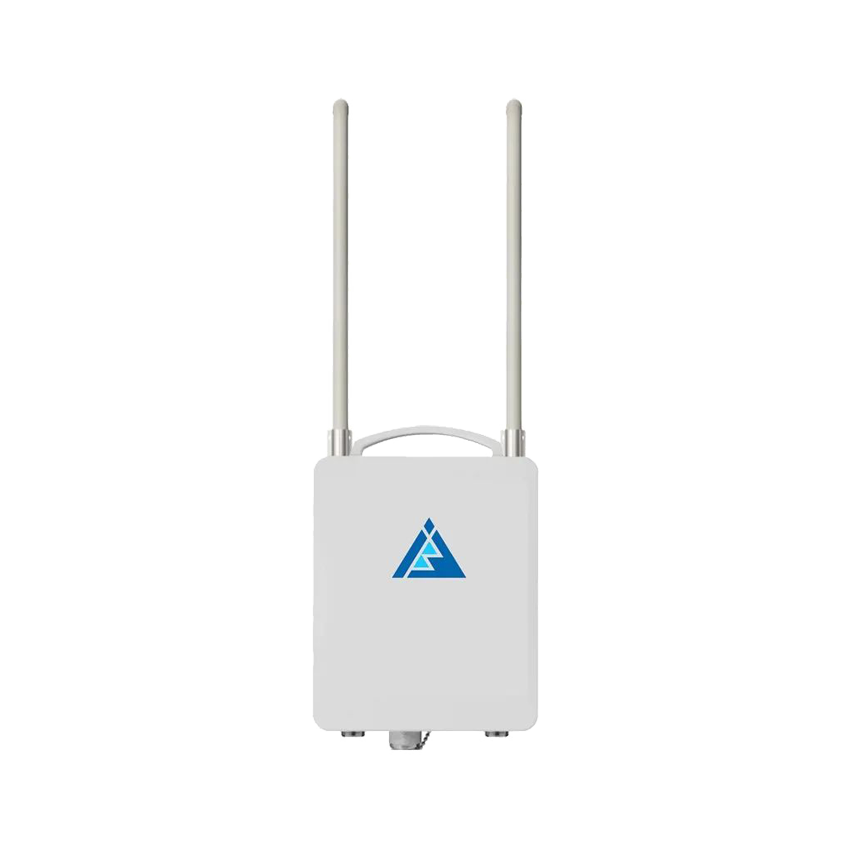
Guoxin Longxin’s Special WiFi Base Station System and Dual-Mode WiFi Wireless Gateway System can well meet the WiFi coverage requirements of port terminals and yards thanks to their wide coverage and strong access capability.
Metropolitan Area Network WiFi Dual-Mode Gateway iMAX-ACG600: This is an iMAX Wireless Metropolitan Area Network (WMAN) and WiFi dual-mode wireless gateway system. It supports both iMAX wireless metropolitan area network technology and WiFi (2.4G IEEE802.11b/g/n), and provides 1 local Ethernet interface, serving as a multi-network convergence gateway. While leveraging wireless private network technology to achieve ultra-long-distance, high-bandwidth and high-reliability transmission, it also supports the access of 2.4GHz standard wireless local area network WiFi devices. This enhances the applicability of system wireless networking and provides users with optimal wireless networking solutions in a more flexible manner. In short, it not only solves the problem of WiFi coverage, but also addresses the backbone network access of APs themselves, enabling a fully wireless network deployment and eliminating the hassle of laying optical cables in port cargo yards.
WiFi coverage is mainly designed to support the access of WiFi terminals such as smartphones, laptops, RFID scanners and PADs. However, due to its massive usage volume and reliance on open IEEE 802.11 series standards, it suffers from poor security and reliability. Therefore, it is not recommended for high-reliability port machinery networking.
2. Wireless Metropolitan Area Network (WMAN) — Construction of iMAX 5G Wireless Private Network System
There are a large number of heavy-duty machinery at port terminals, including ship loaders, ship unloaders, Rubber-tyred Gantry Cranes (RTGs), gantry cranes, portal jib cranes and quay cranes. Their management and control require a wireless private network system. Considering that it is for exclusive private network use, with high requirements for reliability, security and stability, and often needs to support high-capacity HD video access, it is not suitable to be mixed with WiFi systems. The 5G wireless metropolitan area network system adopting iMAX technology is the optimal solution for private network construction.
The iMAX 5G Wireless Metropolitan Area Network System is a “private network” communication system. It can form an independent network without relying on telecom operator facilities and is for exclusive private use, thus achieving excellent availability, reliability and stability. It is designed to build a highly available network or solve ultra-long-distance network interconnection in outdoor environments. All product series feature an extremely long communication distance and support a wide range of network technologies. Unlike technically simpler WiFi bridges, the iMAX wireless metropolitan area network system supports essential metropolitan area network technologies such as VLAN, bridging, routing and firewall. Its network topology supports ring networks, hot standby routing, centerless mesh networks (MESH) and tree networks (point-to-multipoint/point-to-point), and can carry IP networking services for a large number of devices. In addition, the iMAX wireless metropolitan area network system can be perfectly integrated with optical fiber networks, facilitating backhaul access on the metropolitan area backbone network side. Among them, the iMAX-6000 and iMAX-9000 series serve as the wireless backbone network, while the iMAX-8000S, iMAX-8000H and iMAX-8000W series are used for edge access networks.
- Communication Distance: Under line-of-sight conditions, even the smallest iMAX 5G dedicated communication system with integrated antennas can easily achieve a coverage radius of 10 km in point-to-multipoint mode with the iMAX-8000 series products. In point-to-point mode, the maximum distance can reach 50 km, which is very suitable for ultra-long-distance communication and networking in islands, mountainous areas and desert regions. The larger the port, the more prominent its long-distance advantage becomes.
- Transmission Bandwidth: The iMAX-8000H is a 300/600 Mbps high-capacity and large-bandwidth access network system; the iMAX-8000S is a 100 Mbps low-bandwidth but high-reliability communication system; the iMAX-6000 is a 150/300/600 Mbps hot standby redundant communication system for backbone networks; the iMAX-9000 is a high-bandwidth microwave communication system with a bandwidth of over 1000 Mbps. All series are available in single-mode and multi-mode versions, and the bandwidth can be further increased through bundling multiple devices.
- Multi-service Capability: The iMAX 5G Wireless Metropolitan Area Network System is a professional wireless communication system with three high merits: high quality, high performance and high reliability. It can be integrated with metropolitan area backbone networks, and fully supports the hybrid transmission of various media information such as data, video and voice. Rich network features including RSTP, VLAN, VPN, QoS, software firewall and dynamic routing protocols ensure the “multi-network integration” of different user services, greatly improving the security and reliability of users’ IT & DT systems. Its broadband and high bandwidth guarantee its excellent capability to carry high-bandwidth services, especially HD video services (such as security monitoring and video conferencing).
The iMAX wireless network system is a wireless private network system truly designed and manufactured for building wireless metropolitan area networks. Its reliability and stability have won high praise from users, making it the most suitable communication method for networking in port terminals and yards.
3. Wireless Wide Area Network (WWAN) — 4G/5G/Broadband Remote Networking
Some port projects involve remote management, such as equipment management and maintenance systems built by certain equipment manufacturers. For cross-provincial and municipal networking applications that cannot be satisfied by wireless metropolitan area networks, in addition to renting dedicated lines from telecom operators, secure remote network interconnection can also be achieved through “hardware VPN + SD-CX cloud switching technology”. The topology diagram of Guoxin Longxin’s Wireless Wide Area Network (WWAN) solution is as follows:
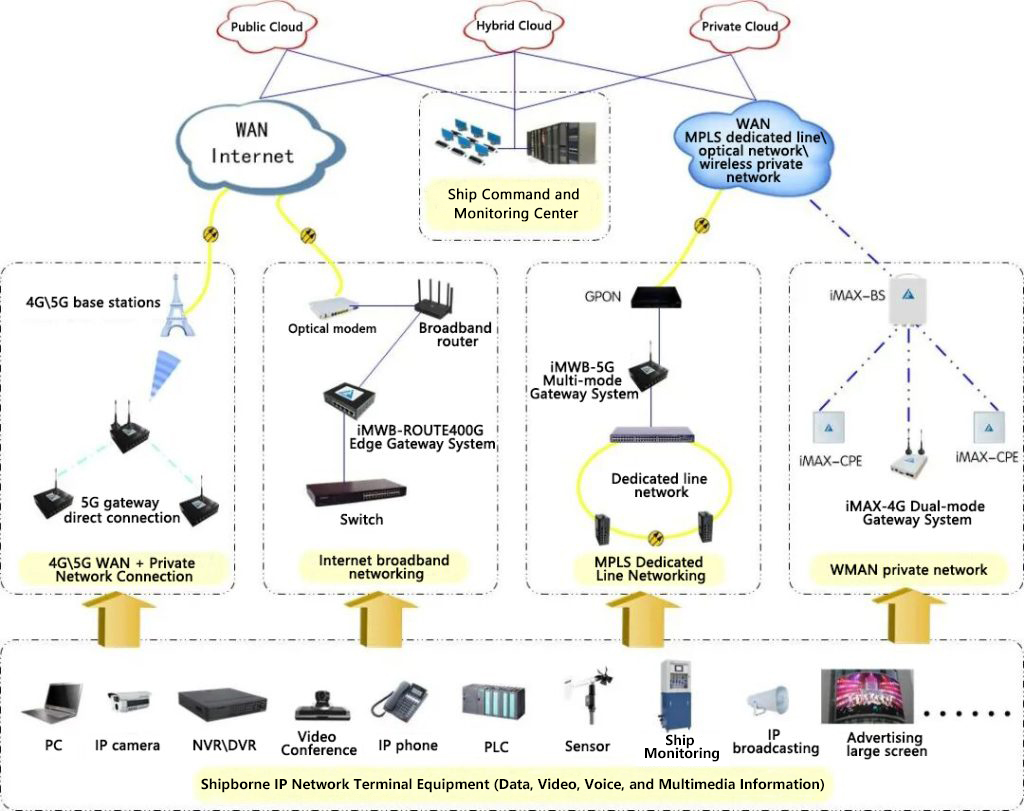
A cloud computing platform, also known as a cloud platform, refers to a service based on hardware and software resources that provides computing, networking, and storage capabilities. Cloud computing platforms can be divided into three categories: storage-oriented cloud platforms focused on data storage, computing-oriented cloud platforms centered on data processing, and integrated cloud computing platforms that balance both computing and data storage/processing. With the development of cloud computing, nearly every enterprise is currently using or planning to use cloud computing, which encompasses three distinct deployment models: public cloud, private cloud, and hybrid cloud.
The cloud exists “up in the sky”—so how do we connect on-premises business services to the cloud? Public clouds typically leverage the Internet, with common access methods including broadband services provided by telecom operators. For private clouds, VPN or dedicated line connections are preferred, such as dedicated lines from telecom operators or fiber-optic/wireless private networks built by the users themselves. As these are exclusive private networks isolated from the public Internet, their connection bandwidth, reliability, and security are significantly higher than those of regular broadband services. Whether for public or private clouds, both face the challenge of how to connect edge nodes to the cloud.
Guoxin Longxin’s iMWB-5GW1000 is the first 5G multi-mode wireless gateway system under the iMWB brand. It supports both 5G wide area networks (SA & NSA) and WiFi 6 wireless local area network coverage (2.4GHz & 5.8GHz), and is equipped with 2 Ethernet interfaces, enabling it to function as an edge VPN access gateway for cloud switching platforms. While delivering high bandwidth, high reliability, and high capacity via WiFi 6 wireless technology, it also supports 5G network access through public networks operated by telecom carriers, providing users with optimal wireless networking solutions in a more flexible manner.
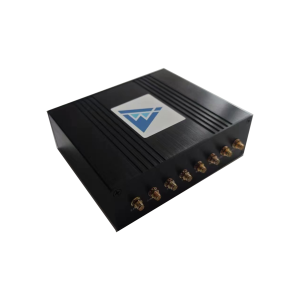
The iMAX-4GW300 Series 4G Metropolitan Area Network Dual-Mode Wireless Gateway System is a powerful tool for connecting cloud computing edge nodes to the cloud. The iMAX-4GW300 supports both iMAX wireless metropolitan area network technology and 4G LTE technology, and is equipped with multiple Ethernet interfaces, enabling it to serve as a multi-network convergence gateway. In terms of wireless communication, it not only leverages wireless private network technology to deliver high bandwidth, high reliability and high capacity, but also supports 4G LTE network access via telecom operators’ public networks, providing users with optimal wireless networking solutions in a more flexible manner.
In terms of ensuring security and stability, it mainly relies on Virtual Private Network (VPN) technology. VPN technology can establish a “private network” over a “public network” (or create an encrypted tunnel over a private network to enhance security) for encrypted communication. VPN technology primarily depends on tunnel encryption protocols, with typical ones including PPTP, L2TP and IPSec. Guoxin Longxin’s solution is built on the “VPN server + VPN gateway” architecture, which is dominated by embedded hardware VPN devices. Undoubtedly, this approach delivers superior reliability and security for remote management and maintenance.
For remote networking across multiple locations, cloud platform-based Internet solutions offer the highest cost-effectiveness and applicability. Port-related enterprises (especially IT equipment and integration vendors) can choose to build a private cloud, or opt for a public cloud or hybrid cloud. They can integrate dispersed operation sites into a virtual private network over the wide area network through VPN tunnel encryption technology. For detailed information on relevant technologies, please refer to the article 5G Virtual Private Networks Solve Networking Challenges for Government and Enterprise Clients.
III. Port Solution Collection
Due to the operating environment of ports and the mobile operational characteristics of port machinery, wireless networks have become the primary communication method in ports. The following port information systems all require the support of wireless network systems, and tailored optimal solutions need to be designed based on specific requirements. One of Guoxin Longxin’s core strengths is its deep understanding of the port industry, and its solutions fully address users’ requirements for reliability, stability and security.
1. Remote Crane Monitoring System (RCMS)
To ensure port production safety, relevant national authorities have issued requirements for the safety monitoring of special machinery. By 2015, full coverage of port machinery safety monitoring was mandated, and RCMS has since become a standard configuration for newly commissioned port machinery. The Remote Crane Monitoring System (RCMS) is responsible for collecting essential production data and operational statistics of cranes, while also monitoring the status of various crane mechanisms, recording and analyzing faults, and managing equipment maintenance. After years of construction and continuous improvement, RCMS has evolved into a foundational system for port informatization, and most port users now regard RCMS as an indispensable component of their management systems. The wireless system solution provided by Guoxin Longxin is critical to the stable operation of the RCMS system.
All functions of the RCMS system are based on periodic data generated by the PLCs of large-scale equipment. The PLC data is transmitted to the RCMS server via the network system, which then integrates and processes the data to implement various functions. The most critical requirement for the RCMS system is real-time performance. Given the actual operating conditions at port terminals, the optimal transmission path for PLC data from lifting equipment is through the highly reliable industrial-grade iMAX wireless network system, which ensures stringent real-time and reliability requirements are met.
To achieve remote real-time monitoring (RCMS), fault diagnosis, maintenance management, and visualization of large-scale mechanical equipment such as rubber-tyred gantry cranes (RTGs) and quay cranes operating on-site, it is essential to first solve the problem of dedicated network interconnection for heavy port machinery. Years of practical cases have demonstrated that Guoxin Longxin’s comprehensive port wireless network solution based on the iMAX wireless system is the most suitable option for RCMS private network deployment, with successful applications across major ports nationwide. The iMAX 5G broadband wireless communication system undertakes the network interconnection and data transmission functions within the entire RCMS system. It is precisely because of this reliable link guarantee that the terminal control room can monitor the real-time operating status of on-site mechanical equipment, collect equipment operational data in real time, and provide first-hand information for equipment management and maintenance.
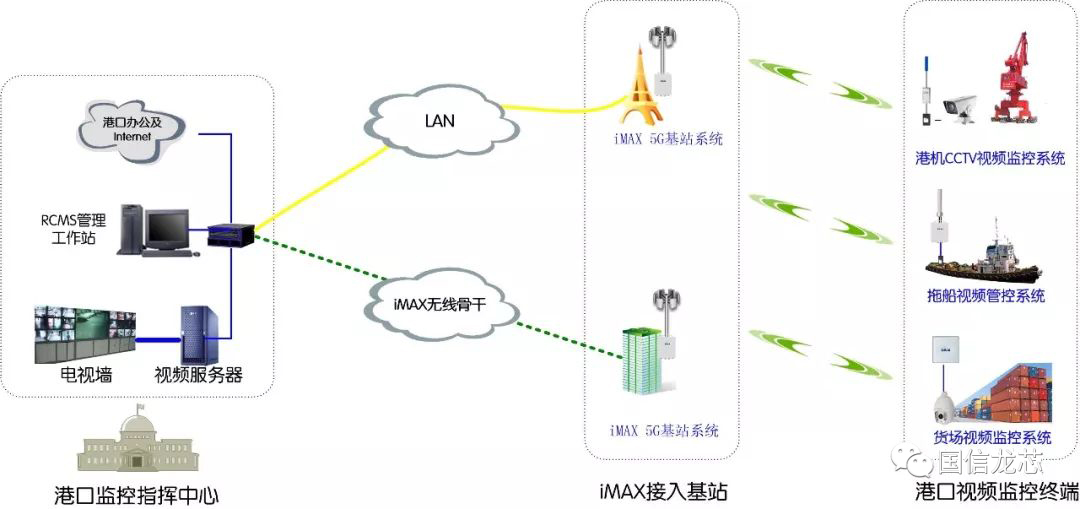
Based on the actual conditions of the port site, using high-end iMAX 5G wireless networking systems of various series is the most suitable and cost-effective way to transmit RCMS system data back to the control center. Typically, multiple central Base Stations (BS) need to be deployed based on local conditions to achieve full coverage of the target area, and iMAX 5G Customer Premise Equipment (CPE) devices can be installed on the port machinery side. Due to the mobile application characteristics of port machinery, the selection of equipment and antennas is crucial, and a customized configuration plan needs to be formulated based on on-site requirements. For example, due to rotation-induced signal obstruction, portal jib cranes require a dual-omnidirectional antenna configuration; however, since their bandwidth requirements are not high, the entry-level iMAX wireless CPE devices can be selected.
The typical application diagram of terminal RCMS is shown below:
In recent years, port HD video surveillance systems are also often integrated with AI video analytics technology, providing users with further intelligent technical support through a variety of video pattern recognition methods. Guoxin Longxin has cooperated with multiple domestic professional port video AI analytics vendors, and can play an important role in the customization of port video intelligent analytics solutions.
3. Port Terminal WiFi Wireless Coverage System
Through the construction of a wireless WiFi network system, various wireless WiFi terminals (laptops, smartphones, PADs, RFID devices, etc.) on the port terminal site can be connected to the port data center. All types of terminals can transmit real-time on-site operation data and machinery running data to the control center, which can directly send operation instructions to mobile or handheld terminals to command the operation of quay cranes, yard cranes, mobile machinery, and container trucks in real time. This greatly improves the efficiency of operations such as loading, unloading, container entry, and container transfer, while ensuring the precise operation and good maintenance of working machinery.
Port clients whose vessels berth at the port also benefit from this system. Information such as vessel and cargo details is transmitted to the port’s online inquiry system in real time via the wireless network, allowing clients to conveniently and quickly check the latest information about routes, vessels, containers, and vessel arrival times, thus significantly improving the overall service quality of the port.
For crew members on foreign vessels, the wireless WiFi network can provide high-speed Internet access services. Functions such as sending and receiving emails, watching online videos, and instant messaging will make the crew’s life more comfortable and convenient, elevating the port’s service standards.
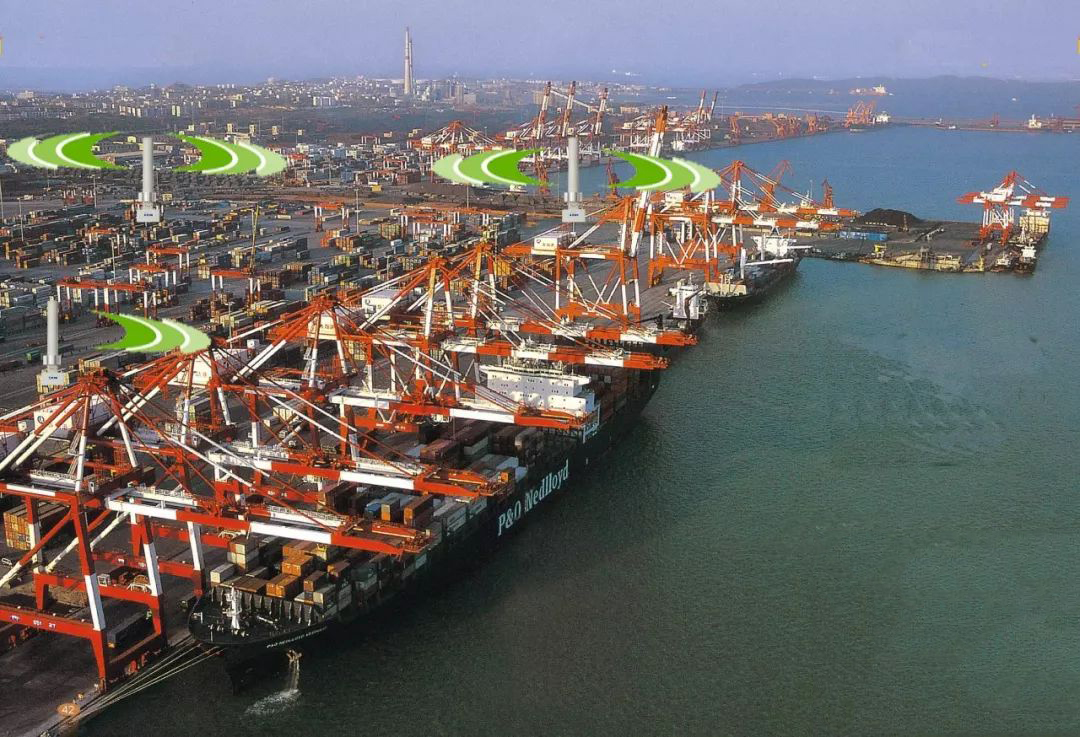
By deploying the high-performance iSAP Special WiFi Base Station or the Metropolitan Area Network WiFi Dual-Mode Gateway iMAX-ACG600 System, the WiFi coverage requirements of target areas in terminals and yards can often be met with a relatively small number of APs, while ensuring excellent system usability and high reliability.
4. Intelligent Port Machinery Remote Control System
Fully automated or fully intelligent terminals represent the irresistible trend of port development. For numerous types of equipment such as quay cranes, yard cranes, and portal jib cranes, the initial phase focuses on achieving remote control of port machinery, and the industry is now moving toward complete intelligence and unmanned operation.
Currently, a port machinery remote control system must first realize the networking of heavy port machinery including terminal port cranes, Automated Guided Vehicles (AGVs), and automatically controlled cranes. Through the integration and development of various hardware and software platforms, operators can control port machinery via remote operation consoles in offices. The production management and control system automatically generates vessel and yard plans, stowage plans, and production operation route plans, which significantly reduces the human resource costs of all terminal operation links. It realizes a revolutionary transformation of terminal operations from traditional labor-intensive to automated and intelligent modes, enabling 24/7 all-weather, efficient, eco-friendly, and safe services.
The automated terminal’s intelligent production management and control system and intelligent control system together form the “brain” and “nerve endings” of this brand-new terminal. The former covers all business links of the automated terminal, connects various port data information platforms, and provides an intelligent production planning module, real-time operation scheduling system, and process control system with automatic monitoring and adjustment functions. The latter replaces the operators on traditional equipment, endows port equipment with intelligence, and transforms port cranes into giant robots capable of autonomous operation. The port intelligent equipment system and port production system are organically coordinated to automatically and efficiently complete terminal loading and unloading tasks, thereby realizing the intelligent operation of the entire terminal. As the underlying communication platform, the iMAX 5G Wireless Metropolitan Area Network Private Network System serves as the “central nervous system” of the entire port machinery intelligent system, playing a directly critical role in data communication.
It should be emphasized that the reliability of a network system is not necessarily related to whether it is wired or wireless—wired and wireless are merely different communication media. Reliability depends on reliable and stable hardware devices, and more importantly, on solution designs with redundant hot standby capabilities. For details on network reliability design, especially wireless network reliability design, please refer to the article Reliability Design of Wireless Network Communication Systems.
There are three common application scenarios for wireless private networks in port machinery remote control/unmanned driving:
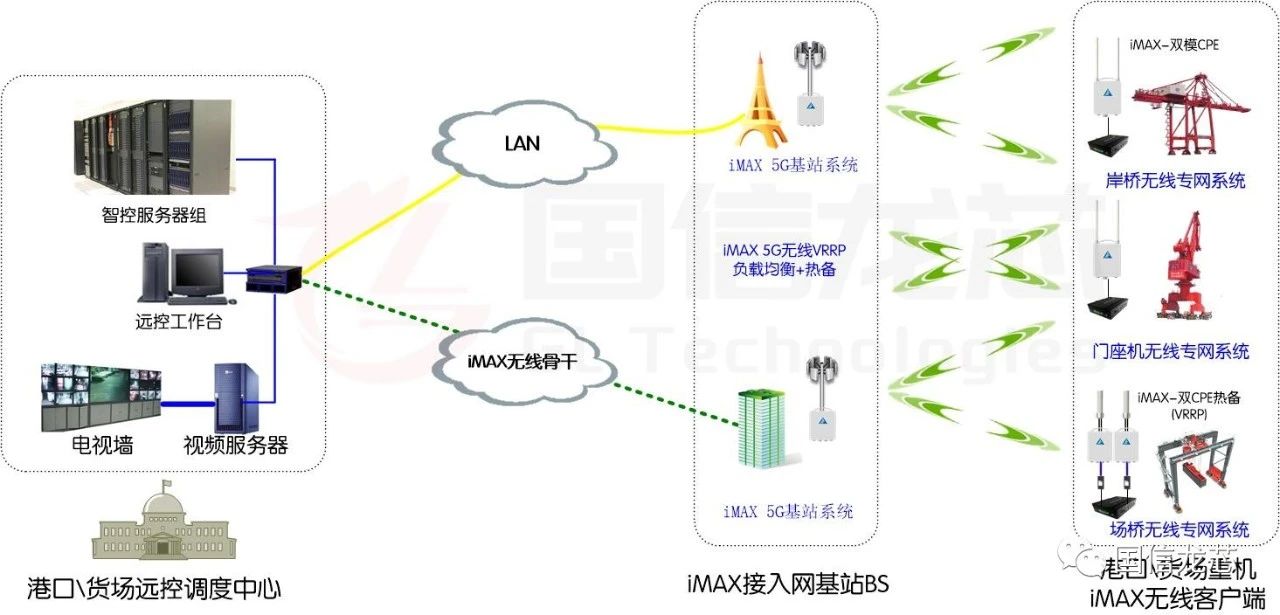
- Pure Wireless Air Interface DesignGiven the safety requirements of production operations, automated port remote control systems must rely on a reliable, high-bandwidth, anti-interference, and high-capacity wireless network system as the communication foundation platform for the entire system—these are exactly the core advantages of the iMAX 5G Wireless Metropolitan Area Network System. The iMAX 5G Wireless Metropolitan Area Network System is widely used in the construction of automated projects at major ports nationwide, and most projects adopt a pure wireless air interface design. Considering the high reliability requirements of crane control systems, users often adopt the VRRP hot standby redundancy solution in this scenario, which well combines “load balancing” and “hot standby redundancy”.
- Wireless Air Interface as Backup for Optical Fiber LinksFor some special intelligent remote control projects involving heavy machinery, even if users have adopted a towed optical cable solution to realize the mobile networking of port machinery, they often deploy a wireless private network system as a “hot standby” link due to the short service life and high failure rate of towed optical cables. The iMAX 5G system supports various hot standby routing technologies such as RSTP, MESH, and VRRP, and can be seamlessly integrated with existing systems.
- Slotted Waveguide Wireless Communication System DesignIn the construction of unmanned terminals with the highest reliability requirements (especially for equipment such as yard cranes, quay cranes, and portal jib cranes), if the port is subject to severe radio signal interference, a special technology—slotted waveguide communication technology—is introduced into the automated terminal system construction to enhance the system’s anti-interference capability, increase bandwidth capacity, and ensure system reliability. To meet this special application requirement, Guoxin Longxin has launched a dedicated slotted waveguide wireless system—the iMAX-8000W Series Specialized Mobile Communication System for Waveguides—and can provide users with overall solution design tailored to their needs.
Of course, the above three scenarios can be further integrated. For example, a “pure wireless air interface” wireless private network can be used as the hot standby redundancy for the “waveguide wireless system”. The sole purpose of all these application modes is to further improve the overall reliability and usability through system redundancy design on the premise of guaranteed equipment quality, thus ensuring optimal system performance. Guoxin Longxin has numerous cases of high-reliability wireless network system design in the port industry. For typical cases, please refer to the article Design of High-Reliability Networking Solution for Quay Crane Intelligent Control.
The typical wireless networking topology diagram of the port machinery remote control system is shown below:
It should be emphasized that Guoxin Longxin only provides wireless private network products and solutions for partners, and does not undertake the overall integration of relevant systems. The environment of port terminals and cargo yards is complex, with no standardized configurations. How should a wireless private network be specifically designed? It needs to be configured according to the on-site conditions of ports and yards, as well as the specific communication situations and remote control requirements of port heavy machinery, mobile machinery and tugboats. In addition, appropriate wireless devices and antennas should be configured for different types of machinery, and the network structure should be designed in combination with system function requirements. These highly customized demands cannot be fulfilled by manufacturers without industry experience. There are also many practical problems in the port industry. For example, how to resolve severe radio interference? Manufacturers need to be deeply involved in the design phase to ensure the effectiveness of wireless system deployment (refer to the article How to Resolve Wireless Interference?).
In projects involving remote control or unmanned driving of port heavy machinery, the wireless system generally accounts for a relatively low proportion of the entire project, but it is critical to the overall performance of the system. Only professional manufacturers like Guoxin Longxin can deliver truly reliable, stable and secure wireless private network designs.
For specific requirements and inquiries, please contact the Technical Department of Guoxin Longxin. We will address your needs and tailor the optimal solution for you.