
Wireless Backhaul Communication Solution for Telecom Operators' 4G/5G Base Stations
5G, namely the 5th generation mobile networks (also referred to as 5th generation wireless systems or 5th-Generation, abbreviated as 5G), is the latest generation of cellular mobile communication technology, and an evolution following the 4G (LTE), 3G, and 2G systems. The performance objectives of 5G include high data rates, reduced latency, energy conservation, cost reduction, improved system capacity, and large-scale device connectivity.
The enabling value of 5G to industries is enormous, which is different from 4G and previous generations that are more oriented toward individual consumers. Whether in emerging fields such as artificial intelligence, autonomous driving, VR/AR, and ultra-high-definition video, or traditional industries like agriculture and manufacturing, the deployment and commercialization of 5G will drive a new round of transformation, facilitating the transformation, upgrading, and innovative breakthroughs of related industries. For this reason, countries around the world attach great importance to 5G infrastructure construction.
On October 31, 2019, the three major telecom operators launched their 5G commercial packages, marking the official entry of China’s 5G into the commercial era. In accordance with the guidelines of the Ministry of Industry and Information Technology, as of July 2023, the number of 5G base stations in China had reached 3 million, and the number of 5G terminal connections had exceeded 700 million. However, due to the high investment, high power consumption, and high density requirements of 5G base stations, the deployment and connectivity of these stations have constrained the development pace of 5G. For the next phase of deployment by telecom operators, 5G will gradually expand to small and medium-sized cities, towns, and even rural areas, extending from core urban districts to suburban and rural regions. In the coming years, 5G will gradually replace 4G and accelerate the realization of seamless coverage and roaming. To support the accelerated deployment of 5G, it is imperative to develop a cost-effective and highly reliable wireless backhaul solution for 5G base stations.
Driven by technological advancements and bandwidth upgrades, the density of 5G operational network base stations is significantly higher than that of 4G. At the transport network level, it has become more flexible, with a clearer trend toward IP-based architecture, greater bandwidth requirements, and stricter latency indicators. Given the stringent transmission requirements such as high bandwidth and low latency, optical networks are typically the optimal choice for connecting 5G base stations. Nevertheless, for remote and dispersed 5G base stations (located in scenic areas, islands, mountainous regions, along high-speed railway lines, in rural areas, etc.), ensuring reliable backhaul links is a critical consideration. Additionally, some newly built 5G base stations in rural towns, development zones, and new urban areas may face temporary lack of optical fiber access, which affects 5G coverage performance. So, what methods can be used to solve the backhaul connectivity for such 5G base stations where optical fiber backhaul is not feasible?
Wireless technology serves as an ideal supplement to optical fiber. Common wireless access methods for base stations each have their own advantages and disadvantages:
1.FibeAir IP Microwave/E-Band Microwave Systems: Microwave systems operate at very high frequencies, with IP microwave typically ranging from 6 GHz to 42 GHz, and E-Band covering 71–76 GHz and 81–86 GHz. These products provide telecom operators and users with high-capacity, multi-interface, multi-service broadband wireless solutions characterized by short construction cycles, reliability, stability, and security. They address various transmission challenges faced by telecom operators in 4G and 5G base station interconnection, key customer access, key customer system integration, and business hall connectivity. For 4G and 5G base station backhaul access, we offer point-to-point high-capacity microwave access solutions, supporting multiple service interfaces including 10GE, 1GE, STM-1/OC-3, E1/T1, 3G, 4G, and 5G based on actual application requirements, making them highly suitable for 5G base station access.
2.iMAX 5G Wireless Metropolitan Area Network System: The iMAX Wireless Metropolitan Area Network typically operates at a frequency of 5 GHz, featuring low susceptibility to weather conditions. Based on OFDM (Orthogonal Frequency Division Multiplexing), the most advanced modulation technology in the wireless communication field, it primarily provides IP network transmission via Ethernet interfaces. The iMAX Wireless Metropolitan Area Network System offers high bandwidth capacity, low latency, and ultra-long transmission distances, along with the advantages of low cost, compact size, light weight, and easy installation and commissioning, making it ideal for large-scale 5G network deployment. More importantly, the new version of the iMAX Wireless Metropolitan Area Network System supports VRRP routing hot backup technology based on routing protocols, which can meet the deployment requirements of “M+N” multiple hot backup systems for 5G base station backhaul links. It can also serve as a hot backup or be used for loop formation in fiber optic links that are not looped. For backhaul connectivity of remote 5G base stations, its cost is not only much lower than that of conventional optical fiber solutions, but also significantly lower than IP microwave and other alternatives, delivering outstanding overall cost-effectiveness.
For 4G base station backhaul, which has relatively low bandwidth requirements (usually 200–500 Mbps), Guoxin Longxin’s iMAX Broadband Wireless Network System is the optimal solution. With its small size, light weight, low power consumption, and strong non-line-of-sight (NLOS) capability, this product is highly suitable for connecting vehicle-mounted emergency communication base stations for emergency support as a type of “non-line-of-sight microwave” technology.
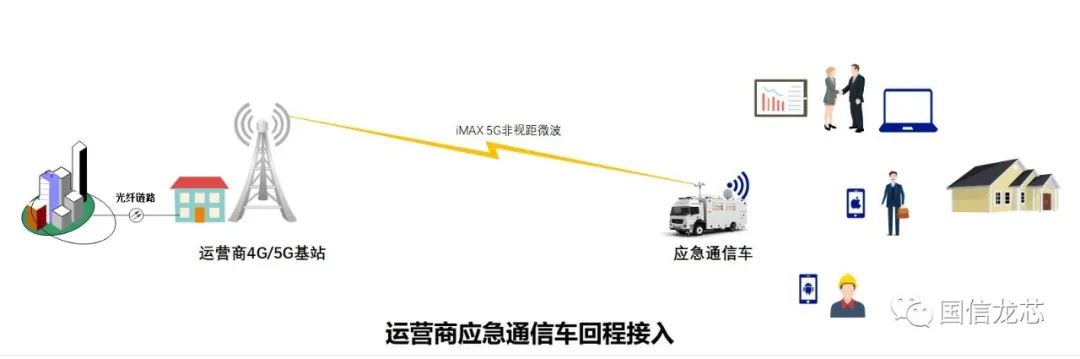
Proprietary Technology for Wireless Metropolitan Area Network — iMAX Wireless Communication System:
The Guoxin Longxin iMAX Wireless Metropolitan Area Network System (under the iMWB brand) is designed specifically for building wireless metropolitan area networks, with all product series boasting extended communication distances. Among them, the iMAX-6000 series serves as the urban backbone network, while the iMAX-8000H series and other variants function as the urban access network.
- Communication DistanceUnder line-of-sight conditions, the iMAX 5G dedicated communication system can easily achieve a coverage radius of 10 km in point-to-multipoint mode. The maximum non-relay communication distance reaches 50 km in point-to-point mode (up to 120 km with customized configurations). Networking spanning hundreds of kilometers can be realized via relay nodes.
- Transmission BandwidthThe iMAX-8000H is a point-to-multipoint communication system with bandwidth options of 300/600 Mbps. The iMAX-6000 is a point-to-point communication system supporting bandwidths of 50/100/300/600 Mbps.
- High ReliabilityEvery aspect of the design and manufacturing of the iMAX Wireless Metropolitan Area Network System meets the requirements of harsh operating environments. Designed as all-outdoor products, they ensure stable and reliable operation even under conditions such as strong winds, heavy rains, extreme temperatures, sandstorms and corrosion. In terms of link design, we can flexibly adopt multiple networking modes — including single-link, M+N multi-link and loop topology — according to user requirements to meet the system reliability needs of users.
Based on the analysis of 4G base station access and networking requirements, the iMAX-6000 Broadband Backbone Wireless Metropolitan Area Network System (a 100/300/600 Mbps IP communication system) is the ideal fit.
Among these solutions, the iMAX-6000 Wireless Communication System delivers the highest cost-effectiveness for 4G base station interconnection. Its high capacity, ultra-long-distance performance and carrier-grade high stability have established its position as the most cost-effective wireless communication system for 4G base station interconnection applications at present.
The FibeAir IP Microwave/E-Band Microwave System and the iMAX Wireless Metropolitan Area Network System form a complementary high-low portfolio. In special scenarios where wiring is difficult, they provide a highly cost-effective solution for telecom operators to implement backhaul and hot-standby routing for 4G/5G base station deployment.
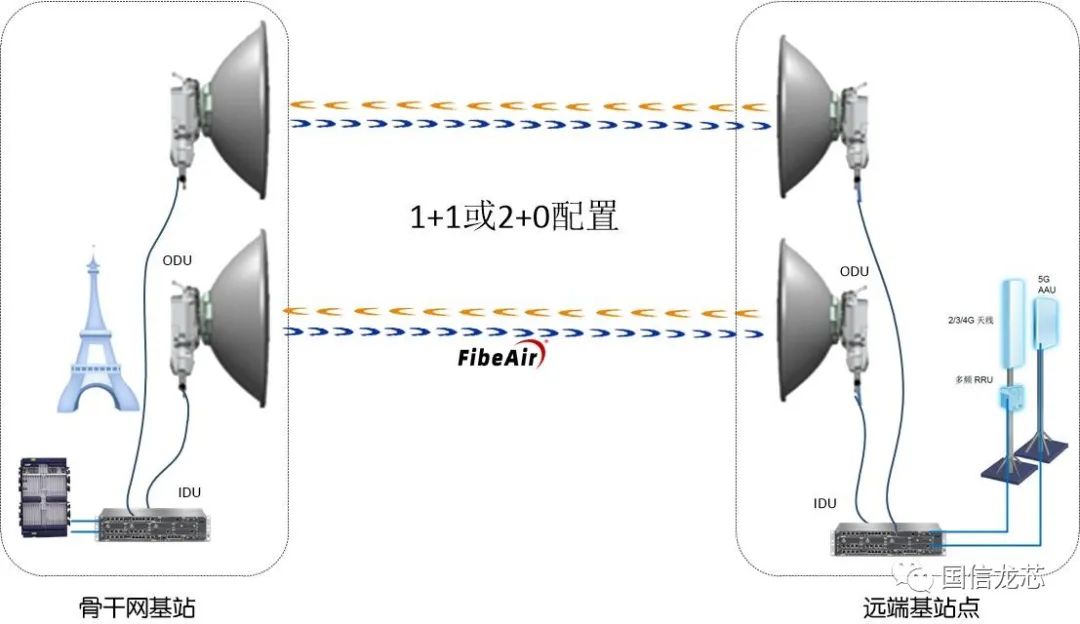
Multiple networking modes are available for the backhaul links required for edge access connections in 4G/5G base station networks. Taking FibeAir IP Microwave as an example, the commonly used modes are as follows:
- Decentralized 5G Base Station Backhaul Networking(Common Scenarios: Islands, mountainous areas, rural regions, scenic spots, etc.)
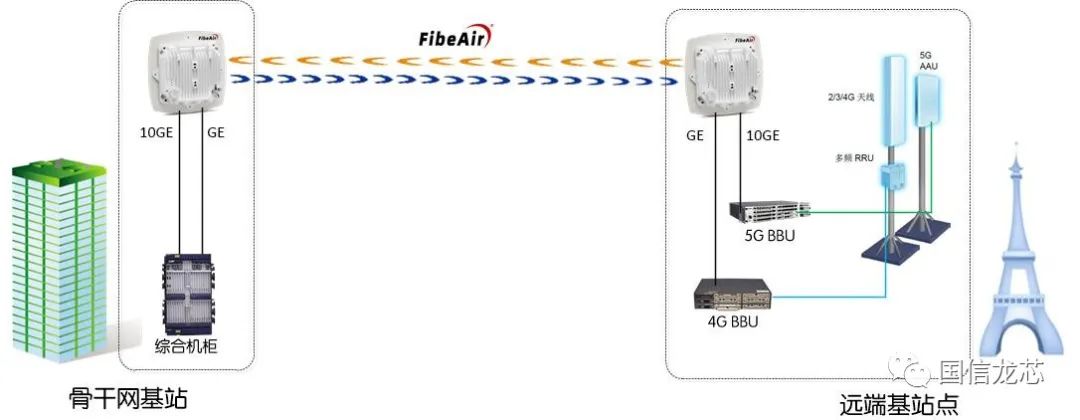
Emphasis: Guoxin Longxin’s base station backhaul wireless solution provides dedicated optical interfaces and supports BBU remote deployment.
- Highly Reliable 5G Base Station Backhaul Link Networking(Common Scenarios: Industrial parks, port areas, scenic spots, etc.)
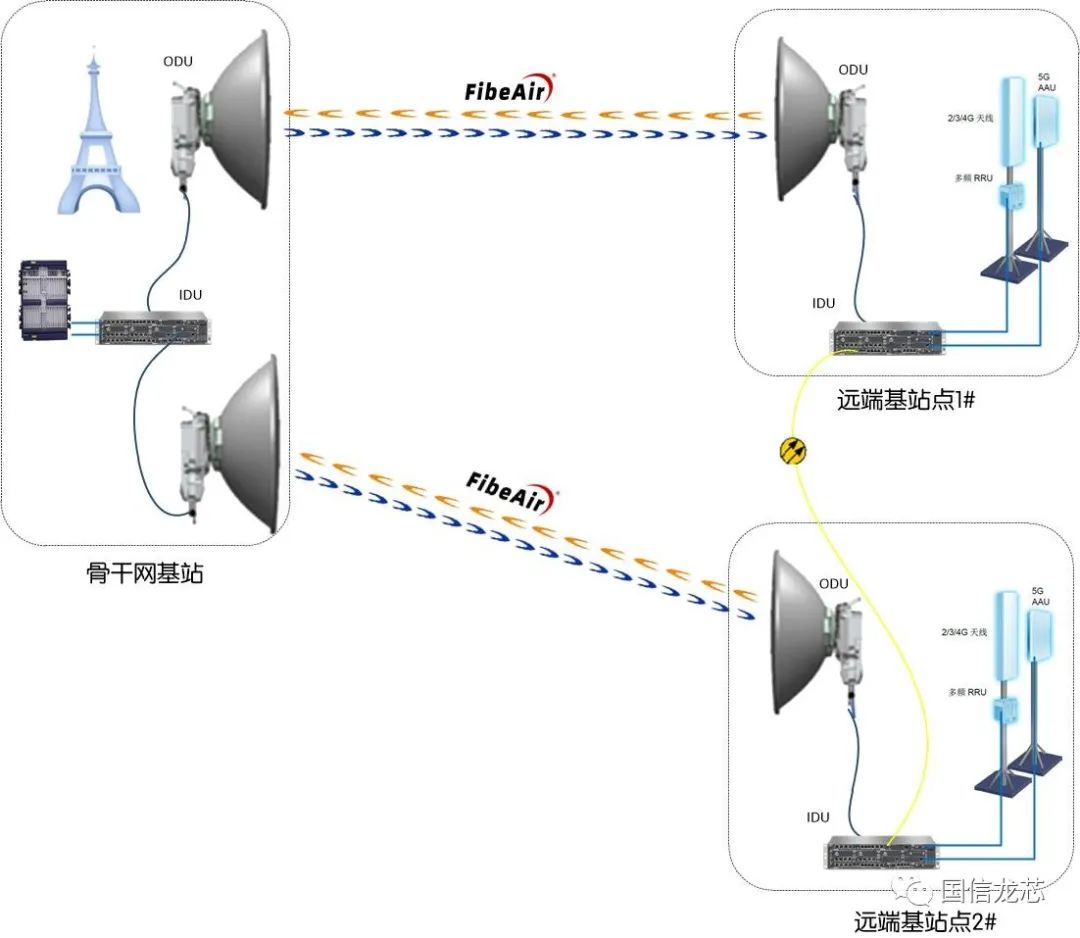
- 5G Base Station Link Hot Backup or High-Reliability “Ring Network” Networking for Existing Optical Links(Common Scenarios: Key base station sites in urban areas, suburban areas, etc.)
Features of the Wireless Network System Provided by Guoxin Longxin:
- Stability and High Efficiency: The wireless system provided by Guoxin Longxin meets the bandwidth requirements of broadband wireless metropolitan area network (MAN) networking for 4G/5G base stations. Characterized by excellent operational stability and high reliability, our wireless system is a true all-weather device supporting 24/7 uninterrupted operation. It features stable bandwidth and strong anti-interference capability, making it extremely reliable for both emergency scenarios and permanent fixed applications in 4G/5G base station networking. In addition, the wireless system is quick and easy to install and commission, realizing true plug-and-play functionality, and serves as a highly efficient wireless solution.
- Security and Reliability: The wireless system provided by Guoxin Longxin is equipped with multiple security control measures, including proprietary communication protocols, access control, and dynamic data encryption. It also supports VLAN, VPN, and Firewall technologies, which provide multi-level and high-standard protection for the security and reliability of 4G/5G networks.
- Long Transmission Distance: Thanks to the adoption of proprietary communication protocols, the wireless system provided by Guoxin Longxin achieves ultra-long transmission distances. In point-to-point (PTP) networking mode, the maximum distance can exceed 50 km (distances ranging from 50 km to 120 km require separate customization).
- Cost-EffectivenessIt:involves a one-time investment with no need for high costs of optical cable construction and operation & maintenance. The system can be relocated freely, delivering significant investment protection benefits. Its easy and quick installation, short construction period, and simple maintenance further enhance the cost-effectiveness of the system.
- Easy Installation and Maintenance:The wireless system devices provided by Guoxin Longxin are small in size and light in weight. The installation of a single link generally only takes 1–2 working days. The devices support WEB & SNMP remote management and software upgrades, and are extremely easy to maintain and relocate.
Beyond the above features, leveraging the high-bandwidth characteristics of this wireless access system, it can also be extended to carry other base station-related services (such as video, audio, broadband, etc.), further improving its comprehensive utilization value.
In summary, adopting Guoxin Longxin’s wireless MAN system to address the access and networking needs of telecom operators’ 4G/5G base stations is not only suitable for decentralized 4G/5G base station scenarios, but also serves as a powerful supplement for the “hot backup” and “loop formation” of optical network access methods. Guoxin Longxin will flexibly customize the most suitable solutions based on users’ actual requirements, deployment conditions, and resource constraints.