
Wireless Monitoring and New Energy Power Supply Solution for Reservoirs and River Courses
The Internet Plus model has profoundly transformed various industries, and Smart Water Conservancy has become a key focus of development in the water conservancy sector. Smart Water Conservancy refers to the widespread application of advanced information technologies such as modern communication, computer networks, security monitoring, and intelligent data acquisition and control across the entire water conservancy industry. It fully develops and utilizes water-related information resources to directly support decision-making for flood control, drought relief, disaster reduction, the comprehensive management of water resource development, utilization, allocation, conservation and protection, as well as water environment protection and governance, thereby improving the scientific management level of water resources and water conservancy projects. Among these, reservoirs and river courses are critical links in water resource management and scheduling, making the construction of informatization and intellectualization imperative.
Information points for the comprehensive monitoring of reservoirs and river courses (e.g., pumping stations, rainfall stations, hydrological stations, sluice gates, etc.) are mostly scattered, located in remote and even inaccessible areas, posing great challenges to power supply and networking. In line with the current development trend of water conservancy informatization, the information transmitted by these points consists of typical multimedia data (data, video, audio, etc.), including HD digital video surveillance, water level and rainfall monitoring, online water quality monitoring and analysis, water flow velocity and centralized sluice gate control, and network broadcasting and scheduling systems. Undoubtedly, all these IT systems require reliable power supply and high-bandwidth network interconnection.
On Power Supply
Adopting the traditional wired power supply method for IT system construction would impose an unbearable financial burden on the project. While drawing power from nearby residents or farmers is feasible in some areas, it involves cumbersome coordination, recurring electricity costs, and the constant risk of power outages. Given that the power consumption of monitoring points for reservoirs and river courses is generally low, the optimal power supply solution is to adopt the new energy power supply system vigorously promoted by the state—namely, solar power supply systems.
Traditional solar power supply systems rely on lead-acid batteries, which are bulky, short-lived, unreliable, difficult to install, and cumbersome to operate and maintain. Additionally, the production, storage and transportation of lead-acid batteries involve severe pollution, raising environmental concerns about this green energy solution. Guoxin Longxin’s iPower2000 is an integrated off-grid independent new energy power supply system, specially designed to address power supply challenges for scattered electronic devices in outdoor IoT scenarios, such as wireless network systems, video surveillance points and information monitoring stations. Based on colloid lithium batteries (with lithium-ion cells as the core) and high-efficiency monocrystalline silicon solar panels, the iPower2000 system offers significant advantages over conventional lead-acid solar power systems, including a simple structure, compact size, light weight and long service life, making it an ideal choice for high-end outdoor applications.
On Networking
TCP/IP-based network interconnection is indispensable for the construction of modern IT systems. However, the unique environmental conditions of reservoir and lake monitoring make wired optical networks (commonly used in urban areas) unsuitable for networking and data transmission in terms of economy, reliability and implementation feasibility.
Although telecom operators’ 4G/5G technology can meet the needs of small-data, non-real-time transmission, it is highly inappropriate for river and reservoir monitoring for the following reasons:
- No signal coverage: Data transmission relies on operators’ cellular networks, which are limited by base station deployment. Communication quality and reliability cannot be guaranteed in remote rural and wild areas—precisely the key areas for reservoir informatization. A highly reliable, large-capacity and high-bandwidth private network is therefore a necessity.
- Insufficient capacity: Real-time monitoring of rivers and reservoirs requires large-capacity IP HD video transmission. Restricted by frequency resources and base station capacity, 4G/5G networks cannot support concurrent transmission of multiple video streams in a single area, and a genuine broadband IP private network system is a must.
- Exorbitant costs: Smart Water Conservancy systems generate massive data traffic, especially HD video surveillance—one single 1080P HD camera consumes 1,000–2,000 GB of data monthly. Adopting 4G/5G would result in prohibitive ongoing traffic fees, making 24/7 continuous operation unfeasible and rendering the system a mere formality.
- Poor security: Networking via 4G/5G public networks is underpinned by the open Internet, exposing servers and databases to cyberattacks, system sabotage and data theft by hackers. If this method must be used, Guoxin Longxin’s Virtual Private Network (VPN) solution is strongly recommended to maximize system security and availability. For details on the 4G/5G VPN solution for government and enterprise clients, refer to the document 5G Virtual Private Network Solves Networking Challenges for Government and Enterprise Clients.
In summary, building a self-owned IP wireless metropolitan area network (MAN) private network is one of the most suitable networking solutions for water conservancy informatization. As the most mature and cost-effective wireless MAN solution in China and even globally, Guoxin Longxin’s iMAX 5G broadband wireless network solution is undoubtedly the optimal choice.
Typical application diagram of the lithium solar power supply system:
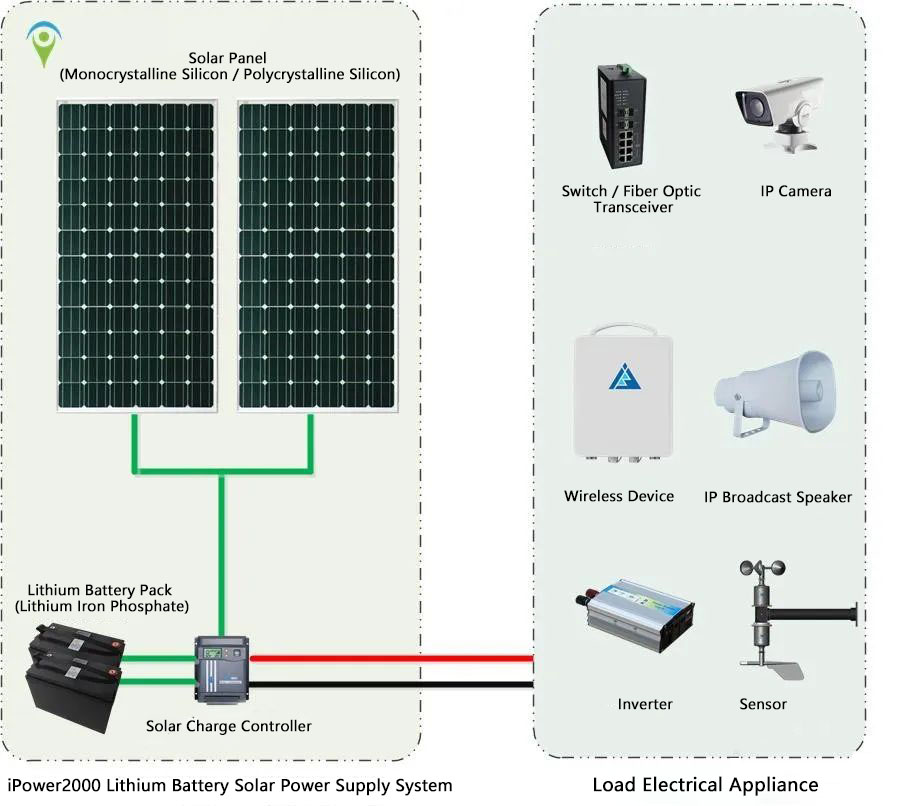
Taking the construction of a smart system for a certain reservoir as an example, the design concept of the solution is as follows:
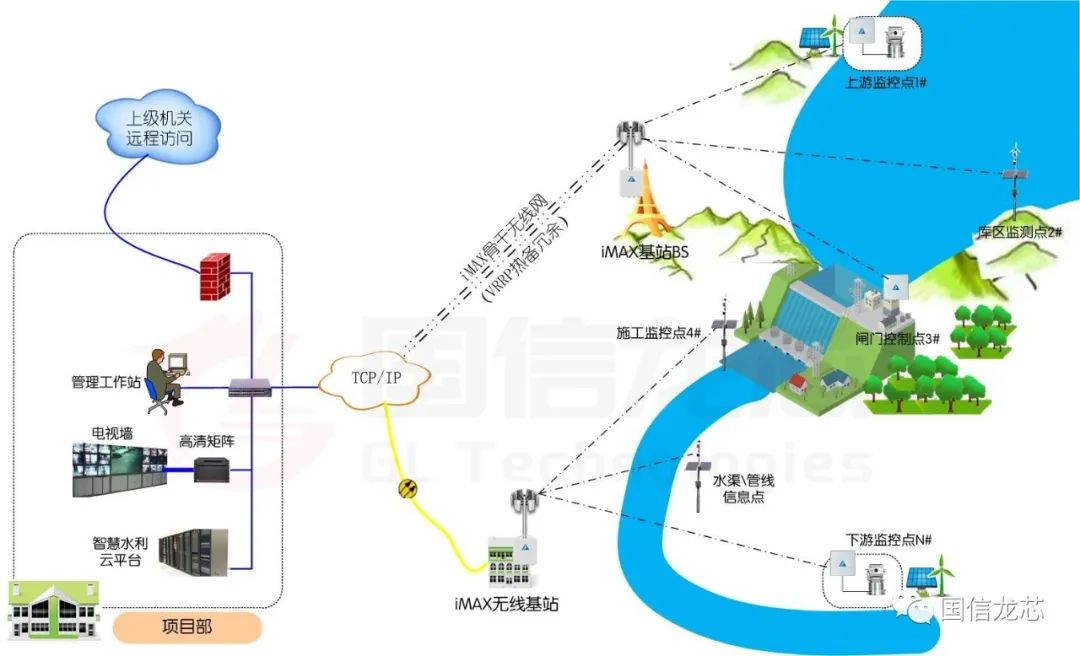
IP cameras, water quantity and level sensors, etc., can be deployed at the front-end monitoring points of the reservoir for real-time collection of images and operational data. The information from these front-end points is then transmitted back to the command center via a wireless IP network, enabling 24/7 uninterrupted monitoring and scientific management of information points and key locations around the reservoir.
A dedicated iMAX high-bandwidth wireless network system is adopted to interconnect the networks of all access points (e.g., pumping stations, rainfall stations, hydrological stations, sluice gates, etc.) within the reservoir monitoring area. Through this network, collected data (such as rainfall, wind speed, water flow, velocity, water quality, etc.) and high-definition IP video surveillance information are transmitted collectively to the command center. Meanwhile, various control commands can be sent to on-site instruments and equipment in real time, achieving remote intelligent control of sluice gates and pumping stations. This not only improves the efficiency of daily reservoir management, but also plays a crucial role in water volume regulation for flood prevention and control.
If Guoxin Longxin’s iMAX 5G system—a dedicated outdoor ultra-long-distance communication solution—is adopted for networking, a small-to-medium reservoir typically only needs 1 to 2 base stations (BS) built at commanding heights in the area to achieve full wireless coverage for circumferential monitoring. As long as high-bandwidth wireless CPEs are installed at the scattered monitoring points around the reservoir, convergence of images and data, as well as transmission of control signals, can be realized, forming a genuine “multi-network convergence” system.
Typical application topology diagram for reservoir/dam monitoring is shown below:
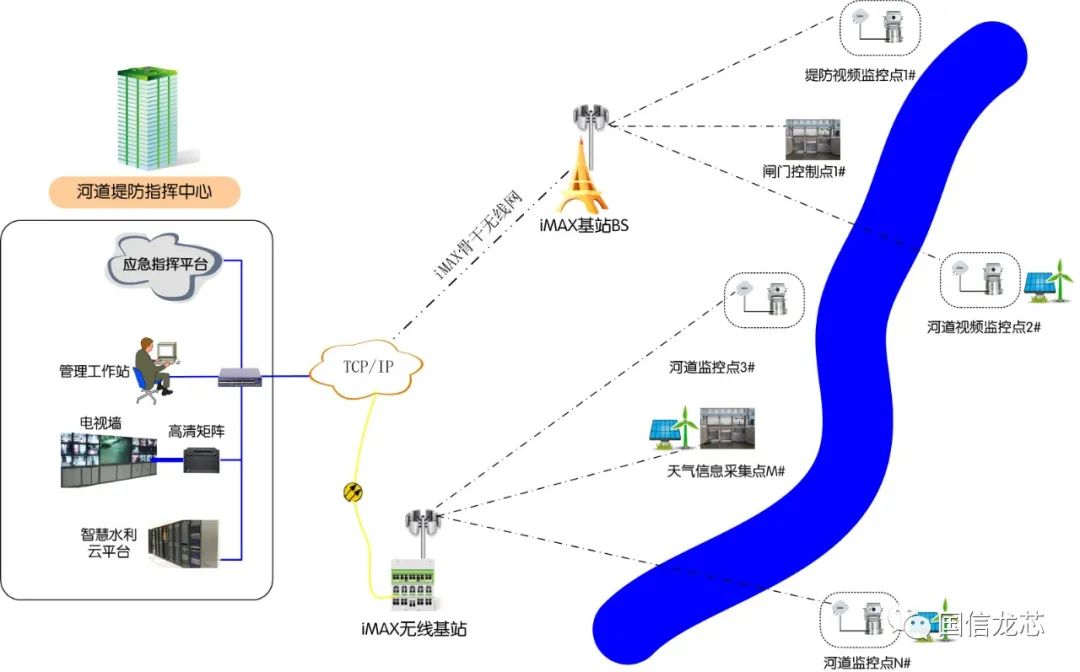
Comprehensive monitoring along river courses differs from that of reservoirs, yet they share common features, mainly reflected in network architecture. Due to the narrow linear distribution of information points along river courses, the network mainly adopts a two-tier wireless networking structure (i.e., backbone wireless network plus access wireless network), or a “multi-hop chain + hot standby redundancy” networking architecture. All other aspects are similar to the comprehensive monitoring of reservoirs.
The typical application topology diagram for river course monitoring is shown below:
Many monitoring points in reservoir areas operate in harsh, unattended environments, and only the iMAX transmission system with high reliability, ultra-long transmission distance and non-line-of-sight wireless capability can meet such operational requirements. Designed to build wireless cities and enable ultra-long-distance outdoor network interconnection, all series of iMAX wireless communication devices deliver extended transmission ranges. Among them, the iMAX-6000 series serves as the communication backbone network, and the iMAX-8000H/S series as the access network.
★ Transmission Distance: Under line-of-sight conditions, even the compact iMAX 5G dedicated communication system with integrated antennas can easily achieve 10-kilometer radius coverage in point-to-multipoint mode; in point-to-point mode, the maximum transmission distance exceeds 100 kilometers.
★ Transmission Bandwidth: The iMAX-8000H is a 600 Mbps point-to-multipoint communication system, the iMAX-8000S is a 100 Mbps point-to-multipoint communication system, and the iMAX-6000 is a point-to-point wireless backbone network communication system with bandwidth options of 150/300/600 Mbps.
The seamless integration of iMAX wireless metropolitan area network technology and iPower lithium new energy technology is truly a golden combination for deploying IT information points in outdoor environments.
With an in-depth understanding of user needs, relentless pursuit of technical and product excellence, and unwavering commitment to superior product and service quality, Guoxin Longxin can tailor the optimal wireless network and solar power supply system design for reservoirs and river courses, and deliver bespoke solutions for users and system integrator partners.