Smart rail transit, intelligent gates, remote monitoring, emergency repair, train-ground communication, and unmanned driving have increasingly become standard configurations for the intelligent operation and management of rail transit. The foundation of these rail transit technological systems is a reliable, stable and secure broadband network system. Both the information points and monitoring points along the lines, as well as the communication between operating trains and the ground command center, require the support of a reliable, secure and practical broadband network system. Due to the particularity of rail transit operation, wireless technology is obviously an indispensable and important component of its network construction. This solution takes the subway as an example, aiming to provide wireless network solutions for different scenarios, businesses and needs of rail transit for industry users and integrators.
The advent of the Internet of Things (IoT) era has profoundly changed the working methods of various industries, and the technological upgrading, intelligence and unmanned operation of the rail transit industry have become an irresistible trend. The development of the subway industry requires the application of various IoT services, including but not limited to video, voice, data and multimedia information. The primary challenge faced is how to solve networking and power supply, which also form the foundation of intelligence. Guoxin Longxin currently provides a variety of wireless system solutions, including 4G, WiFi and iMAX wireless metropolitan area network (MAN) private networks, each with unique characteristics and technical advantages:
- Wireless Wide Area Network (WWAN): 4G LTE (and 5G in the future) is mainly a “public network” and WAN technology, suitable for enabling internet access for 4G smart terminals such as mobile phones and temporary emergency access to the Internet.
- Wireless Local Area Network (WLAN): WiFi is a short-range WLAN solution, suitable for LAN access of smart terminals (mobile phones, PADs, laptops, etc.) and handheld terminals.
- Wireless MAN Private Network: iMAX wireless MAN private network is suitable for the construction of high-reliability dedicated MAN networks in a specific area, solving network interconnection problems for information points with inconvenient wiring and mobile information points. It is particularly suitable for dedicated network access of mobile nodes such as vehicles, shipborne terminals and unmanned aerial vehicles (UAVs).
In meeting the application of multi-service “multi-network integration” for subway industry users, the selection of products and solutions must be designed based on users’ actual conditions and needs. Taking the common business systems in the subway industry as examples, Guoxin Longxin can provide wireless system communication and networking solutions for various businesses as follows:
Security and operation guarantee along subway lines represent a large market in the security industry, in response to government initiatives. Key areas including the surroundings of stations along subway lines, evacuation passages, operation and maintenance passages, elevated bridges, underwater tunnels and operating vehicles are the focus of subway security monitoring system construction.
Fixed-point monitoring in subway security is relatively easy to implement, which can be directly solved by optical cable-based communication methods. However, for mobile points—including operation and maintenance personnel, train cabs and carriages in operation, and temporary monitoring at fault points—wired methods are ineffective, and wireless communication networks are needed as a supplementary communication means. So, what kind of wireless solution can meet the networking requirements of high-definition video monitoring systems along subway lines? Positioned as an IoT industry expert in wireless communication, video and intelligent control, Guoxin Longxin can flexibly recommend the optimal wireless networking solutions for subway line monitoring according to different user needs.
For scenarios involving the integrated access of WiFi terminals (laptops, mobile phones, PADs, scanners, etc.) and low-capacity video monitoring, or scenarios with short communication distances and low reliability requirements, the Guoxin Longxin WiFi system can be adopted for design and construction. For scenarios requiring high-capacity high-definition video access and high reliability, such as remote operation and maintenance and emergency rescue applications, the Guoxin Longxin iMAX wireless private network system is recommended for design and construction. For the comprehensive access of multimedia service systems, multi-network integration and two-way transmission required by fixed monitoring and detection points along subway lines, portable mobile monitoring points for accident emergency repair, vehicle operation early warning systems and on-board monitoring systems, the iMAX wireless private network system is recommended.
The wireless networking topology diagram of the subway monitoring and detection system is as follows:
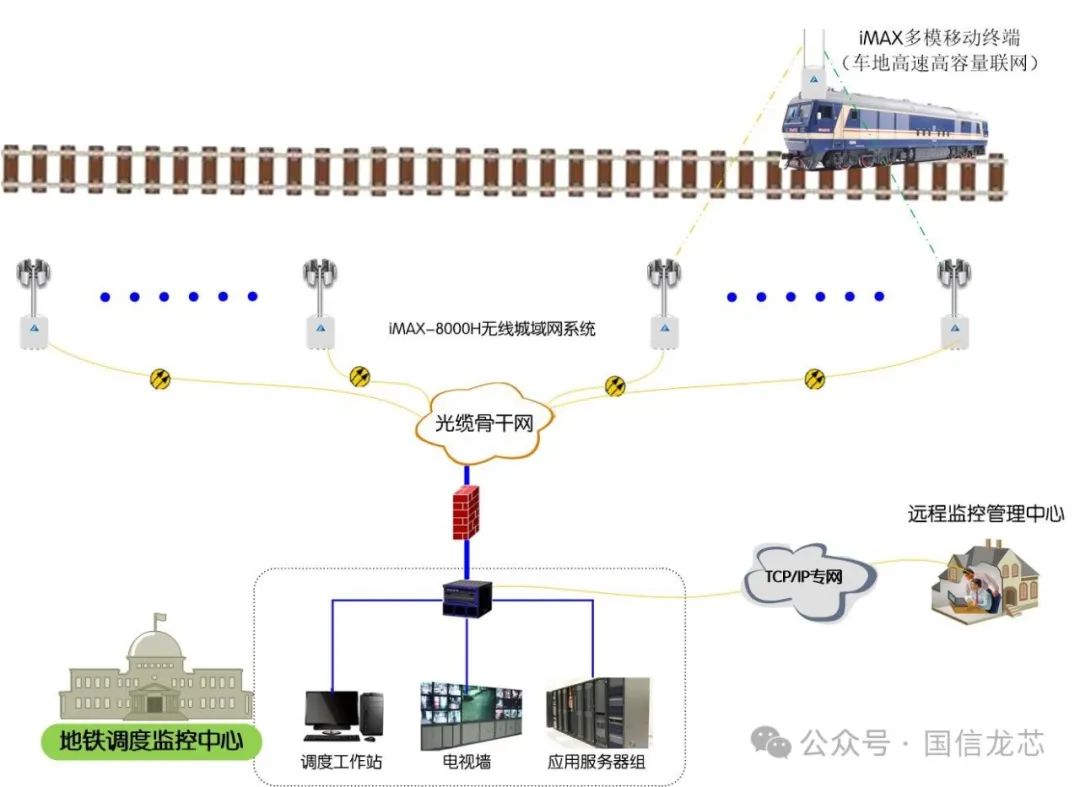
The train-ground wireless broadband communication system is a proprietary IP broadband wireless communication system that enables subway trains to achieve high-speed network interconnection with the remote command and monitoring center in real time during operation. It not only meets the needs of data communication, but also supports the access of large-bandwidth service systems such as high-definition video, real-time voice, on-board WiFi, and vehicle status detection.
Given the requirements for high-speed wireless roaming and network switching while maintaining link stability, only a specially designed wireless system can ensure reliable operation. The Guoxin Longxin iMAX-8000H mobile high-capacity multi-mode MESH wireless access system or the iMAX-8000W waveguide wireless communication system is ideally suited for this scenario. Of course, for higher reliability requirements, the two systems can be integrated to form a dual-system hot backup network, meeting stringent reliability demands.
Typical Application Diagram of iMAX Train-Ground Networking for Subway Trains:
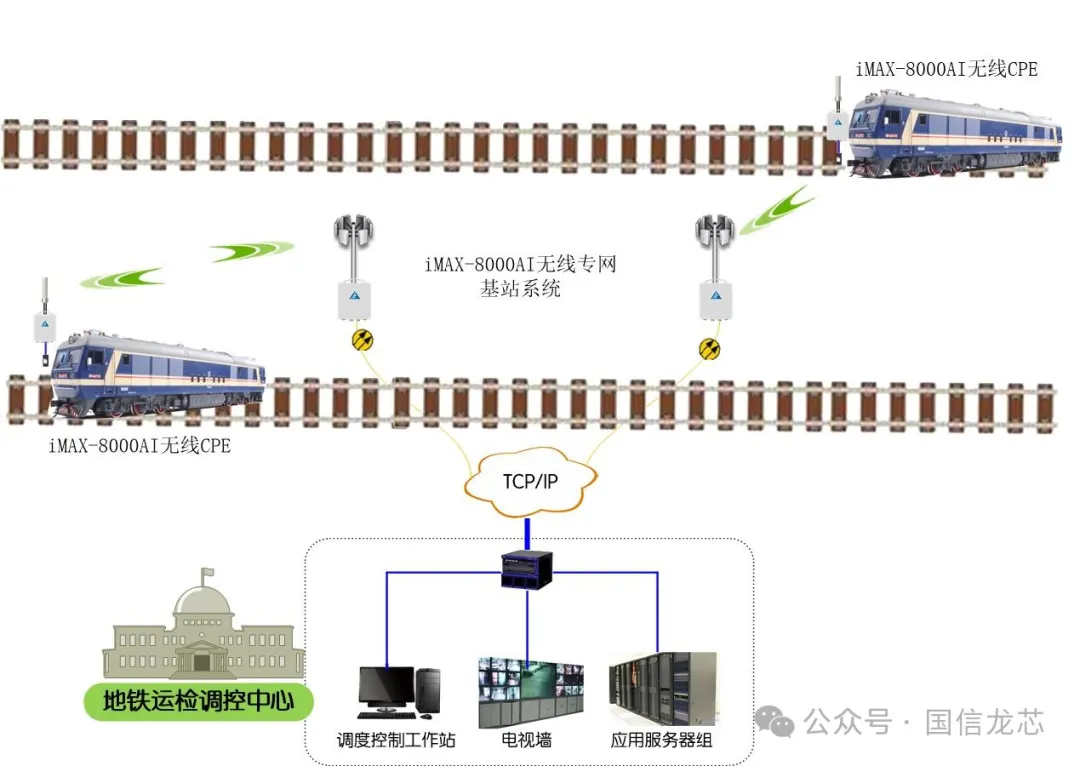
A series of iMAX private network base station (BS) systems are deployed at varying distances along subway lines according to different terrain, coverage requirements and other conditions. Equipping the train with the Guoxin Longxin iMAX-8000H mobile high-capacity multi-mode MESH wireless access system enables high-speed, smooth and seamless roaming. Of course, seamless roaming can also be achieved through VRRP virtual hot backup routing technology—a capability that many wireless communication manufacturers cannot deliver.
Deploying a pure air-interface wireless system along subway lines, especially in subway sections, may be subject to interference from co-frequency radio systems under certain circumstances. In scenarios involving high-reliability train control and remote unmanned driving, prolonged communication interruptions are unacceptable, yet the mobility of trains dictates the exclusive use of wireless technology.
The industry has two primary solutions for reliable wireless communication under interference conditions: first, the leaky feeder cable solution; second, the waveguide communication solution. Leaky feeder cables are cost-effective, but their technical limitations only allow low-bandwidth narrowband communication. Waveguides, by contrast, support high-bandwidth real-time communication. The Guoxin Longxin iMAX-8000W series waveguide dedicated mobile communication system is a customized product for this specific application scenario. It can be used in conjunction with leaky feeder cables or slotted waveguides to meet the demand for real-time, high-speed broadband communication between trains (especially subways, light rails and intercity trains) and the ground command center.
The topology diagram of the iMAX-8000W waveguide communication system for train-ground communication of moving trains is as follows:
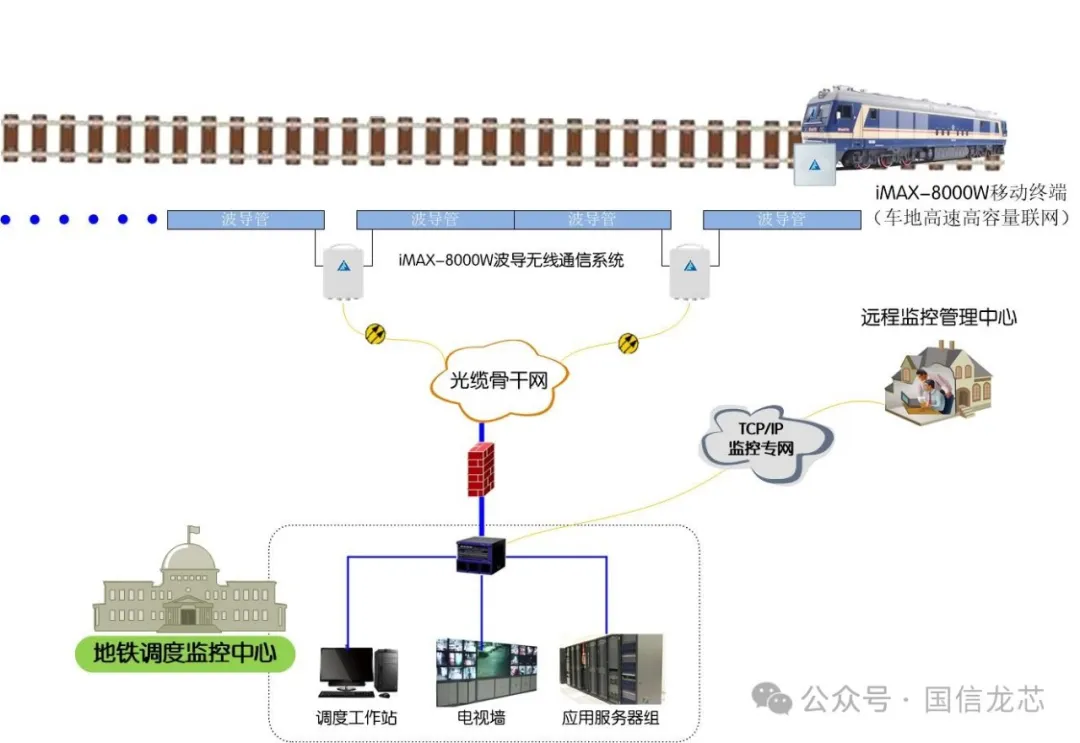
The distribution of waveguide communication base stations, waveguide length, frequency planning and networking mode all represent technical challenges, while high bandwidth and seamless roaming for trains traveling at high speed are the standout advantages of Guoxin Longxin’s solution.
Pure air-interface wireless and waveguide wireless systems are not mutually exclusive. For high-reliability networking, the two systems can be integrated into a dual-network architecture via the VRRP virtual routing protocol supported by Guoxin Longxin’s iMAX series products, delivering two mutually hot-backup and redundant high-reliability systems for train-ground communication.
Notably, Guoxin Longxin’s iMAX wireless metropolitan area network products feature a “multi-link data mirroring” technology, which enables “zero packet loss roaming” between base stations (BS). This advanced technology is ideal for scenarios with stringent reliability requirements but moderate bandwidth demands, a capability that low-end wireless products such as wireless bridges cannot match.
In addition, Guoxin Longxin offers standardized designs for portable monitoring points, detachable monitoring points and individual patrol systems for emergency repair and line inspection. These solutions can also be modularly customized to meet the actual operational requirements of subway users.
The rail transit industry encompasses a wide range of transit modes, including but not limited to ten categories: metro systems, urban rapid rail systems, light rail systems, medium-to-low speed maglev transit systems, straddle-type monorail systems, suspended monorail systems, autonomous rail transit systems, tram systems, rail-guided rubber-tyred systems and electronically guided rubber-tyred systems. China has operational or trial lines for nearly all of these modes. Guoxin Longxin’s wireless private network technology boasts broader application prospects in light rail, suspended monorail, tram and other transit modes than in metro systems. Benefiting from numerous advantages—low wireless deployment cost, high cost-effectiveness, high reliability, easy deployment, mobility and simple maintenance—it will ultimately become an indispensable component of rail transit communication networking.
Wireless communication networking solutions for the rail transit industry typically impose stringent requirements for reliability, security and stability, all of which demand customized design tailored to local conditions. This requires vendors to possess the capability to develop bespoke solutions based on users’ actual needs and objective conditions. Specific application scenarios are not elaborated separately in this solution; interested users and integrator partners may consult the Guoxin Longxin Technical Center for further details.