Wireless Network Solution for Tunnel and Utility Tunnel
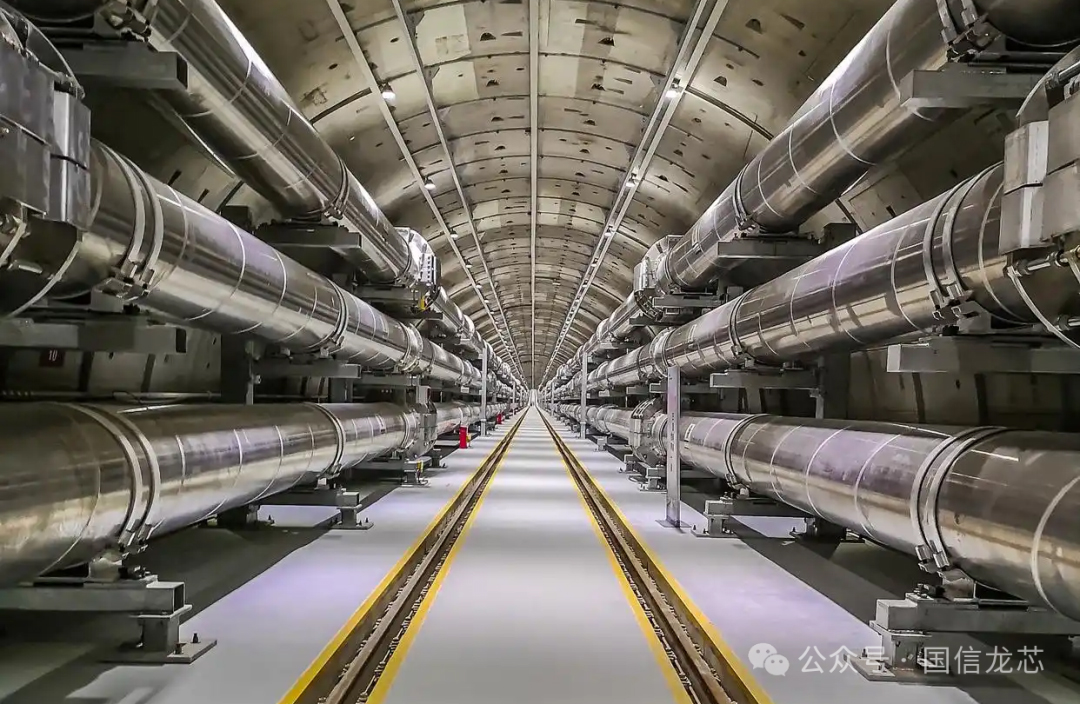
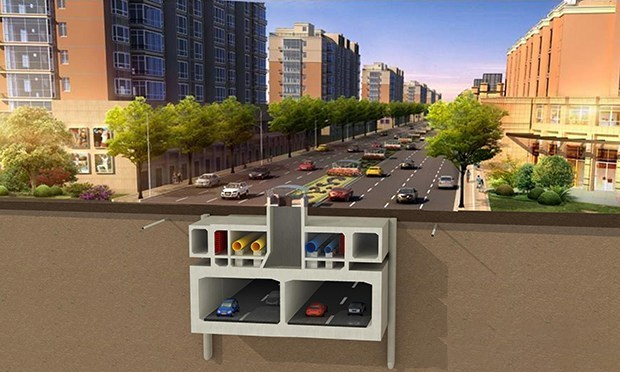
Urban underground utility tunnels are the underground carriers for urban operation, production and daily life, including integrated utility tunnels and specialized tunnels for gas, water supply and drainage, thermal energy, telecommunications and other fields. Tunnels are key connecting passages for transportation, covering railway tunnels, highway tunnels, rail transit tunnels and so on. Scenarios with environments similar to utility tunnels and tunnels include various types such as reservoir culverts, engineering tunnels, mine roadways, and municipal pipe trenches. Undertaking core functions including the intensive laying of public pipelines, traffic passage, and connection of underground spaces, utility tunnels and tunnels serve as the “underground lifelines” that guarantee people’s livelihood services in cities and the stable operation of infrastructure. With the comprehensive advancement of urban intelligence and the refined management of underground spaces, digital services such as intelligent inspection, equipment monitoring, emergency communication, personnel positioning, Internet of Things (IoT) data collection, and remote operation and maintenance for various utility tunnels and tunnels have become standard configurations. Stable, continuous, and blind-spot-free network communication is the core prerequisite for supporting the implementation of all intelligent applications. Taking urban utility tunnels and transportation tunnels as examples, this paper discusses how to build high-reliability wireless networks in such enclosed environments to meet the networking requirements of the aforementioned digital and intelligent applications.
Both utility tunnels and tunnels are typical long and narrow enclosed spaces with limited space and strong interference. They feature complex internal structures and dense pipelines, where reinforced concrete and metal components exert a prominent shielding effect on wireless signals. Additionally, they are commonly characterized by numerous corners, multiple branches and long-distance extension. Some scenarios also suffer from harsh environments such as humidity, dust and electromagnetic interference, which impose natural environmental constraints on network coverage and deployment.
The traditional networking mode dominated by wired cabling faces insurmountable practical bottlenecks in underground utility tunnel and tunnel scenarios. Scarcity of power supply points and limited cabling conditions underground make it difficult to power equipment and pose high construction risks. The narrow internal space requires wall chiseling and slotting, as well as cable tray erection for wired deployment, which not only damages the original structure but also leads to long construction periods and inconveniences in maintenance and expansion. Personnel-worn devices (intelligent helmets, vital sign monitors, UWB positioning terminals, etc.), laptops and mobile phones all require network connectivity, making wired networking unsuitable. It can be said that network connectivity in utility tunnel scenarios must be achieved through the integration of “wired networks + wireless networks”, and the availability of wireless networks severely restricts the implementation effect of intelligent management in underground spaces.
Faced with the dual demands of large-scale construction and intelligent operation & maintenance of urban underground utility tunnels and tunnels, there is an urgent need for a comprehensive wireless network solution that is adaptable to diverse underground scenarios, easy to power, simple to install, widely covered and low-cost. This solution can break through the bottlenecks of underground communication, eliminate communication islands, and provide solid network support for the safety management, efficient operation & maintenance and emergency disposal of various utility tunnels and tunnels.
I. Overview of Wireless Network Requirements for Utility Tunnels and Tunnels
Combined with the rigid demands for intelligent operation & maintenance and safety management of underground utility tunnels and tunnels, and in view of the core characteristics of enclosed, long and narrow, high-shielding and restricted construction in underground scenarios, as well as the complex application status of densely deployed multi-type sensors (temperature and humidity, gas, liquid level, pressure, fire protection, security, condition monitoring, etc.) and mixed access of wireless and wired devices in the scenarios, wireless networks need to possess stronger compatibility and bearing capacity. They must accurately address the pain points of the scenarios, support the digital operation of all services, and become the core foundation for breaking through the communication bottlenecks of enclosed environments and ensuring the efficient management of infrastructure. The specific requirements are as follows:
Requirement for full-area continuous and blind-spot-free coverage.In view of the long-distance extension, multiple corners and branches, and strong shielding effect of reinforced concrete in utility tunnels and tunnels, wireless networks need to achieve uniform signal coverage across the entire section, eliminate communication blind spots, and meet the stable network connectivity requirements of all devices including intelligent inspection equipment, video surveillance systems, personnel positioning devices, IoT sensors and emergency terminals.
Requirement for compatibility with multi-type terminals and mixed access.There are a wide variety of access devices and access modes in utility tunnels and tunnels, which places high adaptation requirements on wireless networks. The networks need to support the unified access of various industrial sensors and stable data upload, while enabling mixed networking of wireless terminals and wired devices to ensure efficient transmission of multi-source data.
Requirement for WiFi coverage.In key sections with frequent inspection operations and concentrated use of mobile devices, some scenarios require standard WiFi coverage capabilities to support wireless networking and roaming access of inspection handheld terminals, mobile operation equipment and on-site operation & maintenance devices, so as to facilitate on-site mobile operations, data query, emergency dispatching and other businesses.
Requirement for lightweight deployment with easy installation and power supply.In response to the scarcity of underground power supply points and the inability to carry out large-scale civil construction due to narrow spaces, network devices need to support simple installation without wall chiseling and slotting. Meanwhile, they must be compatible with flexible power supply modes such as PoE remote power supply and nearby low-voltage power supply to reduce construction difficulty and safety risks.
Requirement for high-reliability and anti-interference stable operation.Adapted to harsh underground environments including humidity, dust and electromagnetic interference, wireless networks need to have industrial-grade anti-interference capability and link stability, support seamless roaming of mobile terminals, and ensure the uninterrupted operation of services such as real-time data backhaul and emergency communication.
Requirement for full-life-cycle management with low cost and easy maintenance.Abandoning the traditional wired mode with high investment and high operation & maintenance costs, the networking mode should focus on one-time investment to reduce subsequent recurring costs. Meanwhile, the devices should be easy to maintain and expand to adapt to the long-term operation and management needs of utility tunnels and tunnels.
Requirement for bearing multi-service compatibility.The network needs to have sufficient bandwidth and compatibility to uniformly carry various intelligent services including video surveillance, sensor data collection, emergency dispatching, remote operation & maintenance and mobile WiFi access, realizing the support of full-scenario digital management of underground spaces through a “single network”.
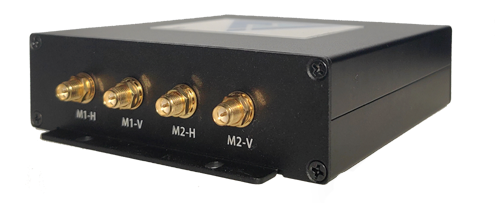
In general, network connectivity for utility tunnels and tunnels requires simultaneous solutions for high-reliiciency backbone ring network interconnection and uniform coverage of WiFi systems; pure over-the-air wireless solutions are not applicable. To this end, Guoxin Longxin has specially developed the dual-band, four-mode ACG600 gateway device tailored for tunnel and utility tunnel network connectivity, and combined it with medium and high-frequency leaky cable solutions to perfectly address the WiFi wireless coverage requirements in the enclosed spaces of tunnels and utility tunnels.
II. Wireless Network Solutions for Tunnels and Utility Tunnels
1. Backbone Private Network Solution for Tunnels and Utility Tunnels
Restricted by the tunnel and utility tunnel environment, optical fiber links are the primary choice for backbone networks. However, laying optical cables in some tunnels and utility tunnels incurs high costs, and the prices of optical equipment (e.g., GPON) are also relatively high. Many users require wireless backbone networks as a supplement to optical fiber networks. The multi-hop MESH system based on wireless networking has emerged as a solution, adopting a “pearl chain” structure with one hop connected to another. This networking structure has two major drawbacks:
First, in a single-band MESH system, the bandwidth is reduced by 50% with each hop, leading to increasing bandwidth congestion as the distance extends.
Second, the pearl chain networking structure makes the entire network vulnerable to failures: a power outage, network disconnection, or other faults at any single node will disrupt the whole network. The advantage of flexible networking in the original centerless mesh network becomes the biggest hidden danger.
In addition, the distribution spacing of backbone wireless network devices should not be too close, as an excessive number of devices will lead to cost overruns; meanwhile, the spacing should not be too far either. Otherwise, devices such as video surveillance cameras, UWB base stations, and LoRa gateways need to realize backhaul connection through wired means on the backbone wireless system, making deployment inconvenient if the spacing between backbone nodes is excessive.
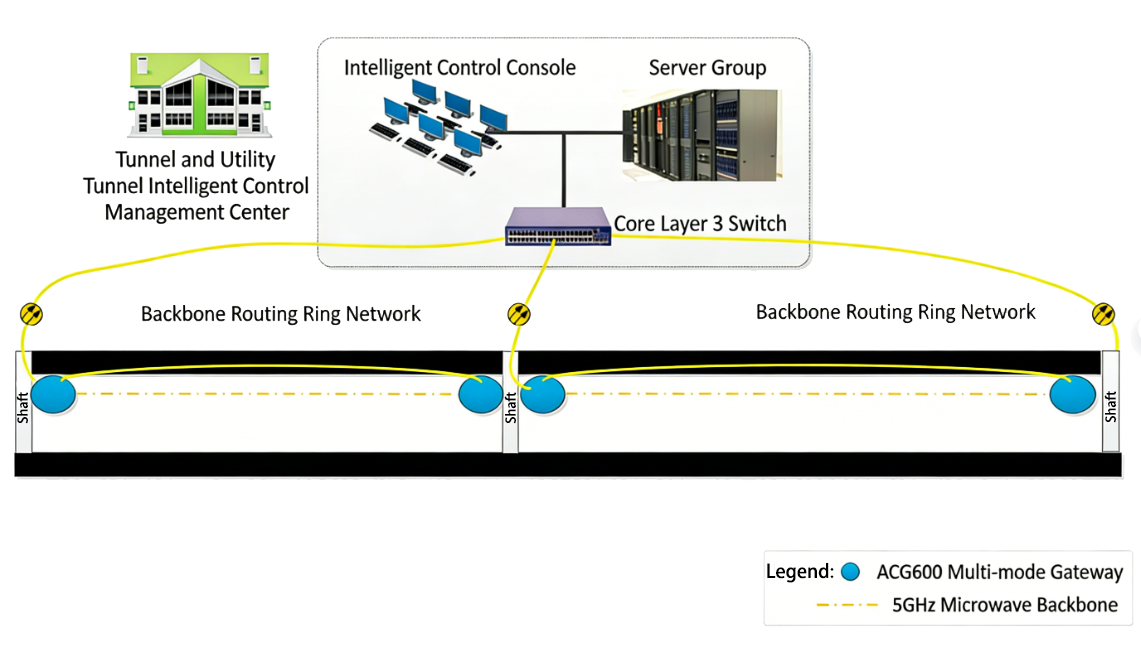
To meet the long-distance, cross-section backbone transmission requirements of tunnels and utility tunnels, the multi-mode ACG600 gateway is adopted as the core node to build a dual-medium backbone ring network of “iMAX 5GHz wireless + optical fiber ring network”. The ACG600 gateways are interconnected via optical fibers or the iMAX private wireless network, and the entire network is connected to the tunnel and utility tunnel intelligent control center through optical fibers, forming a multi-ring backbone network to fully ensure the reliability of the overall system.
The inherent advantages of ring network networking, combined with professional routing and forwarding capabilities, can effectively isolate broadcast domains and reduce collision domains, eliminate broadcast storms at the network layer, and ensure the priority transmission of key service data, significantly improving the overall network throughput and communication efficiency. Meanwhile, the routing-based multi-ring network architecture supports flexible division of network areas and services, with controllable data interaction between each ring network. It not only ensures the smoothness of cross-regional communication but also realizes precise isolation of fault domains. A failure of any node or link only affects the local area and does not spread to the entire network, greatly enhancing network robustness and security from a structural perspective.
For the design principles of wireless system reliability, please refer to How to Ensure High Reliability of Wireless Network Systems?.
The ACG600 gateway features a compact size and easy installation, eliminating the need for large-scale civil construction, with high deployment efficiency and a short cycle. It adopts the iMAX private protocol for private network design, and is equipped with multiple security mechanisms including data encryption, VLAN, VPN, and software firewalls, boasting strong anti-interference capability and secure and controllable data transmission. It adopts a one-time investment model with no subsequent line rental fees, resulting in lower comprehensive costs.
This backbone private network architecture can stably carry backhaul transmission of all services such as high-definition video, sensor data, and emergency communication, providing high-reliability and high-security underlying transmission support for the intelligence of tunnels and utility tunnels.
The schematic diagram of the topology for the backbone wireless private network solution of tunnels and utility tunnels is as follows:
2. Medium and High-Frequency Leaky Coaxial Cable WiFi Solution for Tunnels and Utility Tunnels
To meet the access requirements of various WiFi intelligent terminals in tunnel and utility tunnel scenarios, a highly reliable WiFi access network can be constructed based on the ACG600 multi-mode gateway. Combined with medium and high-frequency leaky coaxial cables, it achieves full coverage of 2.4G WiFi signals, effectively reduces system interference, and addresses the challenges of full-area WiFi signal coverage and access to multiple WiFi terminals in narrow, enclosed, and high-shielding underground environments. The solution features core advantages including easy deployment, easy power supply, high reliability, and low cost.
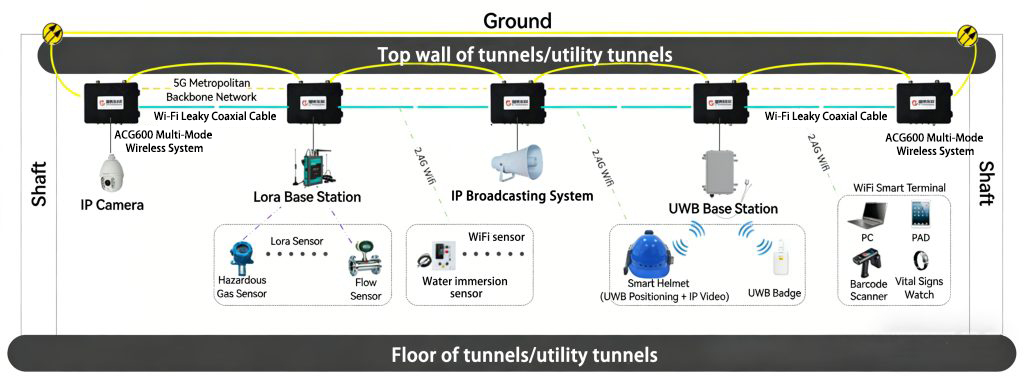
For WiFi coverage in tunnels/utility tunnels, the ACG600 multi-mode gateway serves as the core access node, cooperating with medium and high-frequency leaky coaxial cables to realize full-area continuous signal coverage. The leaky coaxial cable is customized for the dedicated 2.4GHz frequency band, with signals radiated uniformly along the cable, completely eliminating signal blind spots in enclosed scenarios and exhibiting excellent anti-interference capability. The solution supports mixed access of various types of WiFi terminals: LoRa base stations with wired network interfaces, and sensors for temperature and humidity, gas, water immersion, etc., can be directly connected via network ports; 2.4G WiFi intelligent terminals such as inspection handheld terminals, PADs, and barcode scanners can access seamlessly through the leaky coaxial cable, fully meeting business requirements including environmental monitoring, video surveillance, daily inspection, and emergency dispatching.
The leaky coaxial cable can be fixed along walls with clips, eliminating the need for wall chiseling and slotting, featuring low construction difficulty and no damage to the original building structure. The ACG600 multi-mode gateway adopts industrial-grade hardware design, adapting to underground humid, dusty, and strong electromagnetic environments with stable and reliable operation. Based on routing and forwarding capabilities and software firewall configuration, it can classify and isolate different service traffic, realizing true multi-network convergence, ensuring transmission priority for low-speed sensor data or high-definition video streams, and further improving the overall operation efficiency of the access network.
The schematic diagram of the topology for wireless WiFi coverage and terminal access in tunnels and utility tunnels is as follows:
The ACG600 multi-mode gateway supports routing, VRRP (Virtual Router Redundancy Protocol) and multi-link data mirroring technology. It enables highly reliable ring networking for routing links, ensuring smooth and uninterrupted roaming of various Wi-Fi terminals in mobile networking scenarios. The “wireless-to-wired” design of leaky feeder cables effectively resists complex spatial structures and electromagnetic interference in tunnels and pipe galleries, making it an efficient access solution for intelligent operation and maintenance of tunnels and pipe galleries.
Based on the TCP/IP network, this solution features open and compatible scalability. It can seamlessly integrate with UWB positioning systems, LoRa base station-based low-power sensor systems, and others, rapidly enhancing intelligent sensing and precise positioning capabilities for underground spaces.
UWB Positioning System: Capable of real-time precise positioning, location tracking and trajectory playback of personnel, inspection robots and operating equipment in pipe galleries and tunnels. It supports electronic fence configuration, regional intrusion alarms and emergency location locking, providing accurate location services for safety supervision and emergency rescue.
LoRa Sensor Monitoring System: Low-power sensors connected via LoRa base stations can collect real-time monitoring data including temperature and humidity, flammable/toxic gases, liquid level, pressure, water immersion, manhole cover status and fire equipment status in pipe galleries and tunnels. Operating stably in low-power mode for long periods, the system enables wireless data transmission without cabling, supports proactive anomaly reporting and alarms, and realizes unified access of multi-type sensor terminals and remote monitoring of full-area status.
Networking of Other Intelligent Control Terminals: In addition to the above systems, other integrated systems (such as personnel vital signs monitoring, smart hard hats, etc.) that are compatible with the IEEE 802.11b/g/n/ac protocol and equipped with Wi-Fi interfaces can also access the network via Wi-Fi.
Medium and high-frequency leaky feeder cables are highly suitable for network coverage in enclosed environments such as pipe galleries and tunnels. For their working principles and technical characteristics, please refer to the Wireless Private Network Solution for Medium and High-Frequency Leaky Feeder Cables.
3. Wireless Private Network Solution for Pipe Gallery Robot Inspection
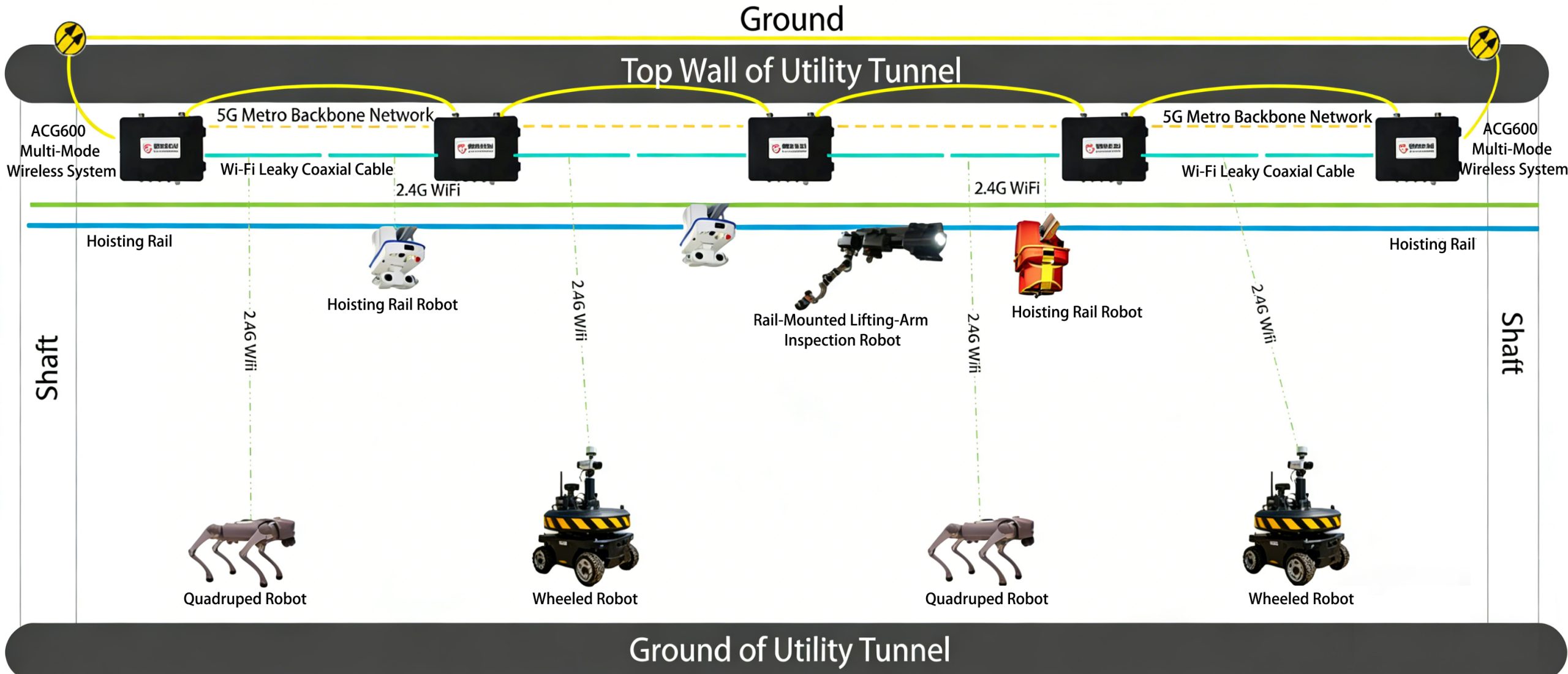
For intelligent inspection robot scenarios in pipe galleries, the ACG600 multi-mode gateway combined with medium and high-frequency leaky feeder cables can achieve full wireless private network coverage. Equipped with the Guoxin Loongson iMAX-8000AI series customized mobile communication system for robots, a highly mobile, stable and high-performance wireless private network can be constructed. This network is specially designed to meet the requirements of high-speed communication, high-definition video transmission and remote control command delivery for various robots.
The solution adopts medium and high-frequency leaky feeder cables to achieve continuous Wi-Fi coverage across the entire area including hoisting tracks and pipe gallery floors. Signals radiate linearly along tracks and floors without obstruction or reflection interference, perfectly matching the mobile inspection scenarios of robots. The iMAX-8000AI is exclusively customized and optimized for pipe gallery inspection robots, highlighting its compact size, light weight and ultra-low power consumption. It is ideally suited for onboard deployment in equipment such as hoisting track robots, rail-mounted lifting arm inspection robots, quadruped robots and wheeled robots, without occupying the limited installation space or power resources of the robots. The matched miniaturized antennas ensure stable communication for pipe gallery inspection.
iMAX-8000AI Mobile Terminal
This customized system delivers a single-device over-the-air bandwidth of up to 600 Mbps and supports software-adjustable full 5 GHz frequency bands. It features outstanding non-line-of-sight transmission and high-speed smooth roaming capabilities. Equipped with VRRP virtual hot-standby routing technology and multi-link data mirroring technology, it enables zero-packet-loss fast handover of robots between multiple base stations. Millisecond-level low latency ensures real-time transmission of high-definition robot video and accurate delivery of remote control commands. It supports point-to-multipoint, MESH, ring network and other networking modes, adapting to the long-distance and multi-branch complex structure of pipe galleries.
The system adopts an industrial-grade protection design, making it suitable for harsh pipe gallery environments such as humidity, dust and wide temperature ranges. The average power consumption of the mobile terminal is ≤12 W, ensuring energy efficiency and durability. Base station and on-board equipment are easy to install without large-scale civil construction, fitting the narrow space layout along the robot inspection track. The solution adopts a one-time investment model with no ongoing link leasing fees, resulting in extremely low operation and maintenance costs. The number of robots and coverage area can be flexibly expanded, providing a solid dedicated wireless communication foundation for unmanned inspection and remote intelligent management and control of pipe galleries.
The schematic diagram of the topology structure of the wireless private network solution for pipe and tunnel robot inspection is shown below:
For the general solution for robot private networks, please refer to Wireless Communication Solution for Intelligent Robots.
Overview
Guoxin Longxin has launched a wireless network solution for pipe galleries and tunnels, addressing core pain points in such scenarios, including long and narrow enclosed spaces, strong signal shielding, difficult power access, and limited construction. It provides full-dimensional network support for underground space environmental monitoring, personnel safety supervision, emergency dispatch, and remote operation and maintenance, completely breaking through communication bottlenecks in underground environments.
For the networking of emergency management systems in pipe galleries and tunnels, portable monitoring systems, the Phantom Travel low-frequency MESH system, or even customized solutions tailored to specific needs can be adopted. For product types and application cases, please refer toCollection of Typical Cases of Emergency Communication Command.
Backed by profound wireless technology expertise and industry implementation experience, this solution can be extended to similar long and narrow enclosed inspection scenarios such as power tunnels, mine roadways, urban underground pipe networks, integrated pipe gallery clusters, reservoir culverts, and rail transit construction sites. It fulfills core demands including continuous wireless coverage in interference-prone pipe gallery and tunnel environments, high-bandwidth access for multiple nodes, mobile inspection by intelligent robots, precise positioning, and status awareness, offering a unified technical approach for intelligent inspection of various underground infrastructure.
Centered on users’ actual scenario requirements, Guoxin Longxin leverages its project implementation experience in underground space inspection and other fields to provide customized optimal networking solutions for construction and management entities of pipe galleries, tunnels, power corridors, mine roadways, etc. It supports the entire process from product selection, solution design, and technical implementation to later operation and maintenance. With professional, reliable, and flexible wireless private network technologies, it helps users achieve the intelligent and digital upgrading of pipe gallery and tunnel management.