
Networking and Power Supply Solution for Fishery Administration & Fishing Ban Management
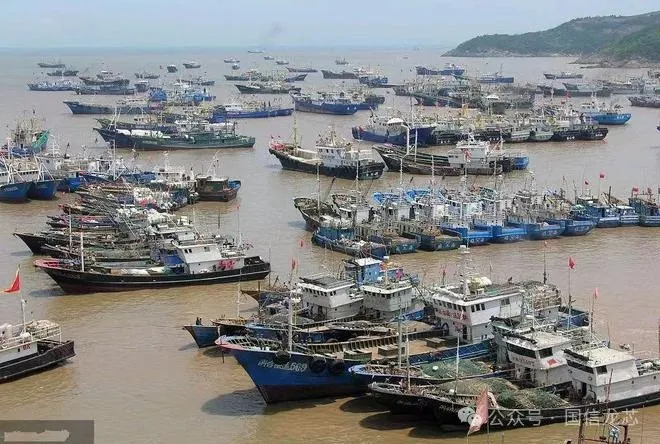
A fishing ban period, also known as a fishing moratorium, refers to a period stipulated by the government during which fishing activities for aquatic animals in waters are prohibited or restricted. Its purpose is to protect the normal growth and reproduction of aquatic organisms and ensure the sustainable recovery and development of fishery resources.Establishing a fishing ban period is a widely adopted fishery resource conservation system across the world, and it is also explicitly stipulated in China’s fishery laws and regulations.
Needless to say, the fishing ban period is of great significance for protecting fishery resources in rivers, lakes and seas and avoiding the destructive practice of “draining the pond to catch all the fish”. However, a tiny number of fishermen still refuse to stop fishing, and even brazenly violate the ban more recklessly.What is worse, illegal acts such as electric fishing, poison fishing, blast fishing and fishing operations by unlicensed, unregistered and uninsured vessels cause severe damage to fishery development and environmental protection. If such illegal activities are left unpunished and imitated by others, the fishing ban period will eventually become a mere formality.

Fishery administration is the primary competent authority for fishing ban law enforcement. Traditional fishery supervision relies on manual patrols by fishery law enforcement vessels. When the supervised river basins or sea areas cover an excessively large area, this manual, non-real-time and intermittent approach is obviously unable to meet regulatory requirements. Restricted by limited law enforcement resources, fishery authorities must keep pace with the times, adopt technological means to detect problems in a timely manner, improve supervision efficiency, and achieve all-weather and uninterrupted law enforcement.

How to prevent the repetitive “cat-and-mouse” game, how to develop fishery resources scientifically, rationally and in an orderly manner, and further standardize fishing ban management? Guoxin Longxin’s Solution for Fishing Ban Management and Illegal Fishing Prevention & Supervision System has been developed precisely for this purpose. Fishery authorities face the following difficulties in cracking down on and preventing illegal fishing during law enforcement and supervision:
  1. Information lag: It is often difficult to obtain information in the first place. When follow-up measures are taken, the fish ecology has already been damaged, with extremely high recovery costs and losses, and in some cases, irreversible damage.
  2. Evidence collection difficulties: Vessels operating along coastal and river areas leave no records. Without on-site detection, it is impossible to verify the exact fishing volume, resulting in difficulties in evidence collection and law enforcement.
  3. Challenges in fishing vessel management: Fishing vessels vary in size and are widely scattered. Delayed information statistics make scientific and rational arrangement and control impossible. Meanwhile, fragmented and random management fails to deter illegal activities, and a unified and holistic supervision platform must be established.
Currently, various technological means are available to support fishery law enforcement, such as UAV patrols and satellite remote sensing imaging. However, both systems entail extremely high construction and operational costs, making them hard to popularize and implement in daily law enforcement; their non-real-time nature also compromises their effectiveness. So, what approach constitutes the optimal solution for fishery law enforcement supervision?

We first analyze the core requirements of fishery law enforcement supervision:

  1. Key area monitoring: Critical locations such as fishing ports and docks require round-the-clock uninterrupted monitoring. Mastering this key point enables 24/7 scientific management of fishing vessels and will undoubtedly drastically reduce illegal fishing incidents.
  2. Function of law enforcement vessels: Fishery patrol law enforcement vessels need network connectivity, which not only enables image acquisition to solidify evidence of illegal acts, but also facilitates communication with the backend command center, allowing leaders to grasp on-site situations in real time and make timely scientific command decisions.
The main technical challenges facing the intelligent fishery law enforcement and supervision system are difficult network connectivity and low intelligence level.

I. Wireless Networking Solution for Fishery Law Enforcement Supervision

Fishery law enforcement networking requires support for both fixed and mobile nodes, making wireless communication the optimal solution. Two primary technical approaches are available based on specific requirements: Wireless Metropolitan Area Network (WMAN) (iMAX wireless ad-hoc network system) and Wireless Wide Area Network (WWAN) (carrier 4G/5G).

1. Wireless Metropolitan Area Network (WMAN) private network system
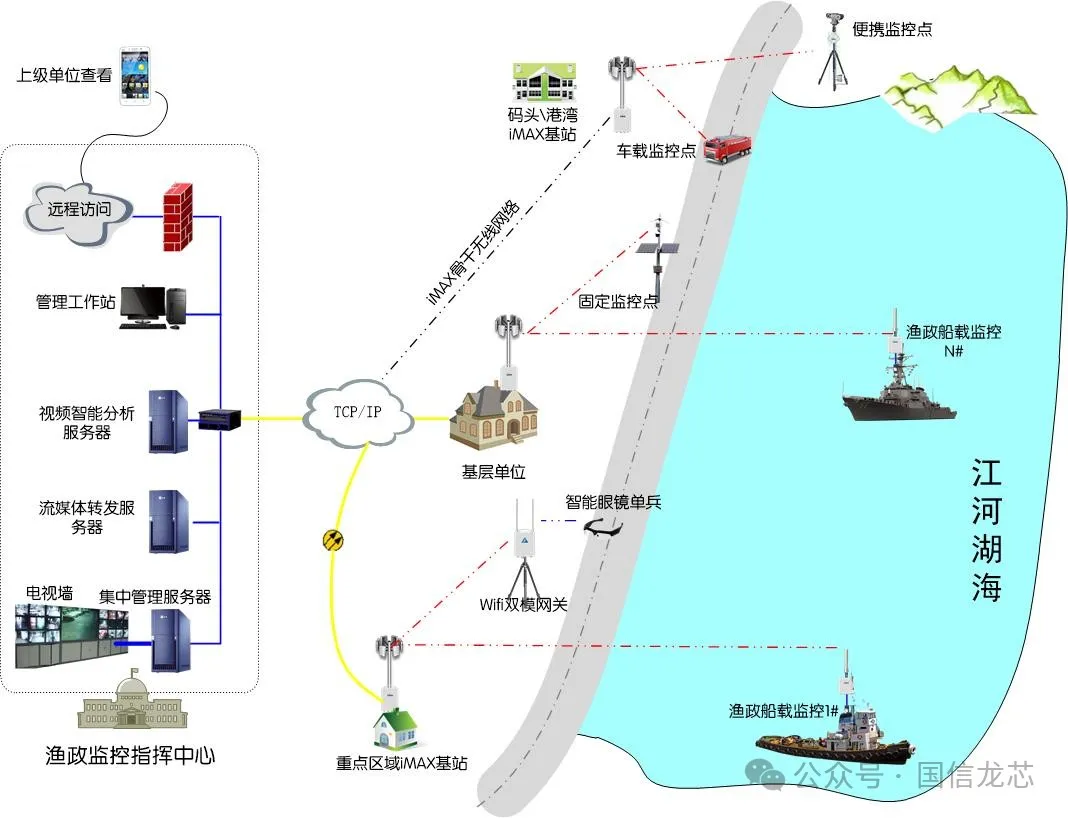
It enables high-speed wireless private network interconnection for fixed nodes, ship-borne nodes and mobile nodes. With one-time construction and bandwidth designed on demand, it is suitable for projects with clearly defined target areas. While the initial investment is relatively high, there are no subsequent exorbitant data traffic fees. Its obvious limitation is the requirement for line-of-sight (LoS) transmission, leading to relatively high technical difficulty. It must be designed on demand, and even on-site surveys and electromagnetic testing are required—and customized solutions tailored to specific needs are Guoxin Longxin’s core strength.
Typical topological schematic diagram of fishery administration networking based on WMAN private network:

Features of the Wireless Metropolitan Area Network (WMAN) System

The Wireless Broadband Metropolitan Area Network system is designed to build a wireless city or enable ultra-long-distance outdoor network interconnection, with all product series supporting an extremely long communication range.For outdoor backbone communication: iMAX-6000 and FibeAIR high-frequency microwave;For access network: iMAX-8000SiMAX-8000H series, and Huanyou low-frequency MESH mobile communication system (for on-the-move scenarios).
✅ Communication Range
Under line-of-sight (LoS) conditions, even the compact iMAX5G dedicated communication system with integrated antennas can easily achieve 10 km radius coverage in point-to-multipoint mode, and up to 120 km in point-to-point mode. The Huanyou low-frequency MESH system meets the 10–60 km communication and networking requirements for ships, aircraft and vehicles in ship-borne, airborne and vehicle-borne mobile scenarios under line-of-sight conditions.
✅ Transmission Bandwidth
  • iMAX-8000H: 600 Mbps point-to-multipoint communication system
  • iMAX-8000S: 100 Mbps point-to-multipoint communication system
  • iMAX-6000: 150/300/600 Mbps point-to-point communication system
  • FibeAIR high-frequency microwave: Up to 20 Gbps bandwidth
✅ Stability
The products have been tested in harsh outdoor projects such as water conservancy, petroleum and forest fire prevention for years. Their high reliability and stability make them ideal for river, lake, sea and mobile monitoring scenarios.
Fishery law enforcement monitoring points consist of fixed monitoring points, ship-borne monitoring points and portable mobile monitoring points, all of which can achieve network interconnection via the iMAX Wireless Metropolitan Area Network system.

2.  4G/5G Wireless Wide Area Network (Public Network) Technology

4G/5G Wireless Wide Area Network (public network) technology relies on base stations built by telecom operators, with cost-effective terminals. It is thus widely used in scenarios with highly scattered points and low data volume, yet its limitations are prominent:

① Excessively high data traffic costs

4G/5G data collection incurs costly data traffic fees. Current traffic package pricing (typical 4G: ~¥100 for a 20G cap; typical 5G: ~¥150 for a 60G cap) is a drop in the bucket for video surveillance (1 channel of 1080P HD video consumes about 1000–2000G of traffic per month), and one monthly package is insufficient for even a single day of use.

② Inadequate security assurance

With 4G/5G solutions, all video and data must be relayed via the Internet + third-party cloud. Data privacy exposed to the public Internet already raises security concerns, and with no control over the network “keys”, security cannot be guaranteed. Private cloud deployment may address cloud-side risks, but how to ensure the security of communication links?

③ Uncertain availability

The technology cannot be used in areas without telecom operators’ 4G/5G base station coverage. Most fishery law enforcement scenarios are in remote riverine and coastal areas, and the extremely limited coverage radius of base stations (4G: typical 1–2 km; 5G: typical 0.5 km) inevitably results in coverage blind spots, reducing the overall system availability.

④ Low reliability

Telecom operators have limited 4G/5G base stations and frequency resources, leading to restricted service capacity. Technically, it is unfeasible for multiple video streams to access through a single 4G/5G base station when numerous monitoring points are concentrated in one area. Worse still, 4G/5G access may suffer from “poorer performance in emergencies and heavy concurrent usage”, which runs counter to the original intent of emergency response.

Application Recommendation for 4G/5G Technology
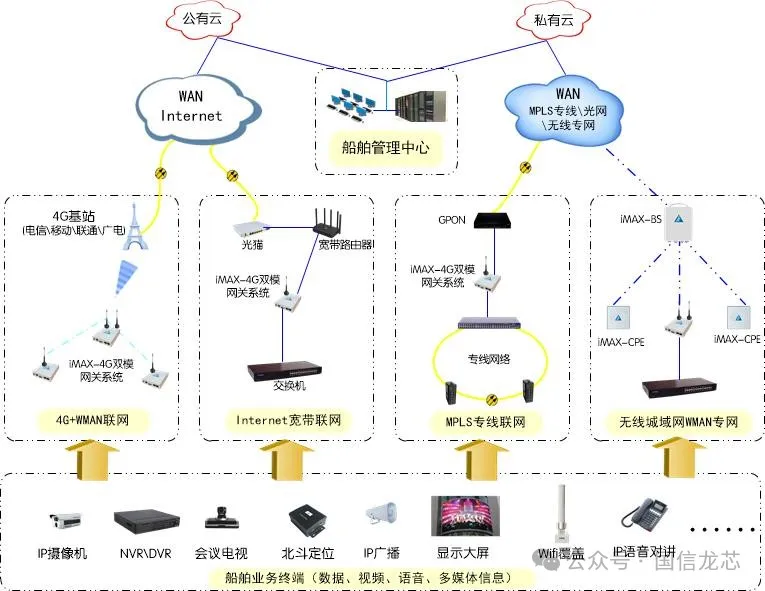
Despite the above limitations, 4G/5G technology features standardization, convenience and low initial terminal investment. It may be adopted for fishery administration projects that do not involve large-capacity video transmission or high-bandwidth services such as infrequent video transmission.
Typical application topology diagram of 4G/5G Wireless Wide Area Network interconnection is as follows:

A major highlight of Guoxin Longxin’s intelligent networking solution for fishery administration vessel & fixed-point systems based on 4G/5G public networks is “security”. By combining private cloud-based cloud interconnection SD-CX technology with VPN tunnel encrypted communication technology, it helps users build a quasi-private network over a regular wide area network, thus greatly enhancing system security and improving network stability. The key lies in providing customized designs tailored to user needs, which can save users on network rental and data traffic costs through various application details, and enable large-bandwidth services such as video surveillance to become optional modules for data collection.

It should be emphasized that the above two solutions are not mutually exclusive, but can be integrated to complement each other’s strengths and offset weaknesses. Guoxin Longxin’s 4G dual-mode wireless gateway iMAX-4GW300 is an integrated product that simultaneously enables inter-vessel private network connectivity and 4G public network access.
For the real-time positioning function required by many users for fishery law enforcement vessel and fishing boat management, please refer to Guoxin Longxin’s article Vessel Networking and Positioning Solution 2024 for further details.

II. Lithium Solar Power System: Solving the Power Supply Problem for Field Base Stations and Fixed Monitoring Points
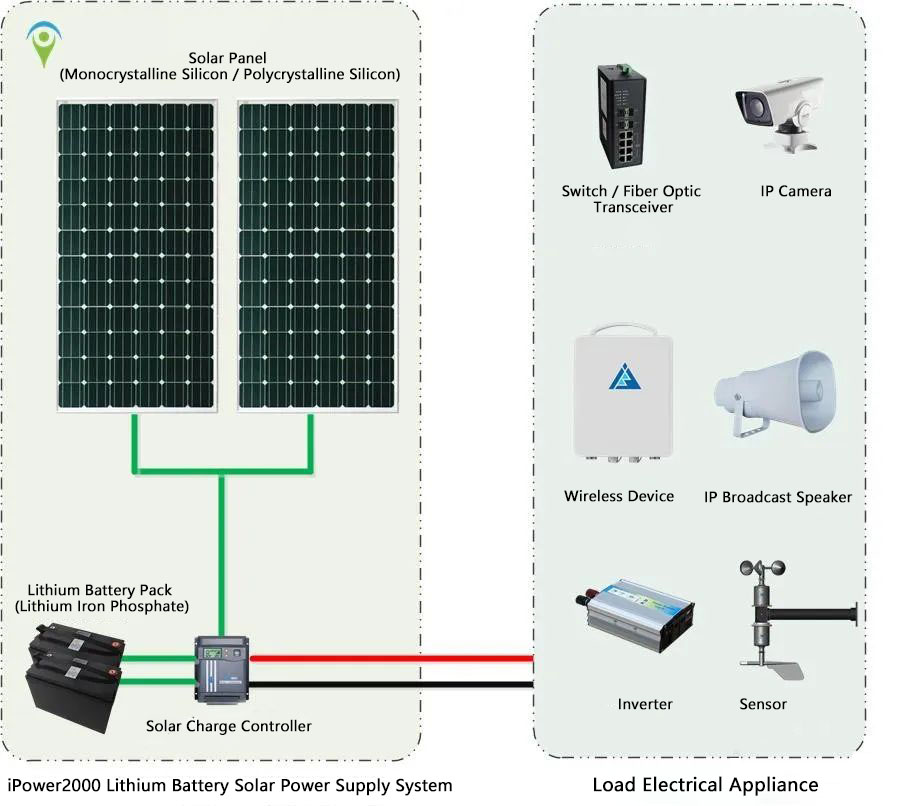
Another major challenge in building monitoring systems along rivers, lakes or sea areas is difficult power supply. If mains power cables are used for connection, the cost of laying cables from the foot to the top of a mountain can easily reach millions of yuan, and the construction cost and cycle are also unacceptable. Some monitoring points are located in remote mountain forests, making power access an extremely difficult task. The optimal power supply solution is Guoxin Longxin’s iPower2000 solar lithium power supply system.
The iPower2000 is an integrated solar off-grid power supply system applied to field environments such as rivers and mountainous areas. It complies with the green and eco-friendly construction concept of scenic areas, and solves the power supply problem for scattered electronic devices such as wireless network systems and video monitoring points in field conditions. This product effectively addresses the long-term or temporary power supply needs of outdoor video monitoring points and information collection stations.
With a host system centered on lithium-ion batteries and high-performance monocrystalline silicon solar panels, the system offers advantages such as a simple structure, compact size, light weight and long service life compared with conventional solar power systems using lead-acid or gel batteries. It is an ideal choice for long-term power supply in the construction of IT systems in field environments.
The typical application connection diagram of the solar power supply system is as follows:
Legitimate fishery production activities deserve protection and supervision, and the construction of this system can safeguard legal fishing operations and ensure that the measures for protecting fishery resources during the fishing ban period are fully implemented. Through real-time video surveillance footage, regulatory authorities, fishery and aquaculture managers can grasp on-site operational conditions in real time, enabling them and fishery practitioners to make scientific decisions promptly.
The fundamental innovation in Guoxin Longxin’s above design philosophy enables the parallel development of supervision and services for the fishery industry, which will help the prevention and management of illegal fishing gradually embrace the “Internet +” era. Moreover, “Internet + fishery administration management” is an inevitable choice for improving the level of sustainable fishery production and safety management.
Backed by strong technical capabilities and rich project experience, Guoxin Longxin can customize the optimal system design and provide the most suitable solutions for customers.
订阅评论
提醒
guest

0 Comments
最旧
最新 最多投票
内联反馈
查看所有评论
0
希望看到您的想法,请您发表评论x