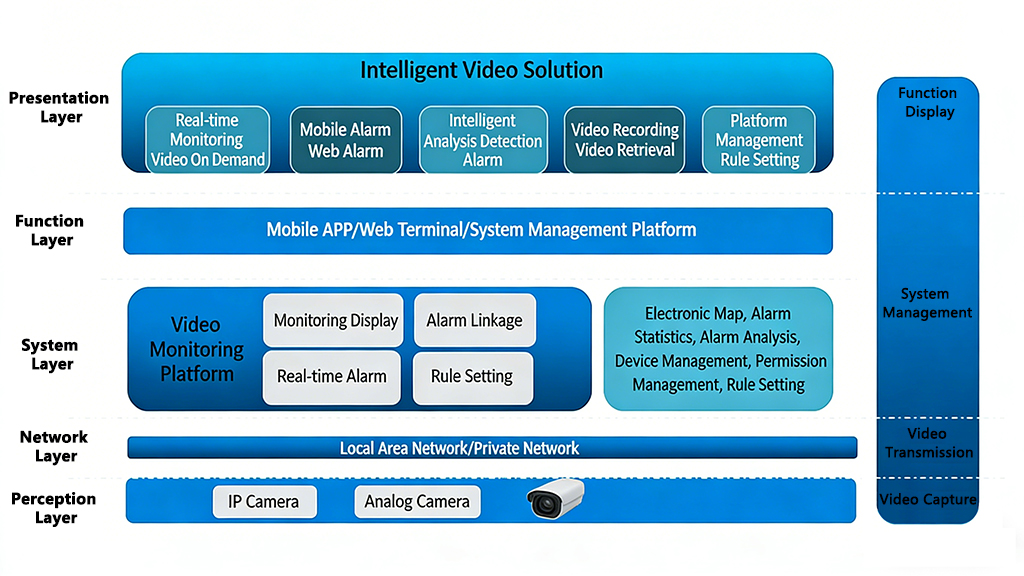
In addition to conventional functions such as video retrieval, browsing, storage and display, the core functions of the iVSS software platform focus on intelligent analysis. With traditional manual monitoring systems, operators are prone to fatigue and absenteeism, making it difficult to monitor each video stream in real time. This leads to drawbacks including poor alarm accuracy, false and missed alarms, long alarm response times, and difficulties in analyzing recorded video data.
Through the intelligent analysis and timely processing of video by the iVSS software platform, combined with machine learning and artificial intelligence, the burden on manpower is effectively reduced. The platform can issue real-time alerts and early warnings for various violation scenarios, achieving the effect of preventing accidents and hazards before they occur. It also preserves irrefutable evidence, and elevates the practicality and intelligence level of the security system.
IP cameras with built-in video intelligent analysis functions are expensive and have single-purpose functionality. One of the greatest advantages of this system is that it does not rely on specific camera hardware, and fully leverages existing camera resources for video intelligent analysis. It is an ideal choice for upgrading conventional security monitoring systems to intelligent security systems.
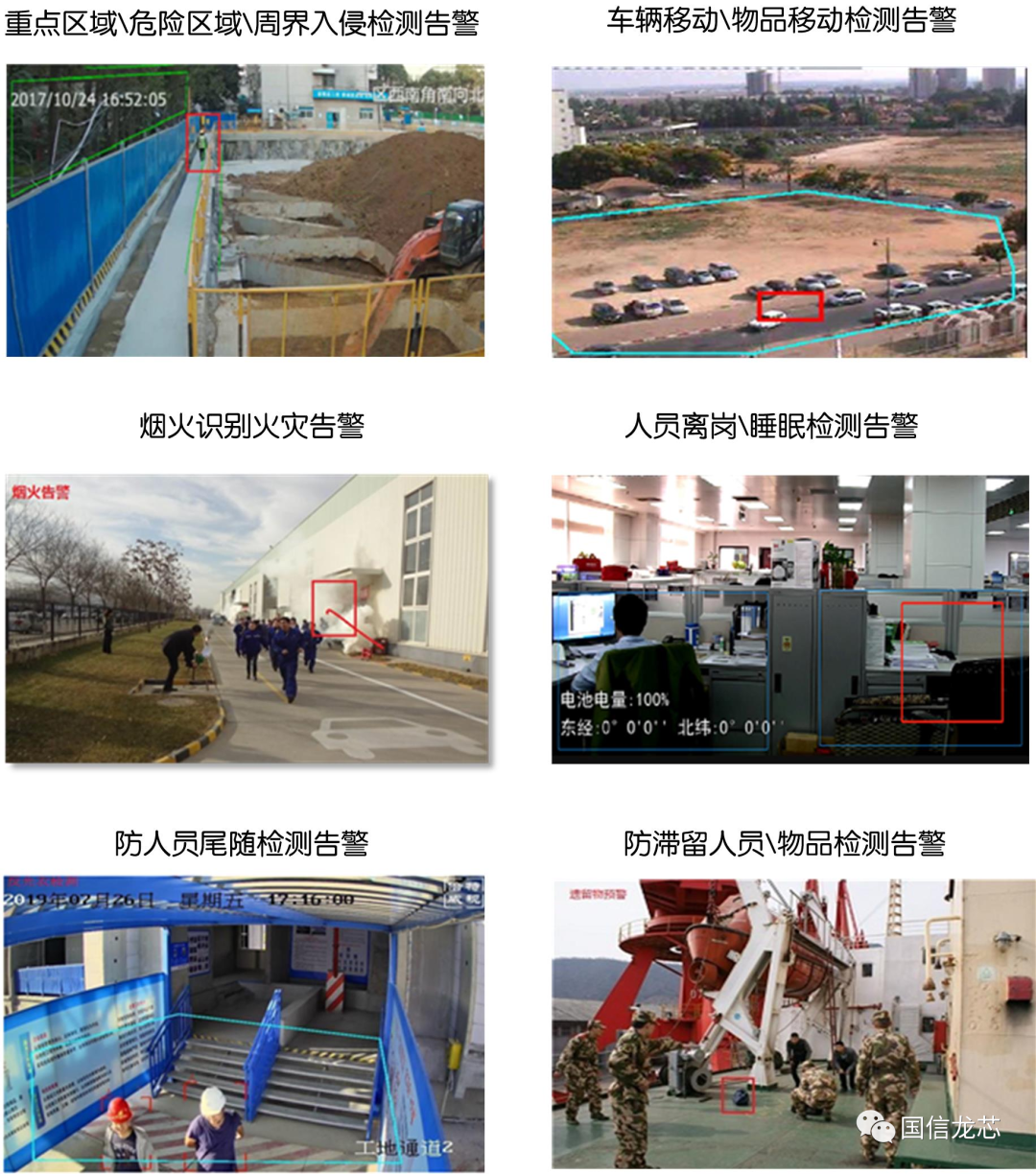
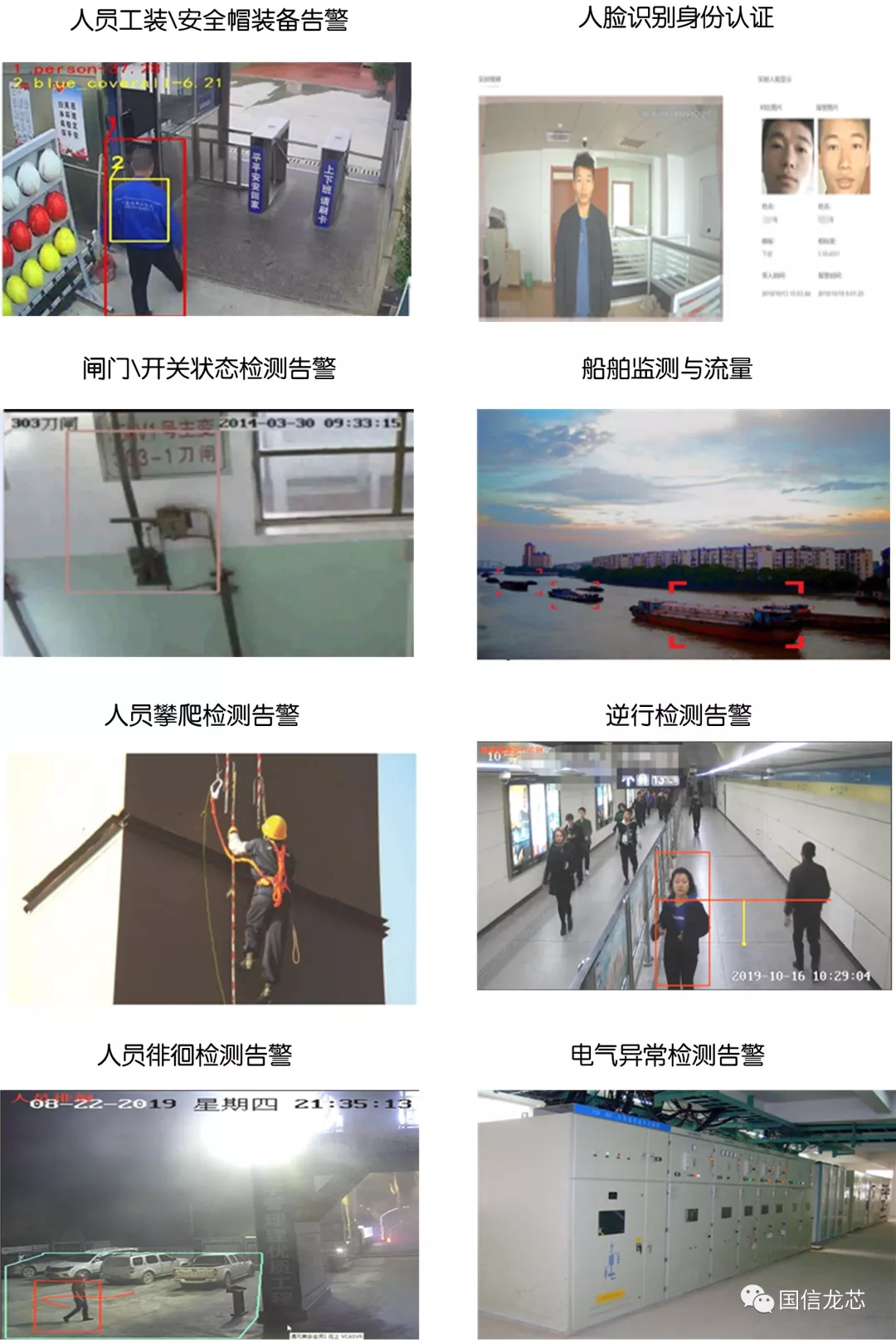
The intelligence of the iVSS intelligent video software platform is prominently reflected in video pattern recognition and AI-based alarm processing. Typical application scenarios are as follows:
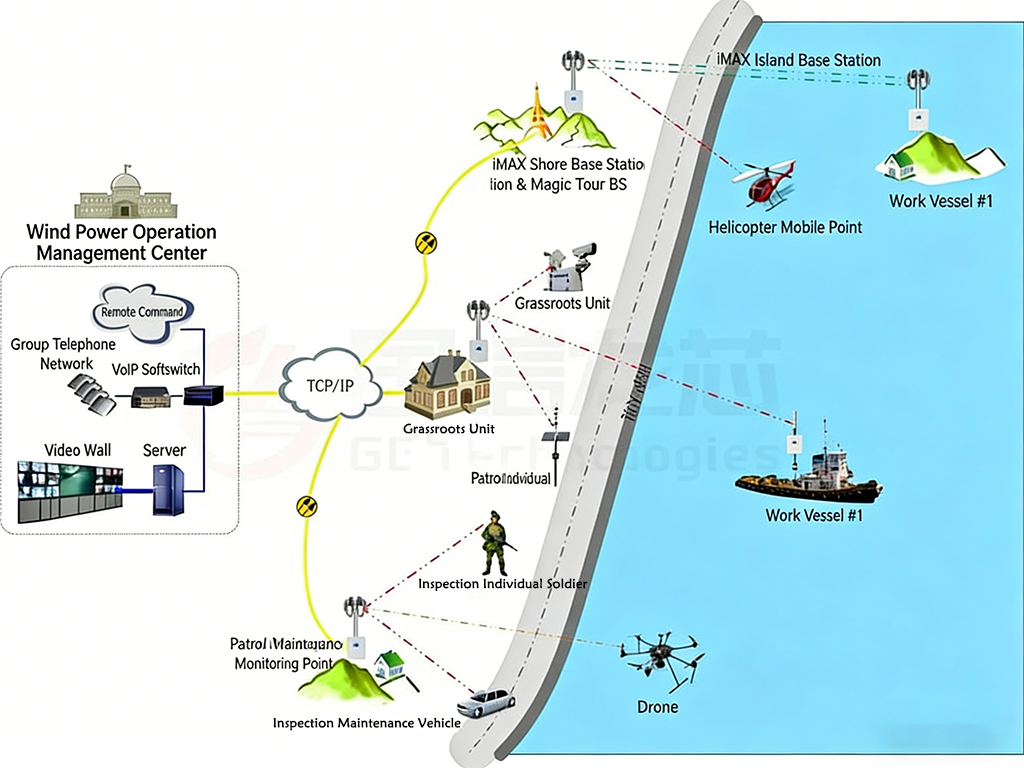
The construction of security monitoring systems requires transmission links with specific bandwidth and capacity, and wireless technology is a necessity for the vast majority of mobile monitoring scenarios. The three main types of Guoxin Longxin’s wireless network systems widely applied in security monitoring are as follows:
1. Wireless Metropolitan Area Network (WMAN) – Wireless Private Network for Regional High-Capacity Mobile Monitoring Needs
WMAN is a private network technology. Unlike Wireless Local Area Network (WLAN), WMAN generally adopts proprietary technical protocols of manufacturers, meaning products from different vendors are mostly incompatible (e.g., Guoxin Longxin’s iMAX 5G wireless communication system cannot interoperate with wireless systems of other manufacturers).The primary reason is that such products require longer communication distances, higher performance in bandwidth and capacity, as well as stricter environmental adaptability and system reliability. Only proprietary protocols and dedicated designs can meet these stringent requirements, which is also one of the reasons why WMAN products are generally priced higher than consumer-grade WiFi systems.
The iMAX WMAN communication system not only supports bridging, but also routing (static/RIPv2/OSPFv2, etc.), VLAN and firewall functions, making it a genuine system for large-scale device networking in metropolitan areas. iMAX WMAN networking is mostly configured in point-to-multipoint mode, with a line-of-sight communication distance of over 10 km (point-to-point line-of-sight communication up to 50 km and above). It delivers higher actual throughput and video capacity, and supports integrated design with optical networks – advantages unmatched by other technologies and devices.
To ensure system security and reliability, on the basis of proprietary communication protocols, Guoxin Longxin’s iMAX wireless communication system has introduced a series of security measures, including wireless ESSID group access control, ACL access control, AES dynamic encryption algorithm for communication channels, VLAN & VPN technologies and software firewalls. These form a multi-dimensional comprehensive security system, which achieves ultra-high security with proper configuration.
Mobile scenario design often involves the need for roaming communication between multiple base stations. Some systems involving remote control have stricter requirements for network packet loss rate and latency, which ordinary consumer WiFi products can hardly satisfy. The iMAX wireless private network system supports a full range of roaming and reliability technologies, such as RSTP Rapid Spanning Tree, VRRP Virtual Hot Backup Routing Technology and multi-link data mirroring technology. With higher product performance and quality, the iMAX wireless private network system is the optimal choice for high-reliability scenarios.
In addition to the iMAX 5G WMAN private network, Guoxin Longxin’s wireless private network portfolio also includes a low-frequency MESH mobile communication-on-the-move system and a high-frequency high-capacity IP microwave communication system. The former meets the ultra-long-distance communication-on-the-move needs of vehicle-mounted, shipborne and UAV devices in non-line-of-sight conditions, while the latter supports ultra-high-bandwidth IP network interconnection for fixed points. The Huanyou low-frequency MESH system boasts broad application prospects for mobile communication scenarios.
A representative and innovative product in Guoxin Longxin’s Huanyou low-frequency MESH portfolio – the Flybird1400 airborne terminal system customized for DJI UAVs – can support UAV control at a maximum distance of 60 km, and realize real-time transmission of uncompressed original high-definition DJI video with network connectivity over 20 km.
Currently, WMAN is the primary branch of private wireless network technology, dedicated to building private networks for numerous enterprise and institutional users in oil, power, communications, water conservancy, public security, ports, railways, highways, scenic spots and other sectors. As one of the most professional wireless private network vendors in China’s high-bandwidth, high-capacity and high-reliability WMAN product and solution market, Guoxin Longxin has accumulated numerous cases and applications across various industries. This solution is mainly applicable to high-capacity, high-reliability and real-time HD video construction scenarios for government and enterprise customers.
2. Wireless Wide Area Network (WWAN) 4G/5G – Virtual Private Network for Remote Interconnection
Public wireless technologies currently mainly refer to 4G/5G and others. They are called public networks because the base station systems are constructed by telecom operators, open to the public and charged by network rental fees or data traffic fees. Public network technologies generally occupy authorized frequency resources that are not allowed to be occupied by other parties. WWAN technology is developing rapidly and is currently transitioning from 4G LTE to 5G. Guoxin Longxin’s 4G dual-mode gateways and 5G multi-mode gateways have long been widely adopted by most users with favorable feedback.
4G/5G network terminal products based on WWAN eliminate the need for self-built base stations, resulting in lower overall system cost compared with private network construction. Meanwhile, the feature of network connectivity wherever telecom operators’ base stations cover greatly expands its service area, even enabling nationwide usage – these are the core advantages of this wireless solution.
WWAN-based 4G/5G network terminal products also have obvious disadvantages. The primary one is that the data traffic package billing model is not suitable for long-term security monitoring use, otherwise it will lead to exorbitant traffic costs and render the system an unaffordable ornament. Even with the gradual popularization of 6G in the future, the traffic package billing model will be hard to change due to technical and frequency resource limitations. Based on the current standard of ¥599 for 300G traffic, it is insufficient for 2 channels of 1080P HD video (typical bit rate 4Mbps) to conduct continuous monitoring for a single day.
Another troublesome problem is that 4G/5G access requires “relaying” via cloud platforms on the public Internet to transmit monitoring video data to the Internet. Most ordinary users are unable to guarantee data security, and this is completely unacceptable for government and enterprise customers with high security requirements, considering the risks of hacker hijacking or surveillance. In addition, irregular network tidal effect, high latency and poor reliability of public networks are also critical issues. This solution is mainly applicable to scenarios with a small number of video channels, occasional emergency use and low reliability requirements.
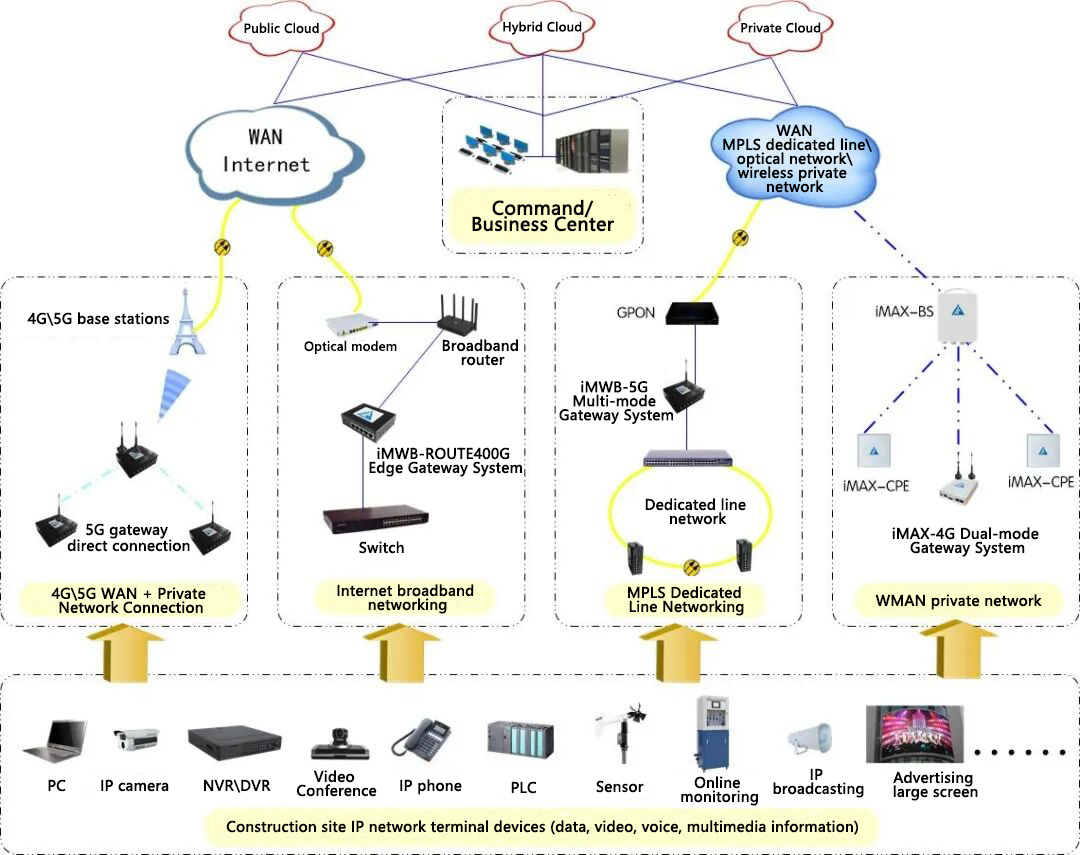
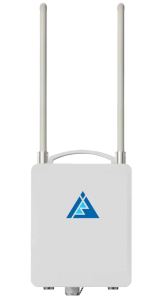
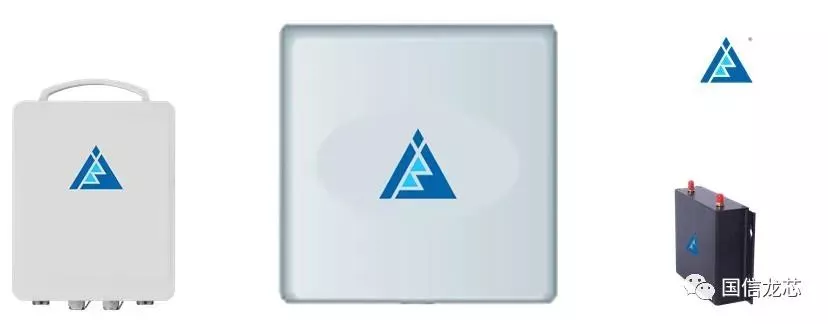
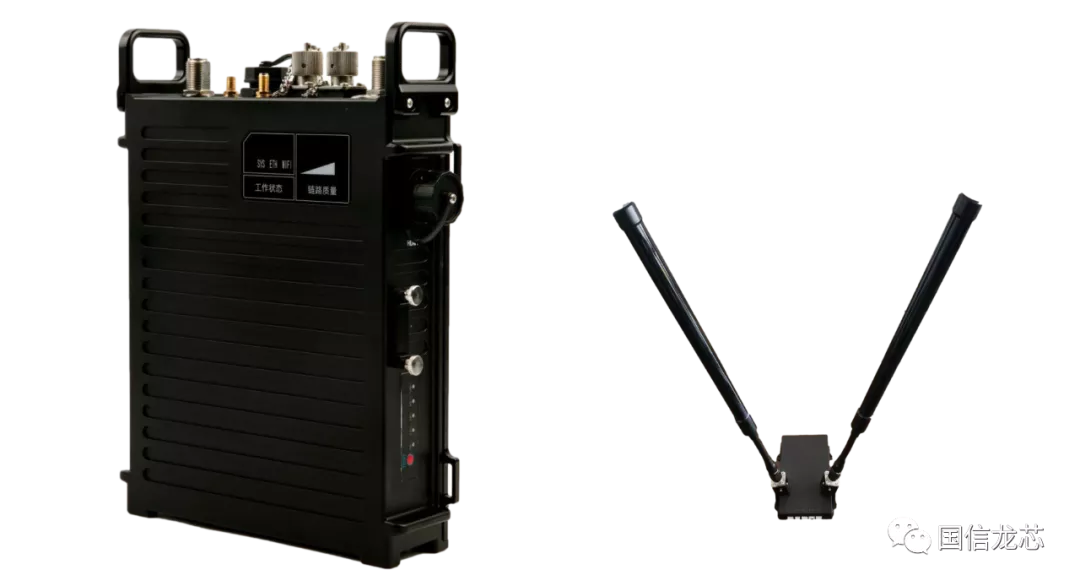
The iMAX-4GW300 is an iMAX Wireless Metropolitan Area Network (WMAN) and 4G LTE dual-mode wireless gateway system. It supports both iMAX WMAN technology and 4G LTE (FDD-LTE & TDD-LTE) simultaneously, and is equipped with multiple Ethernet interfaces, serving as a multi-network convergence gateway. While achieving high bandwidth, high reliability and high capacity via wireless private network technology, it also supports 4G LTE public network access from telecom operators, which improves the adaptability of system wireless networking and flexibly provides users with the optimal wireless networking solution.
The iMWB-5GW1000 is an iMWB brand 5G multi-mode wireless gateway system. It supports both 5G Wide Area Network (SA & NSA) and WiFi6 wireless local area network coverage (2.4GHz & 5.8GHz) at the same time, and is provided with two Ethernet interfaces, functioning as an edge VPN access gateway for the cloud switching platform. While gaining high bandwidth, high reliability and high capacity through WiFi6 wireless technology, it also supports 5G public network access from telecom operators, enabling more flexible provision of the optimal wireless networking solution for users.
3. Wireless Local Area Network (WiFi) – For Short-Distance WiFi Coverage
WiFi technology mainly refers to the wireless local area network technology complying with IEEE 802.11a/b/g/n/ac/ax open wireless protocols, which enables interoperability and interconnection of devices from different manufacturers. Guoxin Longxin’s iSAP special WiFi base station and iMAX-ACG600 WiFi dual-mode wireless gateway system are typical WiFi products designed for outdoor scenario applications of industrial users.
WiFi is currently widely used due to its excellent compatibility, which allows devices from different manufacturers complying with the standard to achieve interconnection and interoperation. At present, support for WiFi has become a standard configuration for most terminal devices such as smartphones, tablets (PADs) and smart large screens.
WiFi products typically have a coverage radius of 100 meters, while Guoxin Longxin’s WiFi products offer stronger coverage reaching 200–500 meters, making them a long-range coverage system. The communication distance can be further extended when paired with wireless bridges. In terms of access capacity, WiFi generally has low video bearing capacity, and is mainly applied in LAN monitoring scenarios of security surveillance projects with a small number of video channels and low reliability requirements.
Guoxin Longxin has innovatively integrated Wireless Local Area Network (WiFi) and Wireless Metropolitan Area Network (WMAN) technologies, and launched the iMAX WMAN & WiFi dual-mode wireless gateway system (iMAX-ACG600), enabling more convenient and flexible WiFi deployment.
Customization of the “Pipe”
Unlike wired networking for fixed-point monitoring, wireless technology is the mainstream for mobile monitoring. Guoxin Longxin’s wireless systems cover multiple modes of the wireless technology family, including WLAN, WMAN and WWAN. Although all can support mobile monitoring, each has its own advantages, disadvantages and applicable scenarios.There is no one-size-fits-all standard solution for selecting the specific “pipe” to transmit users’ mobile monitoring video. A tailored optimal solution must be custom-designed for users on the basis of a full understanding of user requirements and combined with actual constraints.
IV. Customized Monitoring Point Systems
Guoxin Longxin’s years of experience in the mobile communication industry and technical reserves in IP HD video streaming media are the fundamental guarantee for customizing mobile monitoring terminals.Vehicle-mounted (shipborne, airborne) monitoring points support real-time mobility, featuring high moving speed and requiring targeted design for different carriers. Portable mobile video monitoring point systems and movable monitoring point systems are customized products developed by Guoxin Longxin according to users’ specific needs, serving as a powerful supplement to fixed-point monitoring systems.UAV and robot monitoring points are similar to vehicle-mounted ones, but have special requirements for size, weight and power consumption that ordinary IP cameras and wireless communication devices cannot meet, necessitating more professional design. Individual soldier systems mainly realize local storage of personnel’s real-time video and audio, and real-time network transmission within the target moving range.
1. Vehicle-mounted (Shipborne) Real-time Mobile Nodes
Mobile vehicles, ships (vessels), airborne equipment (heavy machinery) and others act as temporary front-end communication nodes or even temporary command centers, generally requiring one-way or even two-way audio and video transmission. Therefore, the wireless mobile terminals installed on board are also crucial.
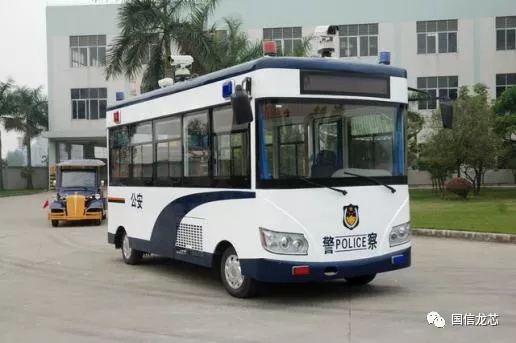
Vehicle mobile nodes are the most common type. For vehicles dedicated to emergency command, necessary modifications must be made. Three optional solutions are available:
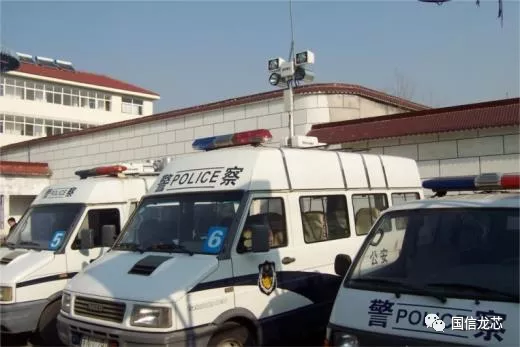
(1) Modification Solution for Medium and Large Mobile Police Vehicles (Iveco or larger models)
This can be achieved by installing an electric vehicle telescopic lifting pole, which can be laid down when not in use and erected with rotation when in operation, making it ideal for medium and large police vehicles.As shown in the figure below:
For small police vehicles, due to limited space and cramped installation positions, a fixed vehicle-mounted suction cup antenna must be adopted for connection to achieve communication-on-the-move. The roof-mounted camera can be installed above or behind the police light.
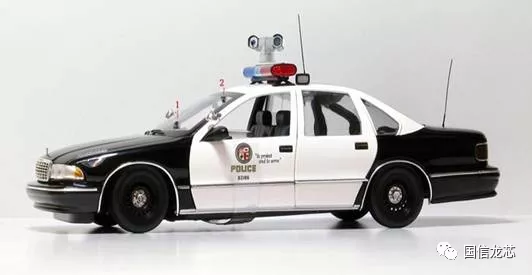
It does not operate in real-time mobility, but stays fixed at one location for extended working hours, even in a semi-fixed state. In addition, the towed mobile police vehicle requires transmission of multiple channels of high-definition video, which demands substantial bandwidth support.
By comparison, the first modification solution delivers the best performance but entails a higher cost. The specific solution to be adopted shall be flexibly combined and customized according to the actual operational conditions of the vehicle. The vehicle-mounted monitoring system also includes vehicle-mounted IP network cameras and vehicle-mounted Network Video Recorder (NVR) systems. Whether to install a lithium battery shall be determined based on user requirements.
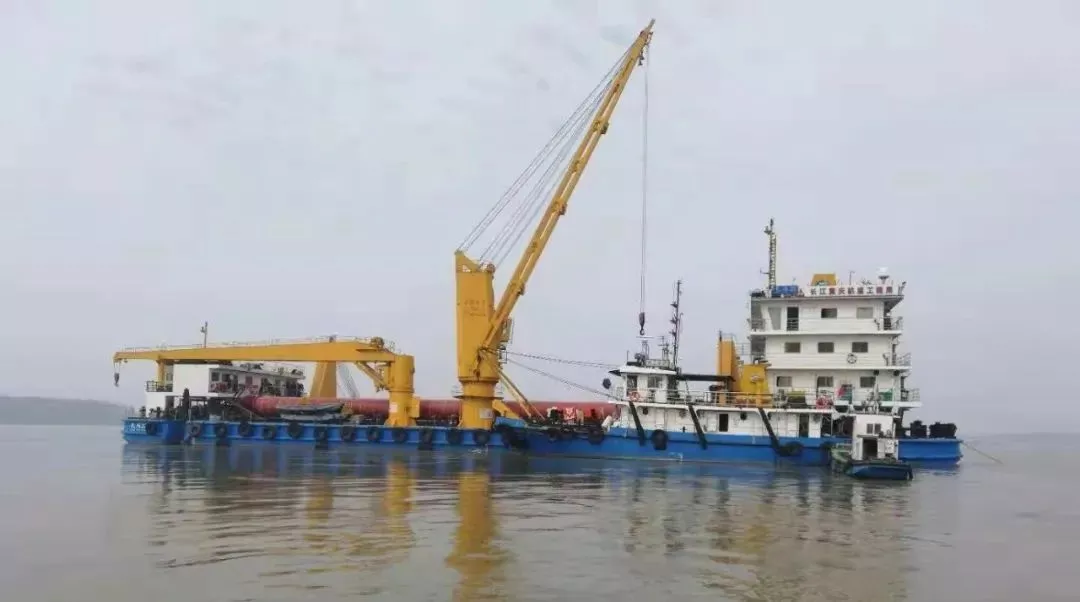
Shipborne monitoring has different requirements for various scenarios – for example, sea-going and inland waterway vessels, ferries and patrol boats all vary in design – yet the design of vehicle-mounted monitoring can often be referenced.
Mobile communication technologies for heavy machinery, AGVs and robots typically impose higher and more specific requirements. For example, the waveguide wireless communication system applied to AI intelligent control of port machinery in high-interference environments has a niche application scope and will not be further elaborated in this solution.Vehicle-mounted (shipborne, heavy machinery-mounted) mobile communication systems generally adopt the iMAX wireless metropolitan area network system or 4G dual-mode wireless communication gateway. In special cases, a WiFi base station may be additionally installed to support access of surrounding WiFi terminals. The specific design is configured on demand and will not be repeated here.
2. Portable/Detachable Mobile Video Monitoring Nodes
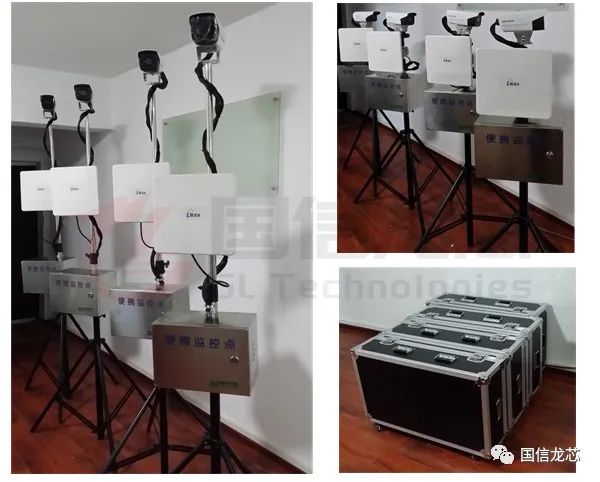
Portable mobile node systems and detachable monitoring node systems feature a nomadic mobility mode, serving as an effective supplement to fixed monitoring nodes in temporary mobile deployment scenarios.The physical diagram of the portable mobile monitoring node integrated with an IP HD camera and iMAX wireless CPE is as follows: (Supporting ground upright deployment)
The physical diagram of the detachable mobile monitoring point is as follows: (Supports wall-mounted or pole-mounted installation mode)
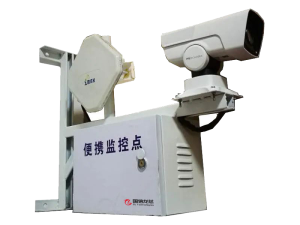
Guoxin Longxin provides dedicated wireless terminals for robots/UAVs, complemented by small lithium batteries and small IP cameras, and customizable design can be carried out according to user needs to meet the mobile monitoring video requirements of UAVs (mainly referring to unmanned aerial vehicles or unmanned ships) and robots. As such applications involve the integration or even modification of third-party equipment and are highly personalized, no specific description will be given here.
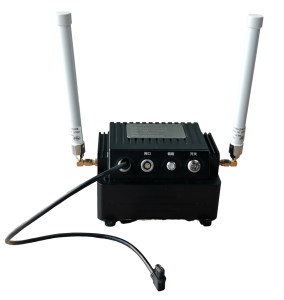
For robot communication, our company has the custom-designed iMAX-8000AI Robot Wireless Communication System, which features seamless roaming and a dual-link mirrored “zero packet loss” high-reliability network, delivering great value for user deployment and operation.
For DJI M300/M350 UAVs, our company has newly developed a low-frequency MESH private network communication system, which can meet the requirement for real-time interconnection between the UAV and the base station or command center. The product features a high degree of customization and easier operation.
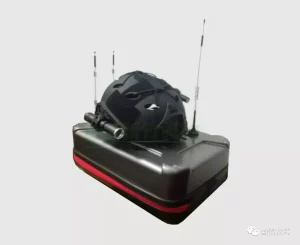
The individual soldier monitoring point based on Guoxin Longxin’s Huanyou low-frequency mobile communication-on-the-move system is typically a backpack-type system (lithium battery can be added), designed to meet the requirement of transmitting video back to the command center when single or multiple personnel work in the target area.
In terms of communication and networking methods, unlike many manufacturers that rely entirely on telecom operators’ 4G systems, Guoxin Longxin’s individual soldier monitoring points adopt a WMAN + 4G LTE dual-mode communication networking mode. Within the coverage of the iMAX 5G private network, the high-bandwidth, low-latency and high-capacity Wireless Metropolitan Area Network (WMAN) is prioritized for use. Outside the coverage of the iMAX 5G private network, 4G LTE can be used to access telecom operators’ networks and further connect to the Internet. This multi-mode design further enhances the reliability of network transmission.
Note: For specific specifications, technical descriptions and other details of the various mobile monitoring systems mentioned above, please refer to Guoxin Longxin’s official website and official WeChat account, or contact our pre-sales technical staff for relevant documents. Our mobile monitoring point system is designed to provide ideas and guidance for integrator partners. Partners are welcome to customize their own mobile monitoring systems with reference to our product designs, and we will provide professional guidance and technical support.
Guoxin Longxin’s full-scenario mobile monitoring solution can also be referred to as the “full mobile scenario” monitoring solution, with two core features: mobility and the seamless integration of the Cloud-Pipe-Terminal architecture. A high degree of customization and flexible modularity are essential to meet the personalized monitoring needs of different users, and also constitute the competitive advantages of the system.
Guoxin Longxin’s mobile monitoring point system currently covers the vast majority of known mobile monitoring scenarios. All mobile monitoring systems consist of power supply, networking and video recording modules, which benefits from Guoxin Longxin’s long-term technical accumulation and R&D innovation in wireless communication, lithium battery & solar power, as well as hardware and software development.
It should be emphasized that Guoxin Longxin’s iVSS intelligent video software platform is widely compatible with surveillance products from mainstream manufacturers including Hikvision, Uniview, Tiandy, Dahua and Keda. Users have a convenient selection of cameras, and our mobile monitoring system can be deeply and organically integrated with users’ existing front-end devices and platforms, whether for new surveillance system construction or upgrade projects, eliminating users’ concerns. Generally speaking, except for a few specially customized cameras, we recommend users to select their own cameras and NVRs, and we provide professional customized integration services.
Based on solid technical strength and years of experience in mobile communication projects across various industries, Guoxin Longxin can provide users with customized design and development of the most suitable mobile communication monitoring systems, as well as tailored comprehensive solutions.