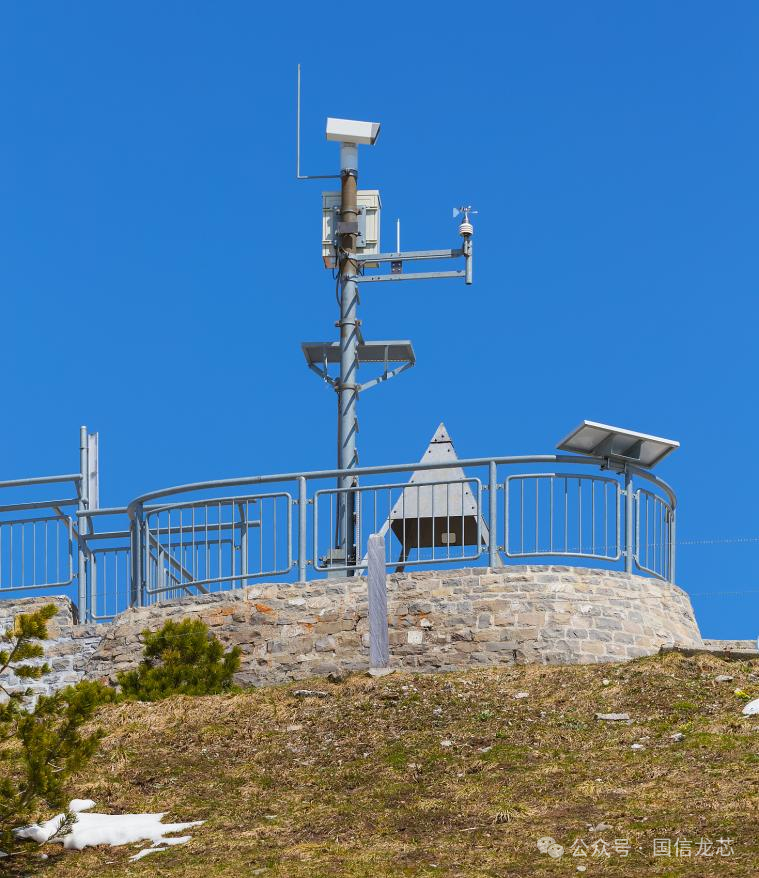
Through real-time monitoring and data analysis, the wireless networking early warning system for geohazards can predict the occurrence of geohazards in advance, enabling timely response measures to be taken and reducing casualties and property losses caused by disasters. The basic principle of the early warning system is based on an in-depth understanding of the occurrence laws of geohazards and the application of data analysis technologies. By comprehensively analyzing various factors such as geological structure, topography and landforms, and meteorological conditions, the system can identify risk points that may trigger geohazards and predict their development trends.
Meanwhile, the early warning system integrates advanced technologies including the Internet of Things (IoT), big data and artificial intelligence (AI) to realize real-time collection, transmission, processing and release of geohazard data, improving the accuracy and timeliness of early warnings. In practical application, by deploying sensors and data collection devices in high-risk areas, the system can conduct real-time monitoring of surface deformation, groundwater level changes, rainfall and other information, and transmit the data to the data center for real-time analysis. Once abnormal conditions are detected, the system will immediately activate the early warning procedure and send early warning information to relevant departments and personnel via SMS, telephone, broadcast and other means to facilitate timely response measures. According to statistics, the application of the early warning system has achieved remarkable results in geohazard prevention and control. Early warnings and timely responses have successfully prevented multiple geohazards and reduced substantial casualties and property losses.
Wireless technology is highly suitable for networking in geohazard early warning systems, mainly due to the following factors:
✅ Real-time performance: The wireless networking early warning system can detect potential geohazard risks in a timely manner through real-time monitoring and data transmission, issue early warning information rapidly, and effectively mitigate disaster losses.
✅ Convenience: Adopting wireless communication technology, the system can cover a wider area to achieve all-round geohazard monitoring, with faster, more convenient and more agile deployment.
✅ Cost-effectiveness: Wireless networking for geohazard early warning systems offers high cost-effectiveness, and can be custom-deployed according to the geohazard characteristics of different regions to meet the actual needs of various scenarios.
In summary, through data analysis and model prediction, the system can provide reliable geohazard early warnings and strong support for disaster prevention and control.
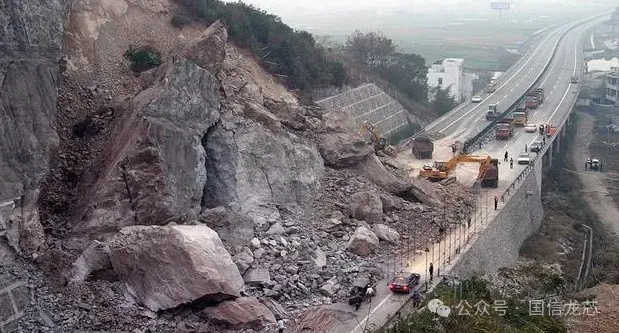
2.1 Real-time PerformanceReal-time performance is one of the core advantages of the wireless networking early warning system for geohazards. In geohazard prevention and control, time is life, and the real-time performance of the early warning system can secure precious time for disaster prevention efforts. Through networking with reliable wireless private network technology, the early warning system can rapidly collect and process geological information, and transmit early warning information to relevant departments and personnel in a timely manner.
For example, in seismic disasters, the wireless networking early warning system can conduct real-time monitoring of crustal movement and seismic activity. Once abnormal conditions occur, the system can issue early warning information instantly, gaining tens of seconds to several minutes of response time for local governments and residents and reducing disaster losses. In addition, real-time performance is also reflected in the update and maintenance of the early warning system. The wireless networking early warning system can achieve rapid system upgrade and maintenance through remote control and automatic update technologies, ensuring the accuracy and reliability of early warning information.
Adopting wireless technology for networking, the geohazard early warning system features wide coverage as one of its prominent advantages. With wireless networking technology, the system can realize large-scale, fast and accurate monitoring and early warning of geohazards. For example, in areas prone to geohazards such as mountain landslides and earthquakes, the system can monitor crustal movement, surface deformation, groundwater level changes and other conditions in real time, and transmit the data to the central server for analysis and processing. Once anomalies are detected, the system can immediately issue early warning information, notifying relevant departments and personnel to take response measures and effectively mitigating disaster losses. In addition, the wireless networking early warning system can achieve all-round, blind-spot-free monitoring through multi-node coverage, further improving the accuracy and reliability of early warnings.
The flexibility and convenience of the geohazard early warning system are also essential for practical application. The system adopts advanced wireless communication technology to transmit early warning information quickly and accurately, enabling timely and effective response to geohazard occurrences. Meanwhile, the system boasts excellent scalability and customizability. It can flexibly adjust and optimize early warning schemes according to the characteristics of different regions and disaster types, enhancing the accuracy and pertinence of early warnings.
In addition, the flexibility of the system is embodied in its user-friendly human-computer interaction interface. Users can flexibly configure and adjust system functions according to actual needs, realizing convenient and efficient release and management of early warning information. Statistics show that after the application of the early warning system, the accuracy rate of geohazard early warnings has increased by 30%, and the early warning time has been advanced by 20 minutes, providing strong support for reducing losses caused by geohazards.
Reliability is a core requirement for the geohazard early warning system, which is mainly reflected in the stability of data transmission, continuity of system operation and accuracy of early warnings. In geohazard prevention and control, the reliability of the early warning system is crucial to safeguarding people’s lives and property.
To improve the reliability of the early warning system, optimization can be carried out in the following aspects:First, strengthen the stability of data transmission by adopting advanced communication technologies to reduce packet loss and bit error rates during data transmission.Second, enhance the continuity of system operation by using high-availability hardware equipment and software architecture to avoid system interruption due to faults.Third, improve the accuracy of early warnings by continuously optimizing algorithms and upgrading the precision of monitoring equipment to reduce false alarms and missed alarms.
In practical application, the reliability of the early warning system can be evaluated and verified through comparative experiments and case analysis to ensure its performance in real scenarios. Networking with a wireless private network (or virtual private network) and dedicated private network operation are the guarantees for reliable and stable network connectivity, especially with the iMAX 5G Wireless Metropolitan Area Network (WMAN) private network system that supports hot backup redundancy for high-reliability networking.
The adoption of wireless networking technology (especially wireless private network) for the geohazard early warning system brings significant advantages in application scenarios. It can be said that wireless networking is the most suitable networking technology for early warning systems in areas prone to geohazards such as mountain landslides and debris flows. The selection of wireless technology varies according to scenarios, the quantity and dispersion of nodes, service types and bandwidth requirements. There are two typical wireless networking methods.
The iMAX wireless communication system is designed to build wireless cities or solve ultra-long-distance network interconnection in outdoor environments, and all series of equipment support ultra-long communication distances. Among them, the iMAX-6000 series serves as the backbone network for geohazard early warning networking, and the iMAX-8000S, iMAX-8000H series and others act as the edge access network.
✅ Communication Distance: Under line-of-sight conditions, even the compact integrated-antenna iMAX 5G client system, the iMAX-8000 in point-to-multipoint mode can easily achieve 10 km radius coverage; the iMAX-6000 in point-to-point mode supports a maximum distance of 100 km, making it ideal for ultra-long-distance communication and networking in remote outdoor areas.
✅ Transmission Bandwidth: The iMAX-8000H is a 600Mbps point-to-multipoint communication system, the iMAX-8000S is a 100Mbps point-to-multipoint communication system, the iMAX-6000 is a point-to-point communication system with 150/300/600Mbps bandwidth, and the FibeAIR high-frequency IP microwave is a point-to-point communication system with ultra-high bandwidth of 1Gbps-20Gbps.
✅ Reliability & Security: The iMAX wireless private network system is an industrial and telecom-grade system, and its product quality, reliability and solution reliability are the biggest advantages distinguishing it from competitors. In terms of security, it integrates multiple technologies including wireless packetization, data encryption, VPN end-to-end encryption and software firewall. For the construction of geohazard early warning systems, its quality, reliability and security are indispensable.
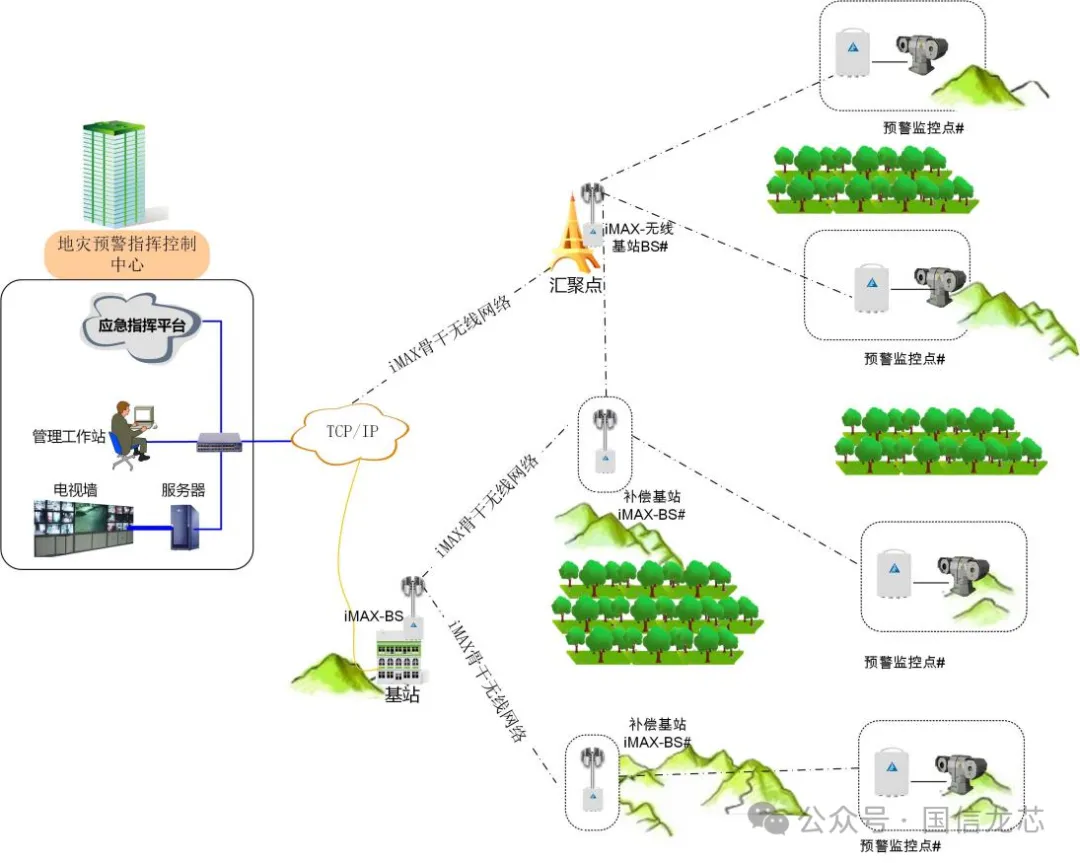
Topology Diagram of iMAX WMAN Private Network for Geohazard Early Warning System:
Using 4G/5G public networks as the underlying networking platform essentially deploys services directly on the public Internet. Without network encryption and reliability technologies in place, the system is vulnerable to cyber attacks that disrupt normal operations, and may even lead to network security incidents such as system crashes and data leaks. Therefore, a “SD-CX Cloud Switch + VPN Virtual Private Network solution” must be adopted to enhance system security and reliability.
For users of geohazard early warning systems, wireless private network technology only addresses on-site private network construction for individual locations. However, early warning sites are often scattered across a city, a province, or even the entire country, making wireless wide area network (WWAN) technology more suitable for centralized management networking of these distributed sites. Leveraging years of valuable experience in the IoT industry, Guoxin Longxin proposes a solution integrating SD-CX Cloud Switch and multi-mode gateways.
A cloud computing platform (or cloud platform) refers to a service built on hardware and software resources, providing computing, networking and storage capabilities. Cloud computing platforms fall into three categories: storage-centric cloud platforms for data storage, computing-centric cloud platforms for data processing, and integrated cloud computing platforms that support both computing and data storage/processing. With the development of cloud computing, nearly every enterprise is adopting or planning to adopt cloud computing, which offers three deployment models: public cloud, private cloud and hybrid cloud.
The cloud exists “on the cloud” – how to connect on-site services to the cloud? Public cloud typically uses the Internet, commonly via carrier broadband access; private cloud usually adopts VPN or dedicated line access, such as telecom carrier dedicated lines, self-built optical fiber or wireless private networks by users. As private networks are dedicated and isolated from the public Internet, their connection bandwidth, reliability and security are far superior to regular broadband. Both public and private clouds face the challenge of connecting edge nodes to the cloud.
Guoxin Longxin’s iMAX-4GW300 series 4G metropolitan area dual-mode wireless gateway system is a powerful tool for connecting cloud computing edge nodes to the cloud. The iMAX-4GW300 supports both iMAX wireless metropolitan area network (WMAN) technology and 4G LTE technology, and is equipped with multiple Ethernet interfaces, serving as a multi-network convergence gateway. In terms of wireless communication, it not only achieves high bandwidth, high reliability and high capacity via wireless private network technology, but also supports 4G LTE public network access from telecom carriers, flexibly delivering optimal wireless networking solutions for users.
The iMAX-4GW300 is an innovative product that uniquely integrates iMAX WMAN and 4G LTE wireless technologies. It can function as an integrated switching gateway platform supporting multiple access methods, including optical fiber access (with Guoxin Longxin FiberDC-IDU), LAN interconnection, MPLS dedicated line access, residential Internet broadband access, iMAX wireless private network, and 4G Internet access. Given the wide geographical distribution of early warning sites and diverse public network connection methods, support for multi-network convergence and interconnection is the core advantage of the iMAX-4GW300.
Security and stability are primarily guaranteed by Virtual Private Network (VPN) technology. VPN technology establishes a “private network” over a public network (or an encrypted tunnel over a private network to enhance security) for encrypted communication. It mainly relies on tunnel encryption protocols, with typical ones including PPTP, L2TP and IPSec. Guoxin Longxin’s solution is built on an embedded hardware VPN-based architecture (“VPN Server + VPN Gateway”), which undoubtedly maximizes the reliability and security of remote management networking.
For centralized remote management and networking of multiple off-site early warning sites, the cloud platform-based Internet solution offers the highest cost-effectiveness and adaptability. Users can choose private cloud, public cloud or hybrid cloud, and form a virtual private network across the wide area network for dispersed early warning sites via VPN tunnel encryption technology.
Topology Diagram of Guoxin Longxin’s Wireless WWAN Solution for Centralized Remote Management of Multiple Early Warning Sites:
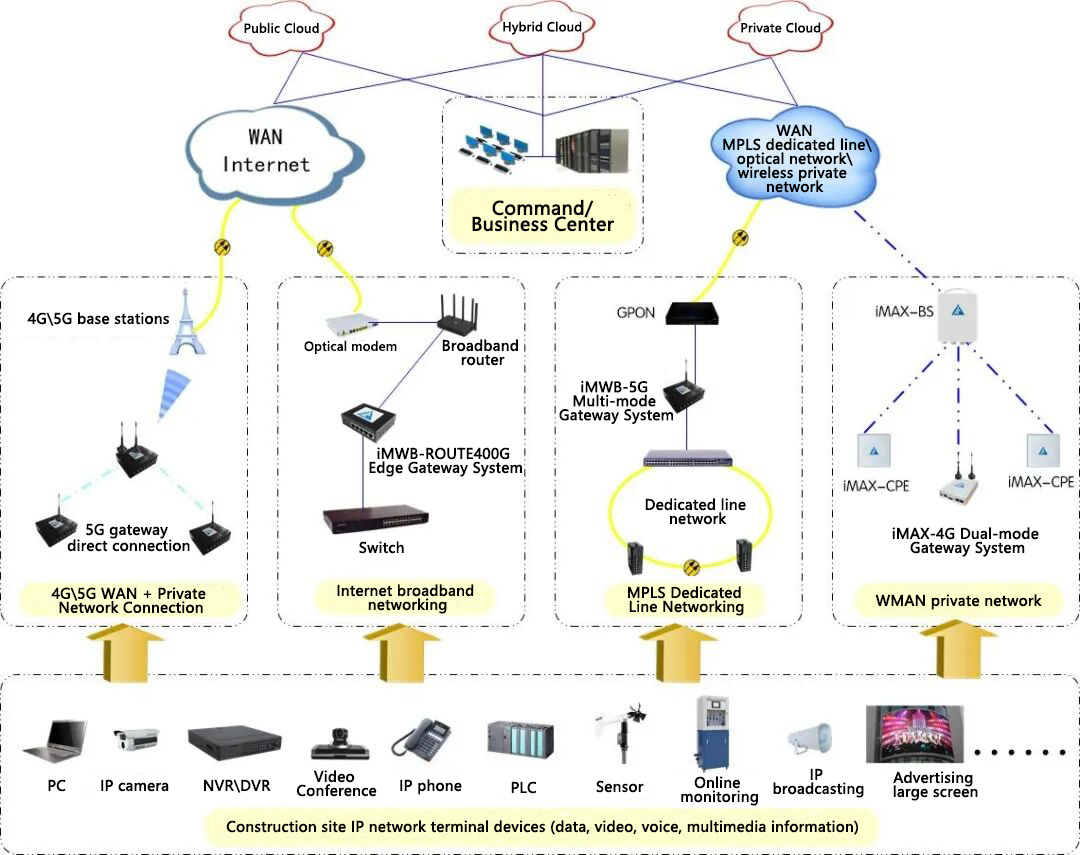
It should be emphasized that the iMAX-4GW300 also supports routing, firewall and VPN technologies, providing users with a variety of secure technical means to meet the security requirements of business networking, especially when connecting to the public network. Networking through this device can effectively prevent cyber security issues such as hacker intrusion caused by exposing services directly to the public Internet (unencrypted open access).
The two solutions mentioned above are complementary and can be designed in combination: the wireless metropolitan area network (WMAN) private network is suitable for on-site internal networking or large-scale urban networking at early warning sites, while the wireless wide area network (WWAN) is ideal for centralized networking of multiple distributed early warning sites.
Certainly, designing an optimal solution for the specific networking and management needs of early warning sites often requires repeated communication and on-site research with users. Leveraging its rich experience and solid technical capabilities, Guoxin Longxin will customize the most reasonable wireless networking solution for geohazard early warning systems for users (including regulatory authorities such as land and resources bureaus, work safety supervision bureaus and housing and urban-rural development bureaus).