
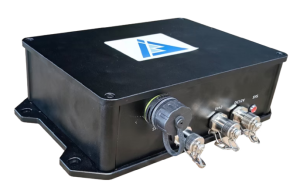
On May 11, 2026, Guoxin Longxin officially launched the iMAX-8000M multi-mode MESH ad hoc network wireless gateway.
Focusing on the long-standing technical bottlenecks and application drawbacks of traditional low-frequency MESH networking, the product features a brand-new architecture, multi-mode convergence, highly stable bandwidth and large-scale networking capability. It delivers a new generation of highly reliable private wireless network solutions for scenarios including emergency communication, underground utility tunnels, mine tunnels, and mobile satellite-on-the-move communication.
The reason why centerless mesh MESH technology is highly recognized by users is that in certain scenarios, any node can access the network as long as it meets communication conditions. There are no critical nodes within the network, and the offline status of any single node will not affect the normal operation of other network segments.
In addition, the MESH system features self-organizing, self-healing and self-adaptive capabilities, and supports networking in a multi-hop chain topology. While centerless mesh MESH technology sounds ideal, it still faces considerable challenges in practical deployment.
Currently, low-frequency MESH systems (typically 1.4 GHz, customizable to 300–700 MHz) are widely adopted, yet they can hardly meet the demands of modern private network communications and suffer from multiple critical inherent shortcomings.
Core Pain Points of Current Low-Frequency MESH Deployment:
Low Total Bandwidth
This is the fundamental bottleneck of low-frequency MESH. Although low-frequency bands boast strong non-line-of-sight (NLOS) transmission capability, available spectrum resources are extremely limited, resulting in insufficient bandwidth to support high-bandwidth services such as HD video, ultra-high-definition images, and radar imagery.
Take the 1.4 GHz band as an example. In compliance with national radio regulatory regulations:
- The dedicated downlink telemetry and image transmission band for domestic drones: 1430–1444 MHz
- Special band for police drones and helicopters: 1430–1438 MHz
- Civilian drone band: 1438–1444 MHz
- Government and emergency broadband private network band: 1447–1467 MHz (total 20 MHz, TDD mode)
The available spectrum is merely 14 MHz or 20 MHz in total, with the effective overall industry bandwidth only ranging from 20 to 45 Mbps, which severely restricts service bearing capacity.
- Severe Bandwidth Attenuation
Most low-frequency MESH devices adopt a single-frequency design (e.g., 1.4 GHz), with all terminals operating on the same frequency band. This leads to massive bandwidth loss during multi-hop relay transmission. Theoretically, bandwidth is halved with every hop. The already limited bandwidth becomes almost unusable after three hops. Moreover, as the number of networking nodes increases, routing computing pressure surges, causing further drastic bandwidth degradation. - Insufficient System Capacity
Low-frequency MESH systems have extremely poor capacity expansion performance, conventionally supporting only 32 to 64 wireless access nodes. This fails to meet the requirements of large-scale and wide-area networking. Restricted by scarce frequency resources, such systems cannot support concurrent high-demand services including HD video backhaul from multiple nodes, multi-channel data transmission, and real-time voice intercom. - Severe Frequency Interference
Low-frequency spectrum channels are overcrowded with severe electromagnetic interference. To improve NLOS performance and anti-interference capability, many manufacturers adopt an unprofessional and crude approach by simply increasing transmission power — a practice that harms the overall network ecosystem. This aggravates low-frequency interference and even causes system self-interference and internal signal conflict.
Due to the above issues, mutual interference frequently occurs in the practical deployment of low-frequency MESH systems, undermining overall operational reliability. It is common for the network to work stably in the morning but suffer unexplained interference and network latency in the afternoon.
Guoxin Longxin Magic Roam low-frequency MESH systems are mainly applied to emergency communication and drone scenarios, and inevitably constrained by the above bottlenecks in actual project implementation. We always prioritize on-site scenario research and planning design, refusing to promote mismatched systems blindly or recommend the simplistic solution of increasing transmission power to customers.
Nevertheless, technical optimization and empirical design cannot adapt to all application scenarios. Relying solely on traditional low-frequency MESH technology is like trying to hold a grand ritual inside a tiny snail shell, leaving these inherent technical problems long unresolved across the industry.
Addressing these pervasive industry pain points, Guoxin Longxin has launched the iMAX-8000M with comprehensive technological innovation, completely reshaping the traditional low-frequency MESH networking model.
Abandoning the conventional fixed BS-CPE communication framework of traditional microwave devices and breaking away from the limitations of the 1.4 GHz low-frequency band, the iMAX-8000M reconstructs the MESH system by adopting the 5 GHz golden frequency band for microwave communication and a multi-mode, multi-frequency, multi-link routing architecture.
Product Features and Technical Advantages of iMAX-8000M Gateway:
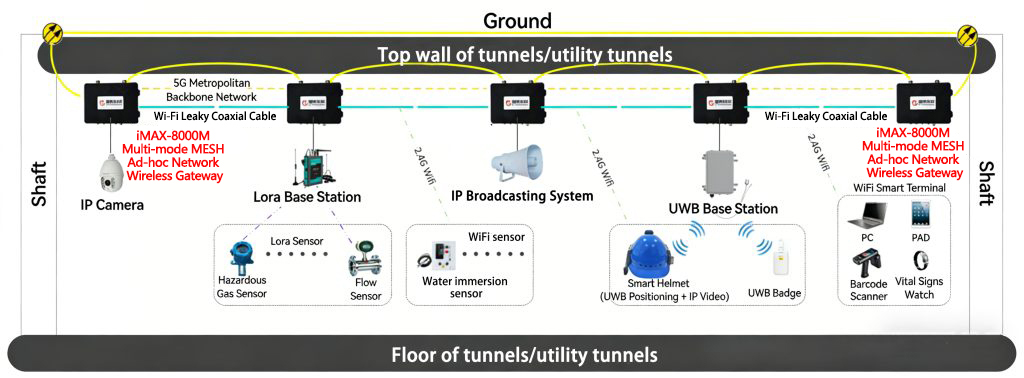
The iMAX-8000M supports centerless peer-to-peer networking and multi-ring network redundant architecture, enabling the flexible construction of multi-path transmission links. It fundamentally eliminates the risk of full-network disconnection caused by single-point failures at the underlying layer.
It also supports integrated networking of wireless MESH and optical fiber, perfectly matching closed chain scenarios such as tunnels, pipe corridors and underground roadways.
Benefiting from its multi-mode design, the iMAX-8000M achieves negligible bandwidth loss during multi-hop transmission. It is highly applicable to large-scale node networking and high-bandwidth service scenarios where traditional low-frequency MESH systems struggle to perform.
Thanks to the integrated application of multi-mode and multi-frequency technology, the product solves the pain point of bandwidth attenuation in multi-hop transmission. It realizes basically lossless bandwidth in long-distance and multi-node relay transmission, ensuring full-process high-bandwidth and low-latency communication.
The device supports flexible customization with four independent wireless modules. The standard configuration adopts dual 5G wireless MAN modules plus dual 2.4G Wi‑Fi modules. It can be replaced on demand with full 5G modules, or dual 5G wireless MAN modules plus dual 4G LTE modules. It also supports routing redundancy and hot backup, making it highly suitable for diverse scenarios such as ultra-high-reliability private network networking, and mutual hot backup between private networks and public network-based VPNs.
With powerful hardware performance, the single 5G module delivers up to 300 Mbps bandwidth, and the four-mode device achieves a peak total bandwidth of 1.2 Gbps, fully meeting the requirements of concurrent transmission of multiple services.
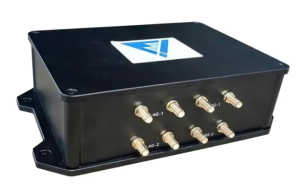
The gateway supports standard TCP/IP Ethernet expansion, enabling flexible access to services such as video and voice.
Adopting an industrial-grade rugged design with IP67 protection rating, it operates stably in an ultra-wide temperature range of -45℃ to +70℃. Aviation connectors withstand harsh working conditions including strong vibration and high corrosion.
Featuring low power consumption and lightweight design, the device is equipped with Gigabit Ethernet ports and LC fiber interfaces. It is compatible with IPv6 and various routing protocols, delivering easy installation and simple maintenance. Support for remote wireless management and firmware upgrade greatly reduces operational costs.
In terms of intelligent networking, the iMAX-8000M supports zero-configuration rapid deployment for plug-and-play and fast network establishment. Embedded intelligent algorithms including automatic channel selection, adaptive rate and intelligent distance learning enable adaption to all kinds of complex electromagnetic environments.
Leveraging self-healing link switching, VRRP virtual hot backup and data mirroring technology, the device achieves millisecond-level latency with a packet loss rate close to zero, ensuring sustained and stable network operation.
For security protection, the air interface adopts proprietary wireless communication technology with AES dynamic bit encryption. It integrates multiple security mechanisms such as MAC address filtering, firewall, DoS attack prevention, VPN tunnel protocol and VLAN isolation, providing comprehensive security for data transmission. It is fully applicable to high-security-level scenarios including military, police, emergency, government and enterprise applications.
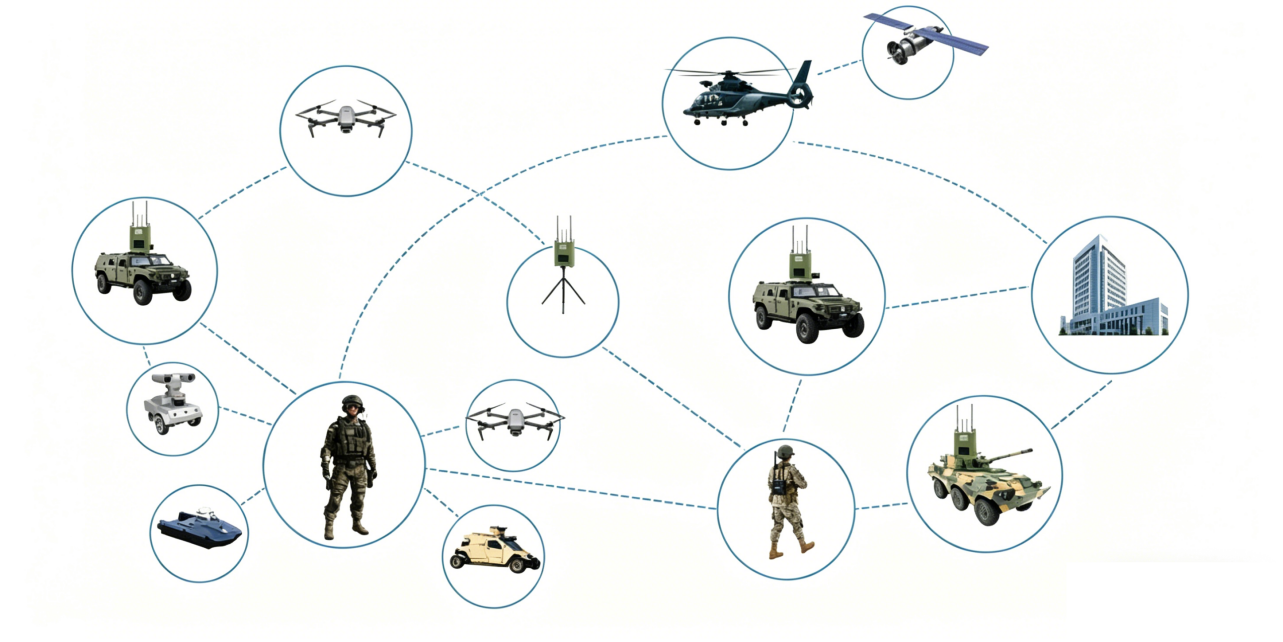
In terms of networking capability, the product breaks through the capacity expansion limit of traditional devices. It supports stable networking of more than 256 nodes, with a theoretical maximum of up to 65,535 nodes, capable of meeting the demands of ultra-large-scale networking and effectively reducing overall construction costs.
At present, the device is fully adapted to application scenarios including tunnel and pipe corridor infrastructure, mine roadway coverage, vehicle-mounted / ship-mounted / airborne on-the-move communication, emergency rescue, as well as military and police emergency communications. It comprehensively replaces traditional low-frequency MESH devices and provides a brand-new reliable option for the upgrading of industrial private network communication.
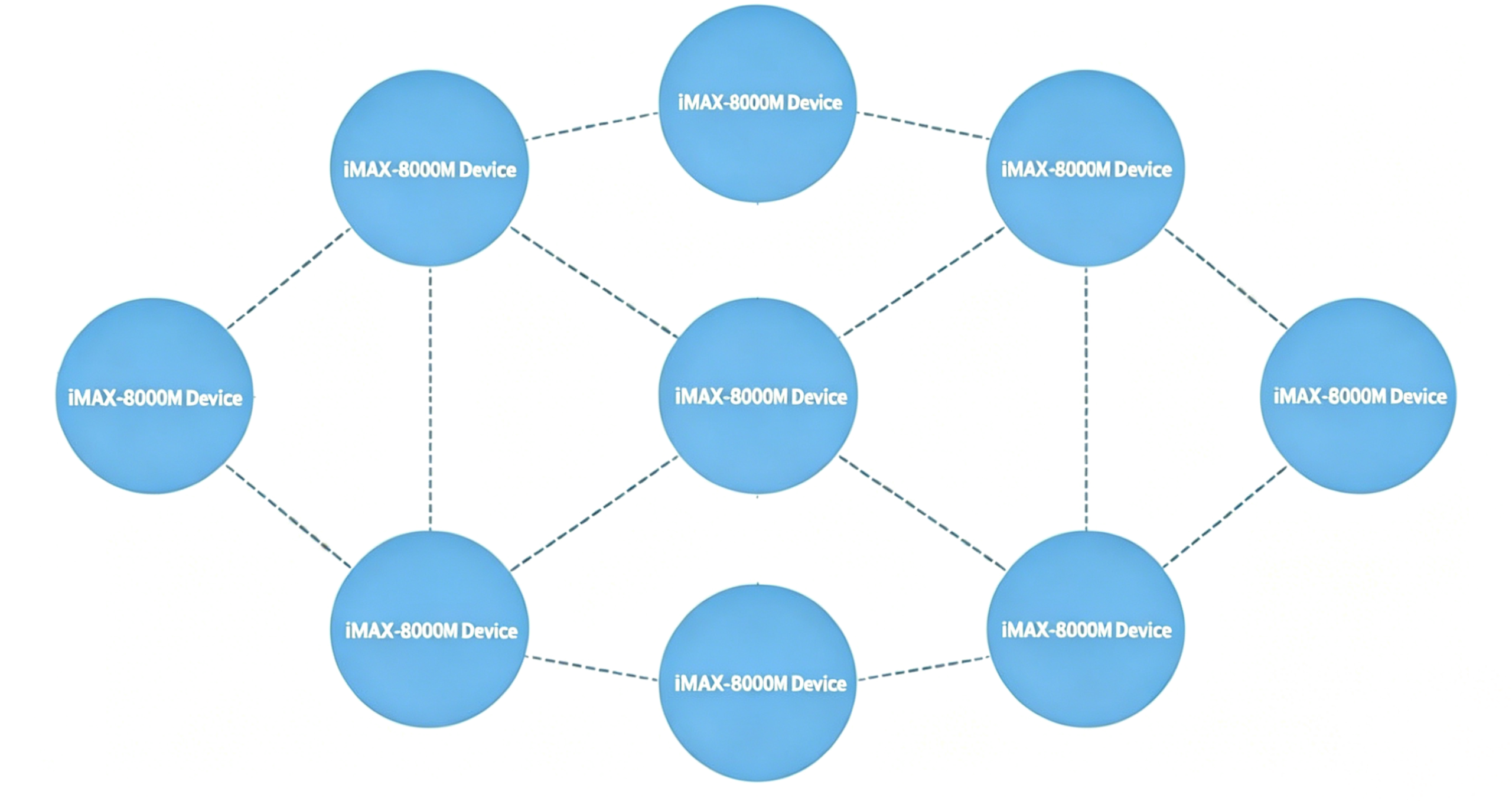
In terms of communication performance, under line-of-sight conditions over the 5 GHz private network, the iMAX-8000M gateway easily supports point-to-multipoint networking up to 10 kilometers. For on-the-move communication scenarios, it enables real-time high-speed networking for mobile nodes within a range of 2 to 8 kilometers.
In extreme scenarios with strong electromagnetic interference, the device relies on Guoxin Longxin’s Multi-Link Data Mirroring (MLDM) technology to enhance anti-interference capability and reduce packet loss and latency.
For more information about the iMAX-8000M gateway, please refer to the document iMAX-8000M Multi-Mode MESH Ad Hoc Network Wireless Gateway.
It is worth emphasizing that compared with traditional low-frequency MESH systems, the iMAX-8000M gateway also boasts obvious cost advantages. The product supports customized development and can provide OEM services for customers.
Innovation makes the world a better place. Guoxin Longxin always adheres to this vision, and takes Integrity & Innovation, Cooperation for Win-Win as our core corporate values.
Powerful in performance and functionality, the gateway is still being explored for adaptation to more application scenarios. We sincerely welcome system integrators and distributors with relevant demands to contact us and explore new business opportunities together.