
Amid the wave of digital transformation, government and enterprise demand for cross‑site networking and multi‑point interconnection has surged dramatically. Traditional private data lines come with high costs, while public clouds suffer from poor security and persistent high expenses. In contrast, 4G/5G networks feature extensive coverage and flexible deployment. Integrating SD‑CX cloud switching and virtual private network (VPN) technologies, Guoxin Longxin delivers a low‑cost and relatively secure networking solution. This article elaborates on the principles, advantages and applicable scenarios of the solution, helping government and enterprise users tackle networking challenges.

I. Traditional Government‑Enterprise Networking: Severe Pain Points — Sky‑High Costs
- Exorbitantly expensive leased‑line networking: Telecom operators charge high initial installation fees and extremely high monthly rent for dedicated lines. For example, a 10 Mbps cross‑city dedicated line from Wuhan to Beijing costs about 70,000 RMB per year from one operator. Even with discounted channels or large‑client privileges, the annual cost remains around 20,000 RMB. However, a 10 Mbps bandwidth only supports 2‑3 concurrent high‑definition video streams, far insufficient for high‑bandwidth services. Higher‑bandwidth requirements or scarce inter‑city link resources can push annual rent to hundreds of thousands or even millions of RMB, unaffordable for most government and enterprise entities.
- Unsecure public cloud interconnection: While third‑party public cloud relays enable node interconnection, they bring three major hidden risks. First, costs surge year‑on‑year, with long‑term bandwidth rent far exceeding expectations. Second, security is not guaranteed; core data hosted by third parties risks leakage of business secrets. Third, stability is poor. Shared platforms for multiple enterprises frequently suffer from network congestion and data loss.
II. 4G/5G + SD‑CX Private Cloud Solution — A Low‑Cost Virtual Private Network Scheme
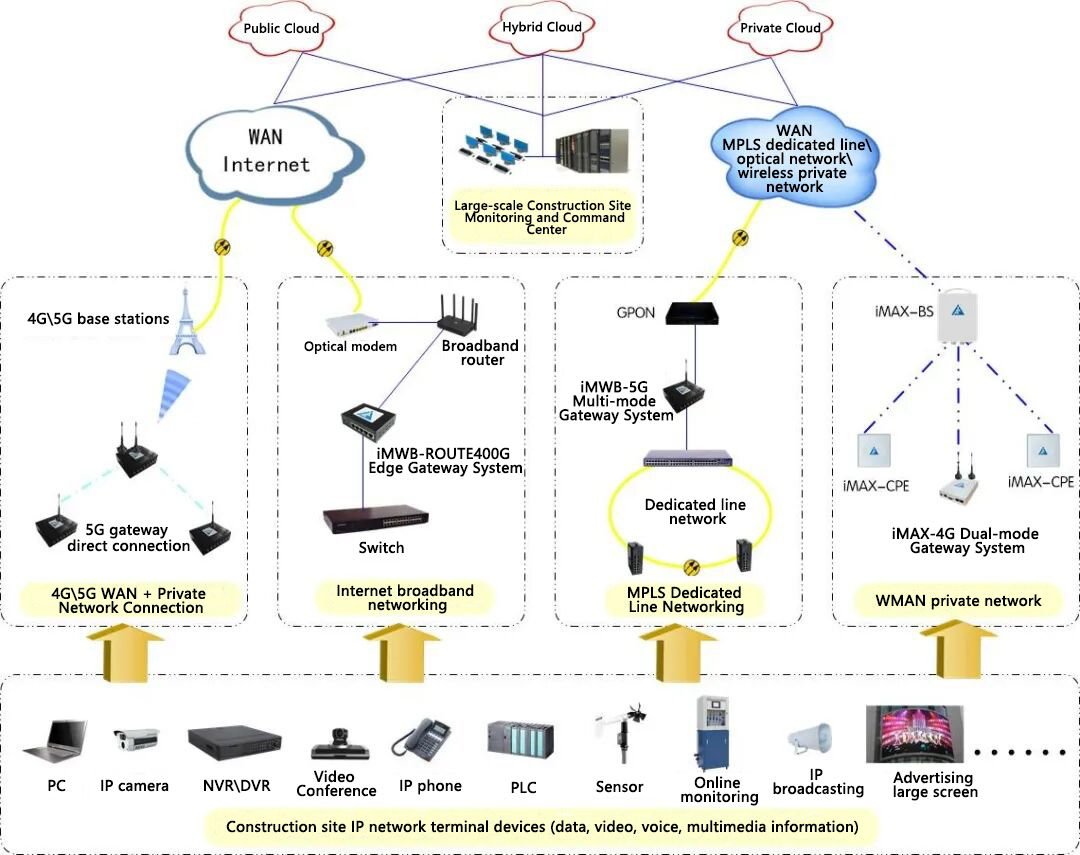
(I) Core Principle: Build Tunnels over Public Networks, Establish Private Networks via VPN
- Underlying Link — 4G/5G Public Network: Leverage full‑coverage operator 4G/5G networks as the basic data transmission channel. No self‑built optical cables are required, enabling flexible deployment and full coverage.
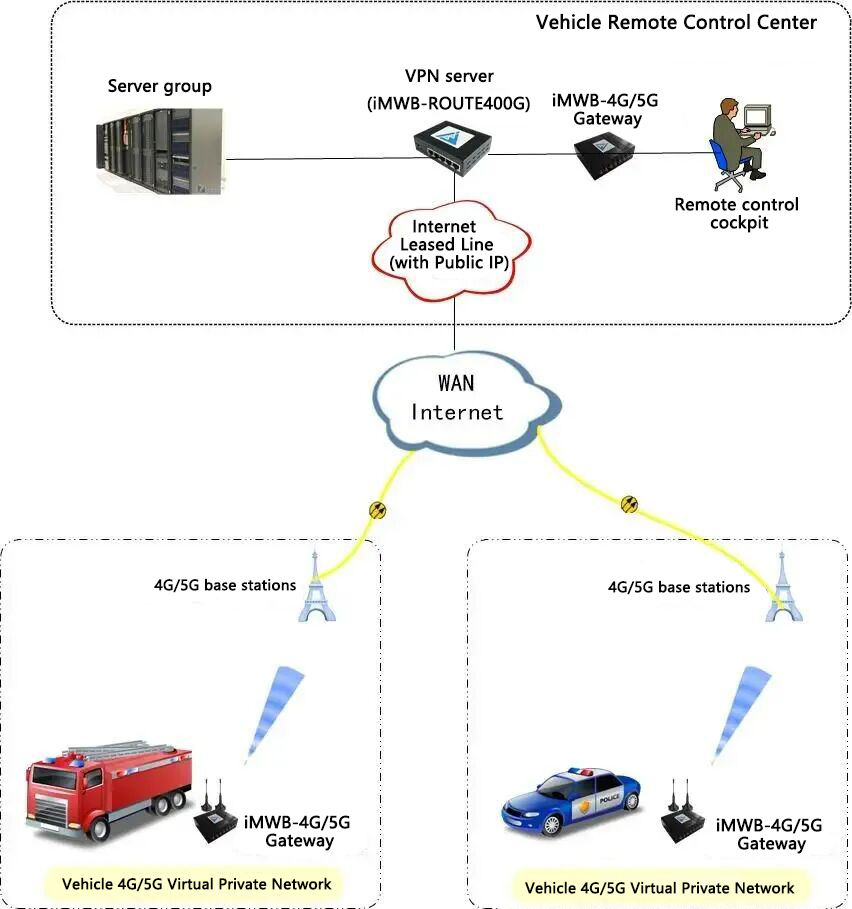
- Core Gateway — SD‑CX‑enabled VPN Gateways: Guoxin Longxin multimode gateways including the iMWB‑5GW2000D and iMAX‑4GW300 serve as the “traffic hubs” of the solution. Supporting 4G/5G access, Wi‑Fi 6 coverage or iMAX metropolitan area private networks, these gateways integrate VPN encryption functions to encrypt, receive, send and forward data from all nodes.
- Orchestration Core — Private Cloud Server: Enterprises build their own private cloud as the “brain” and data relay of the virtual private network. It centrally manages all nodes, allocates network resources and maintains encrypted tunnels for full independent control.
Coordinated operation of the three components forms a closed‑loop path:
Edge Node → SD‑CX Gateway → 4G/5G Public Network → Private Cloud → 4G/5G Public Network → SD‑CX Gateway → Edge Node.
Though traffic travels over public networks, it actually runs on exclusive encrypted “virtual private networks”.
(II) Schematic Diagram of Principles
(III) Key Technologies: SD‑CX Cloud Exchange and VPN Encryption to Build a Robust Security Barrier
- Data Encryption: Data transmitted between nodes is fully encrypted. Even when transmitted over public networks, it is difficult to steal or tamper with, eliminating risks of data leakage.
- Virtual Isolation: Exclusive virtual tunnels are partitioned on public networks. Government and enterprise nodes operate as if on the same local area network, fully isolated from other network users to avoid interference and attacks.
III. Prioritize Private Cloud — Outperforming Public Cloud in Cost, Security and Stability
(I) Drastically Reduced Costs: Only 1/3 or even 1/10 of Public Cloud Expenses
- Public Cloud: Billing is long‑term based on bandwidth and server performance, plus service fees. Annual rent for a 100 Mbps bandwidth server ranges from 80,000 to 120,000 RMB (varying greatly by operator and region), with charges likely to rise year by year.
- Private Cloud Solution: Enterprises purchase private cloud servers and apply for low‑cost internet leased lines from telecom operators (a 100 Mbps leased line with one public IP address generally costs about 10,000–20,000 RMB per year), which can be deployed in‑house.
(II) Maximum Security with Full Independent Control of Data
- Public Cloud: Data storage and transmission rely on third‑party platforms that control encryption keys, exposing core business secrets to leakage and misuse risks. Remote control scenarios also face hacking risks, with users having almost no means of implementing effective security measures.
- Private Cloud: Data is stored and transmitted entirely on the enterprise’s own hardware servers, with encryption keys managed independently and no third‑party involvement. Leveraging hardware‑based VPN encryption, it enables “data staying within the enterprise with full‑process encryption protection” to eliminate security hazards. Guoxin Longxin cloud servers also support software firewalls with customizable access policies to further defend against hacking. Even in the event of a breach, shutting down core SD‑CX cloud servers immediately disconnects the network, keeping data and system security under the user’s full control.
(III) Superior Stability Free from Lags and Disruptions
- Public Cloud: Servers rented on public cloud are shared among multiple enterprises, inevitably causing network congestion. High‑traffic periods often bring high latency, packet loss and data loss, disrupting normal business operations.
- Private Cloud: Dedicated embedded hardware servers and exclusive bandwidth resources eliminate external interference. Combined with intelligent scheduling by SD‑CX gateways, it delivers low network latency and packet loss rates, far exceeding public cloud in stability. It fits scenarios requiring high stability such as HD video transmission and real‑time data collection.
IV. Virtual Private Networks: Wide‑Ranging Scenarios for Diverse Government‑Enterprise Needs
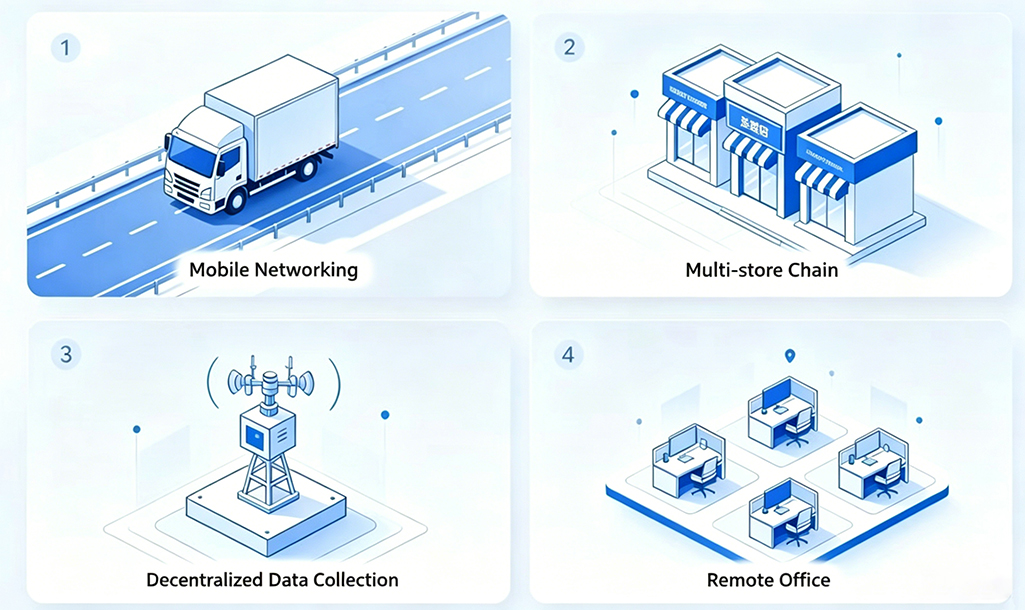
- Mobile Networking (Vehicles / Vessels / Drones):Cross‑regional mobile nodes such as hazardous chemical vehicles, logistics trucks and ships can access the virtual private network via 4G/5G to transmit real‑time location, video and operational data without third‑party platforms. This is a practical and cost‑effective solution.
- Multi‑Store Chain Networking:Chain supermarkets, catering outlets, brand stores and other retail locations across the country can interconnect via virtual private networks to carry billing, surveillance and office data. This replaces costly dedicated lines and saves hundreds of thousands of RMB in annual rental fees.
- Distributed Data Collection:For industries including environmental protection, water supply and electric power, monitoring points are widely scattered. Water quality, power data and video footage need to be transmitted back. The virtual private network supports low‑volume data and high‑definition video transmission with controllable costs and authentic, reliable data.
- Internet‑plus Operation / Remote Office Work:Scenarios such as smart parking, charging pile operation and cross‑regional collaborative office work can transmit billing, management and office data through virtual private networks. Replacing dedicated lines and public clouds, it enables wide‑area private network operation at low cost.
- Centralized Management of Leased Equipment:For large leased machinery such as tower cranes, elevators and construction machinery, shutdown measures may be adopted if fees cannot be collected normally. The above‑mentioned private cloud centralized management solution allows rapid on‑demand startup and shutdown of equipment.
- Remote Management of Network Devices:Various intelligent devices and systems generally support network management. Traditional manual inspection and network management incur high costs. By implementing remote networking via 4G/5G, staff can manage, debug and troubleshoot devices off‑site, significantly cutting labor costs. For details of the remote device network management solution, please refer to Networking Solution for Remote Network Management of Devices.
In summary, the above solution offers cost advantages for one‑way narrow‑band data acquisition systems, occasionally used non‑real‑time networking systems, or networking scenarios with low requirements for reliability, security and stability. For detailed solutions, please refer to 5G Virtual Private Network Solves Networking Challenges for Government and Enterprise Clients. Which scenarios are not applicable? See the following section.
V. View Limitations Rationally: Define Applicable Scenarios and Avoid Delivery Risks
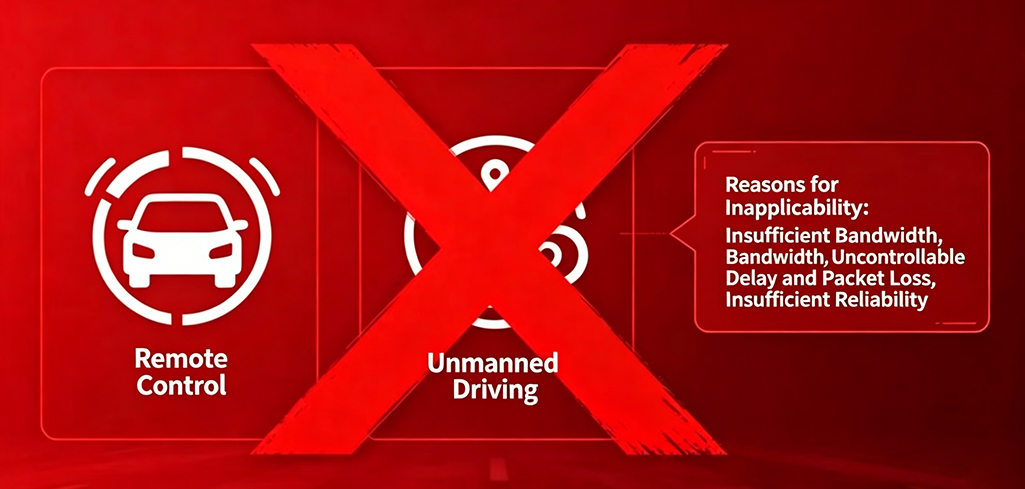
(I) Not Suitable for High‑Demand Real‑Time Scenarios: Remote Control & Autonomous Driving Are Not Recommended
- Insufficient Bandwidth: 4G/5G public network bandwidth fluctuates greatly and is inadequate during peak hours, failing to support the ultra‑high bandwidth required for remote control and autonomous driving.
- Uncontrollable Latency and Packet Loss: Public networks feature complex routing, especially cross‑regional links. Compared with physical dedicated lines, latency is hard to manage, and packet loss rate rises as links extend. For latency‑sensitive real‑time services such as remote control and autonomous driving (which demand strict millisecond‑level low latency and zero packet loss), performance will be unacceptable to operators.
- Poor Reliability: Public networks suffer from the “tidal effect”, with network congestion and even disconnection occurring during high‑traffic periods.
(II) Not Recommended as Primary Link: Constrained by Exorbitant Data Packages, Better Used as Auxiliary Hot‑Standby Link
- High data traffic costs: High‑definition video transmission consumes massive traffic. A single 1080P HD video stream generates 96–340 Gb of daily traffic, exceeding 1,000 GB monthly. Calculated at 1 RMB per GB for IoT SIM cards, monthly costs exceed 1,000 RMB. Thus long‑term use of 4G/5G as a primary link is financially unsustainable. Even if cost is not a concern, high‑bandwidth services are hard to support due to constraints on operator base‑station capacity and frequency resources.
- Heavy reliance on signal coverage: Service is unavailable in areas without 4G/5G coverage, such as remote ports, mines, industrial parks and riverways. Public networks are also less stable than dedicated lines. Therefore, virtual private networks are suitable only as auxiliary hot‑standby links. Internal private networks (wired LANs or wireless MAN private networks) are preferred for primary links. For cross‑site connections, operator point‑to‑point dedicated lines guarantee stable core business performance.