
Networking Solution for Flora and Fauna Protection in Nature Reserves
Lucid waters and lush mountains are invaluable assets. China is advancing a transformation toward green, eco – friendly and sustainable development. Protecting the ecological environment and biodiversity is tantamount to safeguarding productivity, while improving the ecological environment equates to boosting productivity. A sound ecological environment constitutes the most equitable public good and the most inclusive well – being for the people. The modernization we strive to build is one where humans live in harmony with nature. It not only aims to create more material and cultural wealth to meet people’s growing needs for a better life, but also to provide more high – quality ecological goods to satisfy their rising demands for a beautiful ecological environment.
General Secretary Xi Jinping stated, “Biodiversity bears on human well – being and serves as a crucial foundation for human survival and development.” Human survival and development are inseparable from healthy ecosystems. A thriving ecology underpins the prosperity of civilization. We must accelerate the establishment of a nature reserve system centered on national parks to effectively protect wildlife habitats and migration routes. We should continuously refine relevant laws and regulations, enforce strict supervision, crack down harshly on illegal activities such as overhunting and overfishing, and sever the illegal interest chains.

I. Overview of Networking Requirements for Nature Reserves
National parks and nature reserves are mostly located in remote mountainous areas, woodlands, deserts, rivers or wetlands. Protection of these areas not only plays a crucial role in preserving biodiversity, but also holds great significance for climate regulation, ecological barrier construction, tourism development and economic growth. Currently, leveraging modern science and technology to protect nature reserves such as woodlands, wetlands and mountainous areas has become a top priority for safeguarding rare wild animals and plants and the ecological environment.
Investigations show that most national parks and nature reserves across the country have built partial monitoring systems on varying scales. However, due to limited investment and extremely high construction difficulty, these systems fail to form a full-scale coverage and cannot meet the needs of comprehensive monitoring and protection at all. The main challenges hindering the construction of networked monitoring systems for rare wild flora and fauna protection are as follows:
- Vast coverage areaA key feature of nature reserves in mountainous and woodland areas is that remote, inaccessible regions are in greater need of ecological information monitoring and collection, resulting in scattered information nodes. It is common for adjacent nodes to be dozens of kilometers apart. Constructing a monitoring and protection system using conventional methods incurs exorbitant costs, is highly vulnerable to damage, and is even completely unfeasible in some cases.
- Diverse system typesVarious types of information collection require coordination of different systems (dual-spectrum video surveillance, wildlife protection cameras, perimeter electronic stakes, etc.). However, data transmission cannot be standardized, necessitating repeated construction of multiple transmission links, which drastically reduces cost-effectiveness.
- Difficult maintenanceIn sparsely populated reserves with scattered information nodes, the use of low-quality equipment will lead to enormous on-site maintenance costs in the later stage. This not only wastes a great deal of labor and time, but also seriously impairs the system’s operational effectiveness.
Specifically, the primary challenges in deploying monitoring systems in nature reserves are network connectivity for terminal information nodes and long-term power supply for equipment in field environments. With the maturity and popularization of solar power generation systems, the power supply issue has been resolved in many areas, yet network connectivity remains the biggest obstacle to the implementation of such systems. Is there a cost-effective solution to address the networking needs of nature reserves?
II. Comparison of Networking Solutions for Nature Reserves
Optical fiber-based networking, a common urban solution (either self-built or leased from telecom operators), is completely unfeasible for nature reserves, mainly for the following reasons:
- Difficult coordination with local farmersBoth underground pipeline laying and overhead pole erection for optical fibers require coordination with villages and farmers along the route. Underground installation needs shaft construction for maintenance, and pole erection can only be completed with the consent of landowners. Coordination with rural communities has become increasingly difficult nowadays. In addition to soaring one-time construction costs, some farmers demand annual “rent”, and failure to pay may even lead to extreme acts such as fiber optic cable damage.
- High vulnerability to damageOverhead fiber optic cable installation has a slightly lower cost than underground laying, but overhead open lines are easily damaged by passing vehicles, causing system network outages. Even underground cables may be broken due to rural construction and ditch digging, resulting in short-term or long-term outages. Natural disasters (flash floods, mudslides, etc.) and human factors such as theft and intentional cutting by lawbreakers also pose threats to cable integrity. Moreover, remote locations make damage repair more difficult, costly and time-consuming.
- Prohibitive construction costsThe material cost of optical fibers themselves is relatively low, but the costs of ditch digging, pipeline laying and pole erection have risen year by year due to surging labor costs and rental fees for excavators, cranes and other equipment. Construction costs often reach tens of thousands of yuan per kilometer, driving up the overall system cost. Laying optical fibers in mountainous, woodland and wetland nature reserves—regardless of policy permission—may cost several times more than urban construction, with the exorbitant expense of tens of thousands of yuan per kilometer far beyond the affordability of IT systems.
- Long construction cycleOptical fiber construction via ditch digging, pipeline laying or pole erection is extremely challenging, especially in rural and remote field areas. Construction often takes months or even years, and the laid cables may be damaged before project delivery.
- Damage to primitive ecologyOptical fiber construction disturbs and damages the primitive ecosystem, even affecting animal activities and plant growth. A system built to protect flora and fauna resources that causes ecological damage through wired deployment defeats the purpose of protection and must be avoided. Eco-friendly communication and power supply methods, represented by wireless networking and solar energy as new energy sources, are the optimal choice.
In summary, optical fiber networking is characterized by high cost, long construction cycle, poor post-operation usability and maintainability, which reduce the overall reliability and availability of the system. Obviously, wireless communication systems offer distinct advantages in nature reserves and national parks—short construction cycle, easy deployment, low cost, and convenient upgrade, expansion and maintenance.
Some may worry about the reliability of wireless systems. In fact, both wireless and optical communication systems have strengths and weaknesses, with high, medium and low-end configurations available. A truly professional wireless communication system is equally reliable and stable, even more so than optical fiber links in some cases. Wireless technology is undoubtedly the lowest-cost, fastest and most efficient solution, yet the key question is: which wireless technology is the most suitable for this project?
4G/5G public wireless network technology, a popular current solution, is completely unfeasible for nature reserves. Users familiar with nature reserve environments are well aware that limitations such as poor operator base station coverage, insufficient base station access bandwidth, prohibitive long-term data traffic costs, public network security risks and network “tidal effect” render 4G/5G technology inapplicable to such projects.
WiFi technology, another branch of wireless communication, has developed rapidly and become an ideal LAN extension system. However, using 2.4G/5.8G WiFi systems to build metropolitan area networks has inherent drawbacks: short communication distance and insufficient video transmission capacity, which make it impossible to meet the networking needs of nature reserves.
Combining years of experience in wireless networking for field areas in scenic spots, parks, water conservancy, petroleum and other industries, Guoxin Longxin has developed the most suitable wireless private network solution for wildlife protection in nature reserves. The core of the solution is the application of the iMAX 5G wireless metropolitan area private network:
The iMAX wireless metropolitan area network system is designed to enable ultra-long-distance network interconnection in outdoor environments, with all product series supporting extended communication ranges. For field backbone communication networks, the portfolio includes the iMAX-6000; for access networks, it covers multiple iMAX-8000 series products. In addition, the outdoor special dual-mode WiFi gateway iMAX-AGC600 system can provide WiFi connectivity for various WiFi terminal devices within a few hundred meters of information nodes.
✅ Communication Range
Under line-of-sight conditions, even the compact iMAX 5G dedicated communication system with integrated antennas can easily achieve 10 km or even 30 km radius coverage in edge access point-to-multipoint mode with the iMAX-8000; the iMAX-6000 supports point-to-point communication up to 100 km without relays. The superior communication range perfectly addresses the challenges of vast coverage and scattered nodes in nature reserves.
✅ Excellent Compatibility
Based on the universally adopted TCP/IP protocol interface, the system provides open interfaces for various other platforms and systems (video, data, voice, etc.) at field information nodes, enabling plug-and-play functionality. It also supports protocol conversion devices for platforms without IP network interfaces, effectively resolving the problem of interface standardization for diverse information systems.
✅ High Cost-effectiveness
The iMAX wireless metropolitan area network system requires a one-time investment with no subsequent rental or data traffic fees. It delivers the same reliability and stability as optical fiber networks for nature reserve construction, but at 1/5, 1/10 or even lower cost, offering exceptional cost-effectiveness.
✅ Superior Stability
The products have been validated through years of application in field projects such as water conservancy, port operations, forest fire prevention and petroleum exploitation, making them suitable for nature reserves and national parks. With protective measures against extreme outdoor temperatures, water and lightning, the system avoids the problems of frequent maintenance caused by low-end equipment and scattered nodes, ensuring long-term stable and reliable operation.
For special scenarios—such as densely vegetated areas with severe radio signal obstruction, a small number of nodes, and low-bandwidth services dominated by image transmission from wildlife protection cameras—the Huanyou low-frequency MESH wireless system is recommended. This product features superior non-line-of-sight (NLOS) capability, making it ideal for forested areas with heavy signal obstruction.
III. Design of Networking Solution for Nature Reserves
The iMAX 5G wireless metropolitan area network system is a highly customized solution tailored to user-specific needs. This bespoke model minimizes uncertainties and ensures the reliability, security and practicality of the system for users.
The iMAX wireless metropolitan area network system not only meets basic broadband network connectivity needs, but also supports diverse services including HD video surveillance, real-time monitoring data transmission, voice broadcast for intrusion deterrence, wildlife protection camera access, and fire and flash flood early warning. This transforms the traditional way of acquiring field monitoring information. Constructing a wireless private network system for field monitoring and protection in nature reserves benefits numerous relevant institutions, as follows:
- Biodiversity ProtectionScientific research institutions can conduct real-time ecological monitoring and data collection, providing accurate and timely data support for biodiversity research, protection and management decisions.
- Resource ProtectionNature reserve management and security personnel can promptly detect pollution, poaching, illegal logging, environmental damage and natural disasters through real-time video surveillance and environmental monitoring, and take immediate measures to minimize damage.
- Disaster Prevention and MitigationEmergency management departments can identify fire hazards and outbreaks via video surveillance, and deploy manpower and resources for timely fire suppression to avoid severe losses. The system also enables early detection of flash flood, mudslide and other natural disaster risks, facilitating prompt response to protect the lives and property of nearby residents.
- Scenic Area ManagementMany nature reserves (wetlands, mountainous areas) are also tourist attractions. Without effective visitor management, uncivilized behaviors of some tourists may threaten the reserve’s ecological environment. Scenic area management offices or tourism bureau staff can build a “digital scenic area” system through this solution, upgrading the modernization and technological level of scenic area management.
Guoxin Longxin’s wireless metropolitan area private network solution is an integrated multi-network, multi-functional solution that resolves the most fundamental and challenging issue in IT system construction for nature reserves—network connectivity. It is undoubtedly the optimal choice for IT system development in nature reserves.
Solar power supply is available for monitoring and information nodes in nature reserves, and Guoxin Longxin’s lithium solar power supply system forms a perfect combination with the wireless private network system. For details, refer to the product documentation of the iPower2000 Lithium Solar Power Supply System in the Product Center.
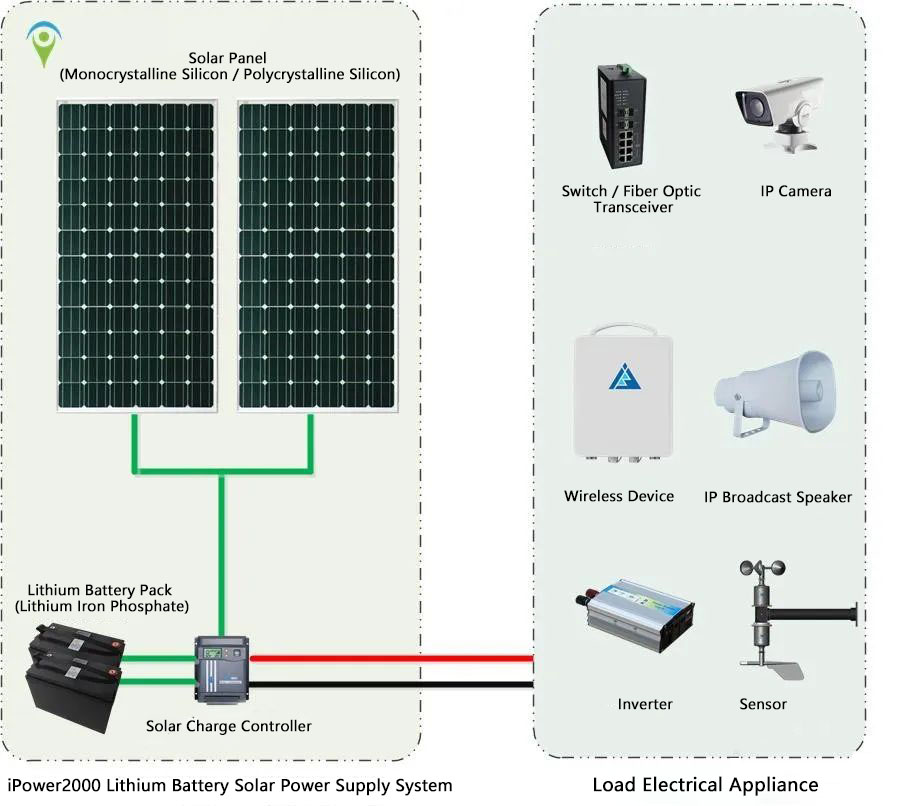
All electrical devices at various information points in the nature reserve can be centrally powered for long-term operation.Once the power supply challenge is resolved, and the network is established with a wireless metropolitan area private network system (e.g., the iMAX 5G wireless metropolitan area private network and the Huanyou low-frequency MESH communication-on-the-move system) to address connectivity issues, half the battle for the intelligentization and informatization of the nature reserve is already won.
Taking the video surveillance system of a nature reserve as an example, the schematic diagram of a typical nature reserve surveillance system is as follows:
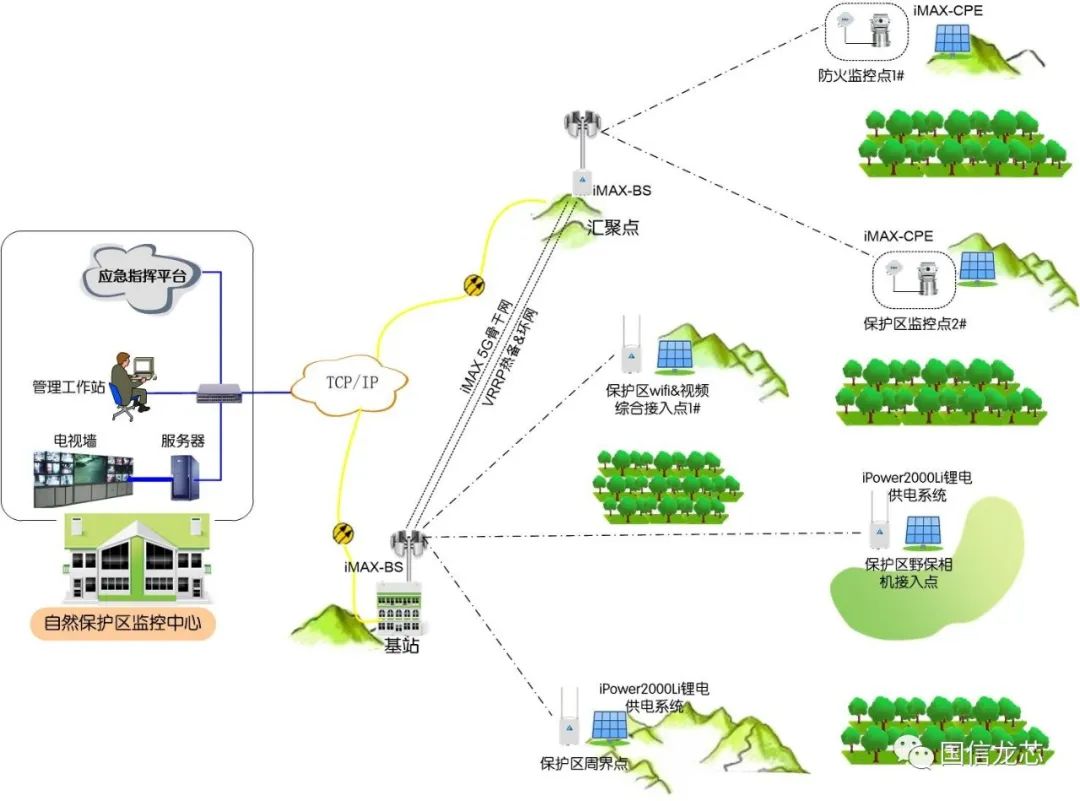
The backbone network of the iMAX 5G wireless metropolitan area network system is typically constructed with high-reliability technologies such as VRRP, delivering superior system reliability. The access network segment supports not only a point-to-multipoint architecture, but also cross coverage by multiple base stations and hot backup redundancy, further enhancing system availability. Such high reliability is particularly critical for field deployment scenarios where installation and maintenance are both inconvenient.
In addition, if customers adopt the outdoor special dual-mode WiFi gateway iMAX-AGC600 system, it can not only achieve long-distance backhaul connectivity at the 10–20 km level, but also provide short-distance WiFi coverage within a hundred meters simultaneously, thereby enabling network connectivity for multiple wildlife protection cameras within a 100-meter radius. This is an innovative system developed by Guoxin Longxin, ideally suited for nature reserve and scenic area applications.
In summary, protecting rare flora and fauna resources is a merit for the present age and a benefit for centuries to come, and building ecological civilization is a millennia-long strategy for the sustainable development of the Chinese nation. The nature reserve monitoring and protection management system provides an all-time, all-weather, uninterrupted, scientific, systematic, real-time and visual integrated management approach for nature reserves. Guoxin Longxin’s wireless metropolitan area private network solution can be custom-designed according to the specific environmental conditions and actual needs of individual users.
订阅评论
登录
0 Comments
最旧
最新
最多投票
内联反馈
查看所有评论