
With the vigorous growth of the marine economy and rapid expansion of industries including offshore‑oil‑gas exploitation, offshore wind power, ocean engineering and near‑shore operation & maintenance, offshore operation platforms have become core operational carriers for marine energy development, offshore engineering construction and sea‑area safety operation & maintenance.
Various fixed offshore platforms, mobile offshore platforms and offshore operation‑and‑maintenance stations undertake critical functions such as oil‑gas production, energy‑equipment monitoring, sea‑area patrol inspection, emergency response, and data collection & transmission. They serve as infrastructure hubs connecting land‑sea energy production and enabling large‑scale exploitation of marine resources. Unlike on‑land operations, offshore work is performed far from shore amid complex environments and special operating conditions, generating extreme demands for communication stability, security, full‑coverage capacity and mobile access capability.
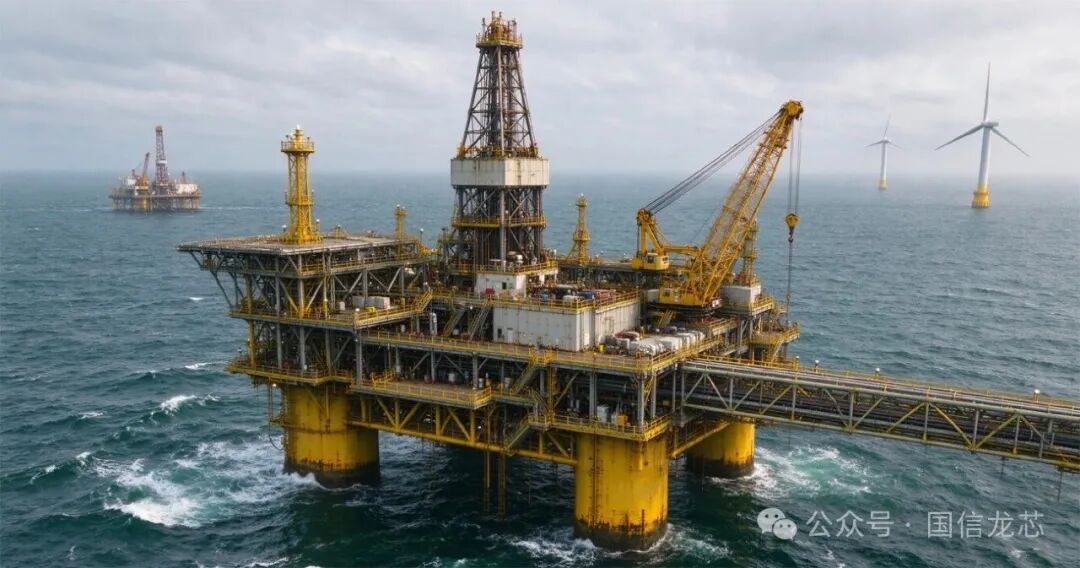
In terms of market scale, China’s offshore oil‑gas, offshore wind power and ocean‑engineering‑equipment markets maintain rapid growth, and the deployment density of near‑shore and open‑sea operation platforms rises year‑by‑year. Driven by the Smart Ocean and Digital Ocean strategies, the traditional extensive manual offshore operation mode is accelerating its transition toward digitalization, intelligence, unmanned operation and remote control. New services such as massive sensor devices, high‑definition surveillance, unmanned patrol inspection, remote central control and ship‑borne mobile networking are being widely deployed, forcing offshore communication networks to upgrade from an “auxiliary tool” to a core production foundation.
The industry development trend is clear: future offshore operations will inevitably adopt an intelligent operating mode featuring full‑domain private‑network coverage, land‑sea interconnection, air‑sea integrated collaboration and full‑link redundant backup. Stable, dead‑zone‑free, mobile‑capable and highly‑reliable wireless private networks will become mandatory standard equipment for all smart offshore operations. They also constitute a core instrument for avoiding offshore operational safety risks, improving production efficiency and cutting operation‑and‑maintenance costs.
For offshore‑platform operations, communication outages equal production risks. Nevertheless, offshore‑platform networks face many practical challenges.
Communication networking for numerous offshore operation platforms has long been caught in a dilemma. Many operators believe networks are fully reliable once submarine optical cables are laid. However, submarine cables can suffer damage triggered by seabed displacement, fishing‑boat anchoring or reef abrasion, which will paralyze the entire link instantly. If relying solely on microwave backhaul without professional design, link fluctuations will occur under heavy fog, torrential rain, salt‑fog and strong sea winds.
Inside platforms, dense steel‑frame structures and metal walls severely block wireless signals. Dynamic movement exists between platforms and among support vessels. Air‑to‑ground communication frequently drops after inspection UAVs take off.
Public‑network signals cannot reach open‑sea areas. Satellite communication suffers exorbitant bandwidth costs, high latency and extremely low throughput, making it difficult to support multimedia services such as high‑definition video, equipment sensor data and group intercom.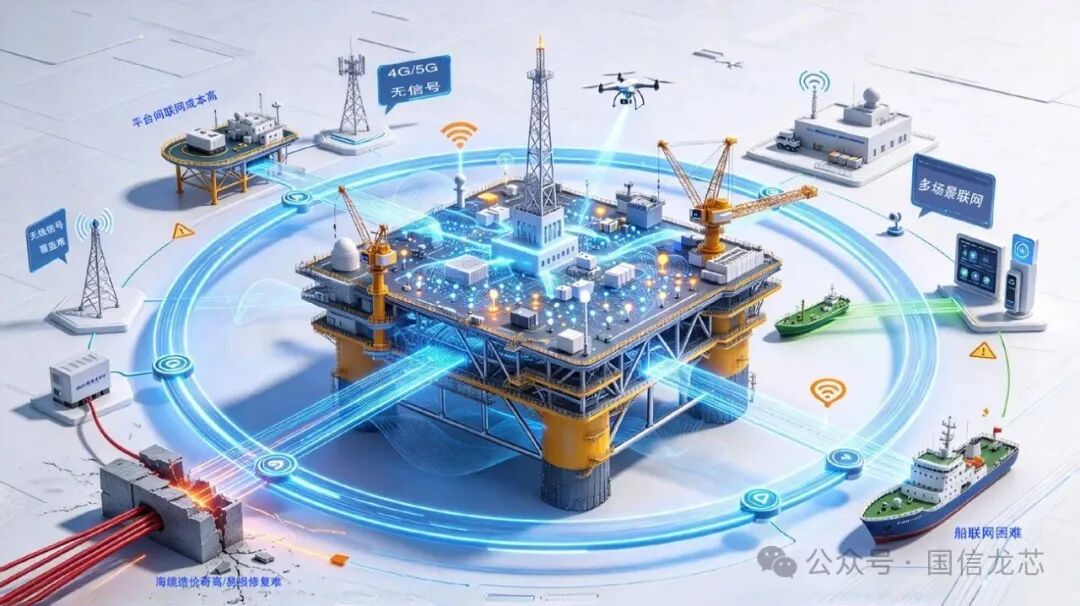
In short, the conventional single‑cable networking model can no longer satisfy service requirements for smart offshore operations.
How to build an offshore‑platform wireless private network with dual‑redundant backbones, inter‑platform interconnection, in‑depth intra‑platform coverage and air‑sea integration?
I. Overall Networking Idea: Four‑Layer Three‑Dimensional Private‑Network Architecture
The whole network is divided into four layers: land‑to‑platform backbone backhaul layer, inter‑platform aggregation & ship‑borne mobile networking layer, intra‑platform local area network coverage layer, and air‑ground UAV ad‑hoc network layer.
Instead of simply depending on one single transmission medium, fiber optics, high‑frequency microwave, metropolitan private network, leaky cable, WiFi and low‑frequency MESH work in coordination to form a multi‑layer three‑dimensional offshore wireless private‑network system.
1. Land‑to‑Offshore‑Platform Backbone: Submarine Optical Cable + FibeAIR Microwave + iMAX Private Network — Triple‑Link Redundancy
Many projects deploy submarine optical cables without building wireless backup links. Precisely this practice creates major hidden risks.
As the primary backbone link, submarine optical cables deliver high‑bandwidth stable backhaul for platform production SCADA data, surveillance video and office services.
Once a submarine cable is damaged by external forces, backhaul of platform production data will be interrupted, and on‑site command as well as remote monitoring will fail entirely. Cable repair often takes several days.
Deploying wireless private networks as hot‑standby redundancy for optical cables represents the most common and cost‑effective industry practice. Please refer to Avoid Pitfalls in Ring‑Network Redundancy for Optical Cables! Wireless Private Networks Are Reliable Alternatives.
This solution deploys FibeAIR high‑frequency microwave and iMAX wireless metropolitan private network. Both wireless links serve as geographically‑separated wireless backups for submarine cables.
■ Normal operating conditions: Submarine optical cables bear major backhaul traffic; FibeAIR microwave and iMAX private‑network links stay in hot‑standby status, monitoring link quality in real‑time and undertaking partial information flow for load balancing.
■ Upon submarine‑cable failure: Services automatically switch to the dual wireless links. Redundancy is further realized between FibeAIR and iMAX at the wireless level.
■ When salt‑fog or severe convection attenuates high‑frequency microwave links: Services are automatically diverted to the intermediate‑frequency iMAX private‑network wireless backbone. Although bandwidth is somewhat impacted, service continuity is guaranteed.
Typical application schematic diagrams are available below: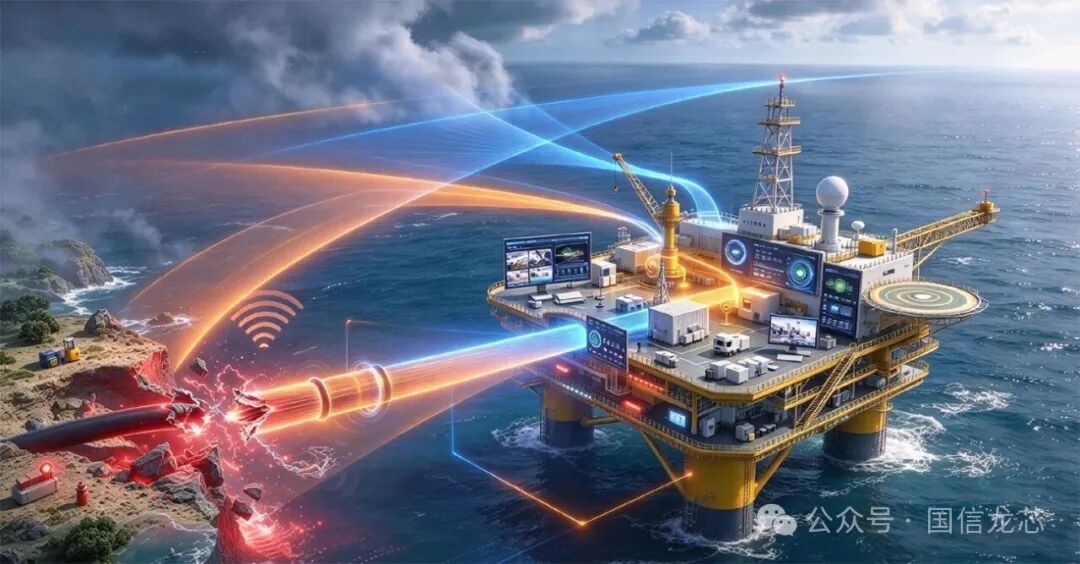
Core value of the backbone layer: Network continuity is maintained even if submarine cables break. Total communication paralysis of offshore operation platforms caused by submarine‑cable damage is prevented.
2. Inter‑Platform Aggregation & Ship‑Networking: iMAX Metropolitan Private Network Building the Foundation for Offshore Mobile Private Networks
Within a sea area, multiple offshore operation platforms and oil‑production platforms are usually distributed, along with dynamically operating work vessels, supply ships, floating production‑storage‑offloading units, maintenance vessels and emergency‑rescue ships.
It is impractical to lay short‑distance submarine branch cables between all platforms due to high construction costs and great subsequent maintenance difficulties. Fixed fiber optics cannot accommodate real‑time access for constantly moving work vessels.
To address these demands, the iMAX wireless metropolitan private network is preferred for wireless aggregation and networking between offshore platforms. Interconnected high‑bandwidth ring networks are constructed to guarantee reliability and stability of inter‑platform networking.
iMAX private‑network base‑station systems are deployed on major large‑scale offshore platforms, while remote CPE terminals are installed on surrounding platforms. Alternatively, the multi‑frequency multi‑mode MESH system iMAX‑8000M can be directly adopted for ring‑network construction, realizing high‑speed inter‑platform interconnection and forming the backbone of regional offshore private networks. Schematic diagrams for typical platform‑cluster private‑network setup and ship‑networking applications are shown below: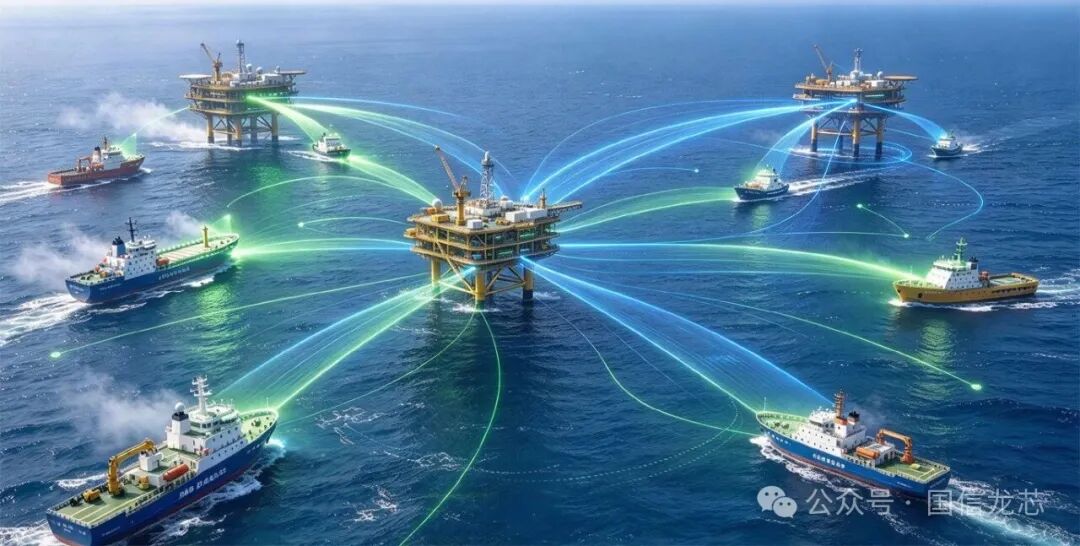
Inter‑platform networking belongs to internal networks with stringent requirements for reliability, safety and stability — which are exactly the core strengths of the iMAX wireless metropolitan private network. For detailed information, please visit the official website or the Technical Center section on our official WeChat account, including two‑episode video tutorials on Wireless Private‑Network Security.
Meanwhile, the iMAX private network supports moving‑via‑satellite access via ship‑borne mobile CPE terminals. When maintenance ships, supply vessels and emergency work ships navigate across platform‑cluster waters, terminals achieve seamless roaming among multiple base stations. High bandwidth enables real‑time access of on‑board surveillance, voice intercom and operational data to offshore private networks.
Based on this solution, closed‑loop data private‑network transmission for “ship‑to‑platform‑to‑land” ship networking can be completed without costly satellite services. If vessels are equipped with integrated communication‑sensing terminals, high‑precision Beidou positioning and motion‑attitude perception (heading, speed, etc.) for vessel dispatching and management can also be fulfilled. See Solutions for Vessel Networking, Positioning and Intelligent Control.
Data generated inside platform clusters is preferably exchanged within offshore private networks. Partial information such as high‑definition surveillance video can be stored locally and retrieved on demand instead of being fully transmitted back to land, easing bandwidth pressure on backbone links.
3. Intra‑Platform Local Area Network: WiFi + Medium‑&‑High‑Frequency Leaky Cables — Resolving Signal Blind‑Zone Challenges on Steel‑Frame Platforms
Offshore operation platforms feature typical metallic steel‑structure environments. Thick steel plates, pipelines and equipment steel frames strongly shield ordinary wireless signals.
After conventional AP deployment, signal black holes emerge in numerous interlayers, pump rooms, lower walkways and corners of equipment decks, frequently triggering wireless disconnections for inspection personnel, on‑site sensors and explosion‑proof cameras.
A hybrid coverage solution combining BreezeAIR industrial WiFi or iMAX‑8000M multi‑mode MESH systems with medium‑&‑high‑frequency leaky coaxial cables delivers excellent performance for intra‑platform local area networks.
Customized industrial explosion‑proof APs are deployed on open decks for access by operators’ handheld terminals and mobile monitoring devices.
Medium‑&‑high‑frequency leaky cables are laid in narrow interlayers, equipment corridors and enclosed pump houses. Leaky cables radiate wireless signals along their length, providing continuous coverage along narrow passages and eliminating signal blind zones caused by steel‑structure obstructions. For technical and application introductions of medium‑&‑high‑frequency leaky cables, please refer to Wireless Private‑Network Solution for Medium‑&‑High‑Frequency Leaky Coaxial Cables.
On‑platform production sensors, explosion‑proof cameras and handheld intercom terminals uniformly connect to the local private network; intra‑network data is then uploaded to backbone devices on the corresponding platform.
Due to structural complexity, traditional WiFi requires massive APs to realize wireless coverage for decks, cabins and narrow corridors while still failing to eliminate all blind spots. Guoxin Longxin’s wireless‑LAN solution based on medium‑&‑high‑frequency leaky cables achieves full‑near‑zero‑blind‑zone coverage with only one‑third or fewer devices. It supports digital on‑site inspection, equipment status collection, on‑site video backhaul and other services.
Schematic diagrams for typical intra‑platform coverage combining WiFi and medium‑&‑high‑frequency leaky cables are presented below.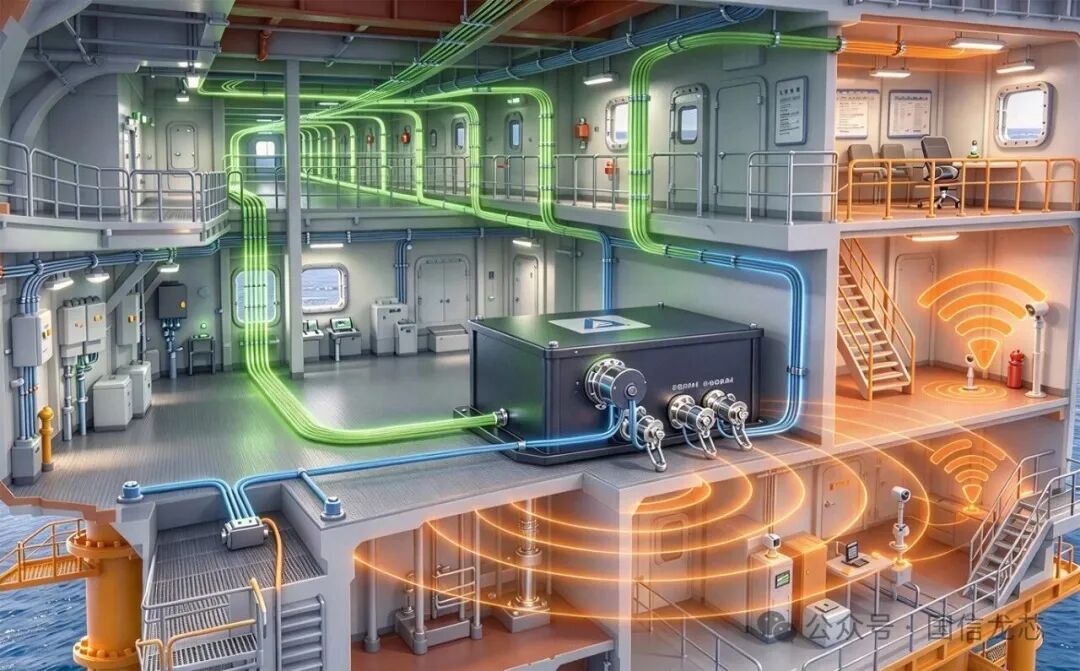
Important note: Given the high‑salt‑fog, flammable‑and‑explosive environment on offshore platforms, WiFi APs must adopt customized explosion‑proof and anti‑corrosion specifications, and cabinet salt‑fog protection must be implemented.
4. Air‑Ground Inspection: Huanyou Low‑Frequency MESH System Supporting Communication for Offshore UAV Operations
UAVs are widely deployed in current offshore‑operation scenarios for deck inspection, pipeline patrol, sea‑area oil‑spill monitoring and emergency disaster investigation.
Conventional video‑transmission links feature short communication ranges. For large‑area offshore inspection missions, connecting UAVs via operator‑provided 4G/5G is impractical: it incurs high costs and often lacks signal coverage entirely.
For offshore platforms deploying medium‑to‑large‑size UAVs, the Huanyou low‑frequency MESH ad‑hoc network system is dedicated to establishing air‑to‑ground UAV communication links. MESH base‑station nodes are installed on platforms, while airborne MESH terminals are mounted on UAVs.
Leveraging non‑line‑of‑sight transmission advantages of low‑frequency bands, UAV operating radii can extend to 10 km or even 20 km while maintaining stable communication links, fully meeting inspection requirements for medium‑and‑large‑size UAVs.
The Huanyou system supports center‑free ad‑hoc networking among multiple UAVs. Inspection UAVs can exchange data with one another and interconnect with MESH nodes on offshore work vessels to serve as data relays for other MESH nodes.
High‑definition inspection video and infrared temperature‑measurement data are transmitted in real‑time to local platform command rooms, and can also be relayed to on‑shore central‑control centers via the iMAX private network or microwave links.
During offshore emergencies, UAVs can take off rapidly and act as aerial communication‑relay nodes to temporarily expand offshore‑private‑network coverage and efficiently support offshore rescue‑and‑relief operations.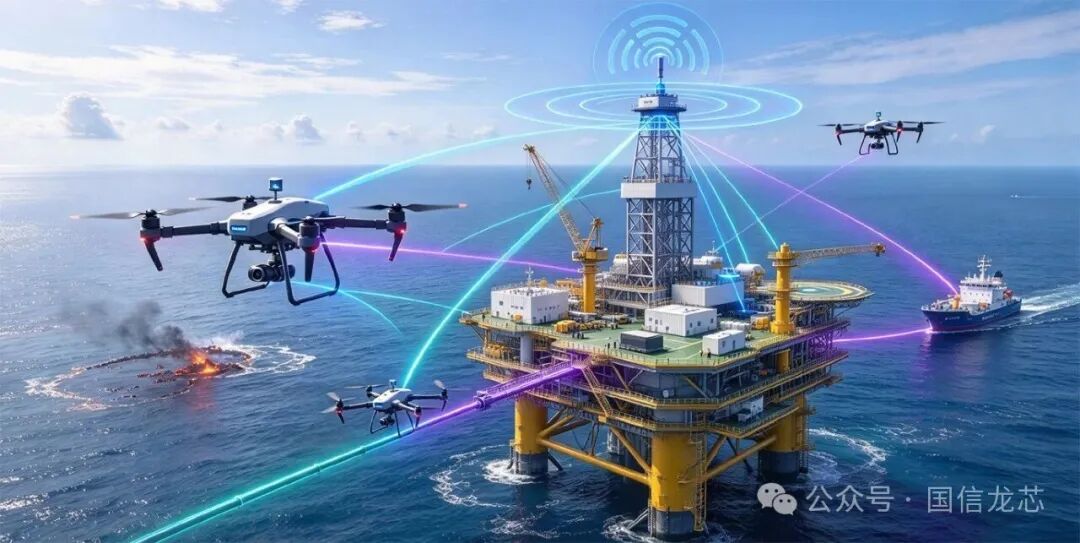
If UAV hangars are adopted on offshore platforms, only the iMAX private network is required for hangar networking; built‑in links between hangars and UAVs can be utilized directly. For more ideas about UAV networking, see How to Network UAVs?.
II. Complete Service‑Flow Logic
■ Field side: Data collected by on‑platform sensors, explosion‑proof cameras, inspection handheld terminals and UAVs enters the platform local area network through leaky cables and industrial WiFi.
■ After local aggregation on platforms, data is transmitted back to land over three paths: submarine optical cables (primary); FibeAIR high‑frequency microwave plus iMAX wireless metropolitan private network (the two wireless links back each other up and together with optical cables form hot‑standby redundant ring networks).
■ Maritime mobile services: Work vessels access offshore private networks via iMAX mobile CPE terminals; UAVs establish air‑ground communication via the Huanyou low‑frequency MESH system. Data among platforms, vessels and UAVs is preferably exchanged inside offshore private networks.
■ On‑shore side: All offshore‑platform service data is received and fed into central dispatching systems to enable remote monitoring, production scheduling and emergency command.
Within this entire network, different systems perform respective functions while interconnecting with each other. Frequency‑band resources including 2.4 GHz, 1.4 GHz, 5 GHz and higher‑frequency microwave bands are fully utilized to exert their respective strengths. As integral components of the overall network, wireless systems cooperate with wired networks to complement mutual weaknesses. They not only facilitate mobile networking but also enhance overall network reliability, security and stability while substantially cutting offshore‑platform network‑construction costs.
iMAX undertakes inter‑platform aggregation networking and participates in wireless backup for land‑to‑platform backbones; Huanyou MESH serves air‑ground UAV applications; leaky‑cable‑and‑WiFi solutions deliver in‑depth intra‑platform‑and‑deck local‑network coverage; FibeAIR high‑frequency microwave supplements backbone redundancy.
III. Core Advantages of the Platform Private‑Network Solution
 Triple backbone redundancy: resisting submarine‑cable‑break risks Submarine optical cables serve as primary links with dual hot‑standby wireless links from FibeAIR microwave and iMAX. Operational communication for offshore platforms is no longer fully dependent on costly submarine optical cables. Automatic switching upon cable faults is realized at costs equivalent to 1 % or less of submarine‑cable investment, guaranteeing uninterrupted production‑related communication for offshore operation platforms.
Foundation for offshore mobile private networks: supporting both fixed platforms and dynamic vessels The iMAX offshore metropolitan private network implements wireless interconnection between platforms. Wireless equipment can be relocated together with platforms upon completion of operations to protect prior investments.
It also supports high‑speed roaming access for work vessels and reduces investment in offshore branch submarine cables.
Based on the iMAX private network, Guoxin Longxin has also developed mobile command boxes, man‑portable stations, portable monitoring points and detachable monitoring points. These devices can be flexibly configured and customized on demand, and connect in real‑time to platform command centers over the iMAX private network, delivering effective support for routine inspection and emergency communication.
Medium‑&‑high‑frequency leaky‑cable systems: in‑depth wireless coverage for steel‑structure platforms eliminating cabin signal black holes Hybrid networking combining medium‑&‑high‑frequency leaky cables and explosion‑proof industrial WiFi adapts to complex metallic cabins and narrow corridors on offshore platforms, ensuring stable online status for inspection terminals and on‑site sensor networks.
UAV networking: air‑sea integrated inspection; UAV emergency relays empowering offshore emergency response The Huanyou low‑frequency MESH system addresses communication‑obstruction challenges for offshore UAV inspection. Under emergency conditions, UAVs act as aerial relays to temporarily expand private‑network coverage and support offshore rescue‑and‑relief missions.
Closed‑loop private network: local service offloading lowering backhaul bandwidth pressure Intra‑platform‑cluster services can be exchanged within offshore private networks without full backhaul to land. This reduces backbone‑link traffic and mitigates cybersecurity risks introduced via public 4G/5G access, complying with network‑security‑control requirements for oil‑gas and other industries.
IV. Concluding Remarks
Network deployment comes first for building smart systems on offshore operation platforms!
Problems with traditional solutions are two‑fold:
First, during communication‑planning phases for many offshore platforms, submarine optical cables are prioritized, while wireless private networks are treated as dispensable supplements. Unexpected submarine‑cable damage may directly trigger massive losses from production shutdowns.
Second, multiple wireless technologies exist to satisfy diverse‑scenario demands, yet most end‑users lack relevant knowledge. Some even hold the misconception that wireless solutions are unreliable and insecure — this stems from insufficient understanding of professional wireless technologies.
In fact, high‑reliability, mobile‑capable and relatively‑low‑cost wireless‑private‑network solutions feature superior practicality for offshore‑platform networking, with reliability, safety and stability potentially outperforming wired networks. Can unmanned‑system reliability and security surpass wired systems? Absolutely yes!
Guoxin Longxin’s wireless‑private‑network solution for offshore operation platforms unifies backbone‑link redundancy, inter‑platform aggregation and ship‑networking, in‑depth intra‑cabin platform coverage and UAV air‑ground ad‑hoc networking within one holistic design. It builds a multi‑layer three‑dimensional dedicated wireless network for offshore‑platform operations and consolidates the communication foundation for intelligent and digitalized offshore‑platform operations.
Our solutions are flexible and customizable. Partners with offshore‑platform‑networking requirements are welcome to contact us for inquiries.