
Driven by dual forces of carbon peaking‑carbon neutrality goals and industrial digitalization, China’s power sector is accelerating its transformation toward intelligence, unmanned operation and network‑wide connectivity. Power infrastructure has evolved through successive phases: standalone automation, substation comprehensive automation, and partial on‑site intelligence. The next leap is Power Intelligence 4.0 featuring full‑domain perception and end‑to‑end collaborative operation. Secure, reliable and stable network connectivity is the prerequisite for intelligent upgrade.
As new‑energy installed capacity keeps expanding and ultra‑high‑voltage (UHV) grid frameworks take shape, a host of intelligent services are being deployed at scale, including UAV inspection, inspection robots, AI security monitoring, equipment condition monitoring and cluster control of distributed energy resources.
Nevertheless, single optical‑cable networks are ill‑suited for mobile‑oriented scenarios. Stable and dependable wireless private networks are no longer an optional add‑on but an essential requirement.
Power‑sector operations span generation, transmission, transformation, distribution and consumption, presenting diverse intelligent scenarios with distinct pain points:
- Transmission lines stretch hundreds of kilometers across mountainous terrain;
- Substations feature dense steel structures with severe electromagnetic interference;
- Wind turbine towers create metallic shielding that blocks signal penetration;
- Underground utility tunnels are confined, humid and difficult for cabling;
- A growing number of mobile endpoints such as UAVs and inspection robots rely primarily on wireless networking.
Traditional wired solutions show clear drawbacks: optical‑cable construction is labor‑intensive and costly to retrofit, and mobile devices like inspection robots and UAVs cannot be connected. Meanwhile consumer‑grade Wi‑Fi and commercial operator 4G/5G suffer from short coverage range, poor anti‑interference performance and insufficient security compliance, and cannot support high‑reliability services such as remote control.
Core business use‑cases including UAV inspection, robot‑based substation patrol, equipment health monitoring, AI video recognition, high‑precision personnel positioning and group coordinated control for distributed energy call for a dedicated wireless network with full sovereignty, large bandwidth, low latency and high stability.
Wireless private networks constitute an indispensable communications foundation to enable viable power‑sector intelligence and underpin secure operational compliance.
I. Five Key Industry Pain Points for Power‑Sector Private Networking
Power private networks demand dedicated‑use allocation, low packet loss, non‑stop service, robust data security and strict regulatory compliance. Conventional communications technologies exhibit prominent limitations, summarized as five major pain points.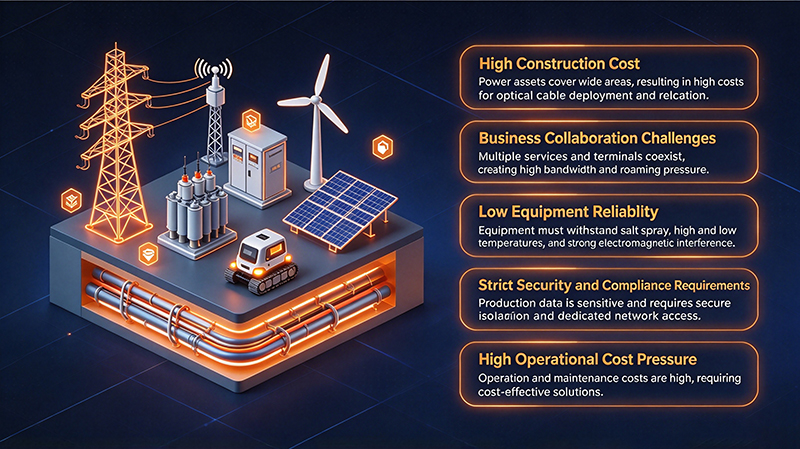
Pain Point 1: High construction cost and difficult field retrofit
Power assets cover extremely wide geographical areas. Transmission lines run hundreds of kilometers; wind‑farms and photovoltaic plants span dozens of square kilometers, with widely separated stations. Optical‑cable deployment entails massive engineering work and high capital outlay. Construction in remote mountain and desert zones proves arduous, while relocation and maintenance of physical lines incur persistent high expenses. Ordinary wireless devices lack sufficient coverage radius to deliver continuous full‑area coverage and cannot satisfy wide‑area power‑sector networking requirements.
Pain Point 2: Complex service mix and challenges in multi‑terminal concurrent collaboration
Power networks must simultaneously bear equipment control commands, sensor measurement data, multi‑channel high‑definition video and dispatching voice traffic, while supporting large volumes of mobile devices including operation‑maintenance handheld terminals, inspection robots and UAVs. Concurrent multi‑system, multi‑terminal access imposes stringent requirements on network bandwidth, compatibility and handover performance. Independent networking for disparate systems results in complex architecture, high maintenance overhead and accumulated costs.
Pain Point 3: Harsh operating conditions and inadequate reliability of commercial‑grade equipment
Power‑sector sites are exposed to salt spray in coastal regions, thunderstorms in mountain areas, extreme temperature swings in deserts, low temperatures on plateaus and damp underground environments. Substations additionally suffer intense electromagnetic interference. Commercial off‑the‑shelf wireless units feature low ingress‑protection ratings and inadequate resistance to interference and weathering, leading to high failure rates. Communications outages directly compromise inspection workflows and equipment safety monitoring, creating production‑safety hazards and driving up subsequent maintenance expenditure.
Pain Point 4: Rigorous security‑compliance requirements where public networks fall short
Production‑control power‑sector services demand physical isolation from public networks, with data confined entirely within intranets in accordance with power‑monitoring security‑protection regulations. Operator‑run 4G/5G public networks show evident weaknesses in deterministic latency, security isolation and indigenous controllability. Conventional Wi‑Fi fails intranet security reviews in terms of identity authentication and threat prevention, bringing risks of network intrusion and data leakage.
Pain Point 5: Heavy operational‑cost pressure and strong demand for cost‑effective solutions
With the phase‑out of new‑energy subsidies and mounting operational pressure on power utilities, operators require communications solutions that are affordable to build, dependable in operation and economical to maintain. Legacy wired networking incurs high one‑time capital expenditure plus heavy retrofit costs; operator‑hosted private networks demand recurring spectrum and service‑management fees. There is urgent demand for professional wireless private‑network solutions with low entry‑level investment, easy scaling, high stability and robust security.
In summary, secure, stable and compliant wireless connectivity forms the foundational prerequisite for intelligent operation‑maintenance, safety governance and cost‑reduction‑efficiency‑gain in the power industry. Appropriate products must be selected and customized solutions tailored for each practical scenario.
II. Seven Core Products and Technical Options
Guoxin Longxin’s seven wireless product lines address differentiated operating‑condition pain points across power generation, transmission, transformation, distribution and consumption.
1. iMAX 5G Wireless Metropolitan‑Area Private‑Network System — long‑range high‑capacity metropolitan‑area private‑network construction
Optimized for wide‑area metropolitan‑scale power networking. Each base station delivers aggregate bandwidth up to 600 Mbps × N; point‑to‑multipoint coverage radius reaches 50 km; point‑to‑point communication extends to 100 km. It supports multiple topologies: point‑to‑point, point‑to‑multipoint, MESH meshing and hot‑standby ring networks, enabling seamless terminal roaming.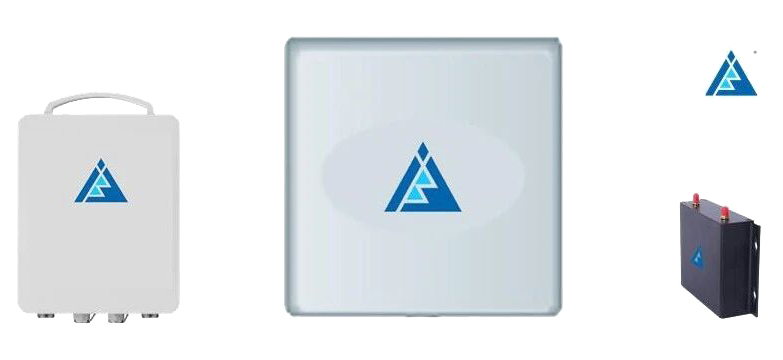
This product serves as the core building‑block for private‑network aggregation in UHV sites, wind‑farms, substations and distributed photovoltaic installations, as well as transmission‑line coverage. It carries high‑reliability services such as high‑definition video backhaul, dispatching instructions and equipment monitoring data.
2. Huanyou Low‑Frequency MESH On‑the‑Move System — non‑line‑of‑sight mobile connectivity
Typical operating frequency at 1.4 GHz (customizable across 150 MHz‑6 GHz). Purpose‑built for obstructed non‑line‑of‑sight environments to enable on‑the‑move networking for UAVs, unmanned ground vehicles and inspection robots. Under line‑of‑sight conditions, ground‑to‑air range per base station hits 60 km. Multi‑base‑station deployments support large‑scale mobile‑unit networking covering hundreds of square kilometers. It represents the primary solution for UAV‑based transmission‑line inspection and mobile connectivity in sites without public‑network coverage.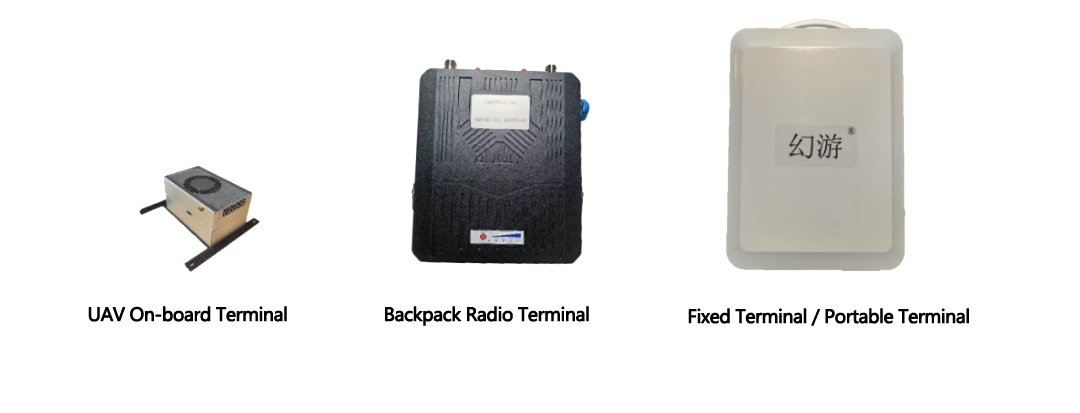
Hardware variants: UAV airborne unit, backpack man‑portable unit, fixed / portable rack‑mount unit
3. FibeAir High‑Frequency High‑Bandwidth Microwave — building ultra‑high‑bandwidth backbone links
Single‑link throughput from 10 Gbps to 20 Gbps. Suited for high‑bandwidth backbone services including unit‑group control, high‑definition video and power dispatching. Acts as an efficient alternative backbone transport option where fiber‑optic deployment is infeasible or construction timelines are unacceptably long.
4. ICSE1000 Communications‑Perception Integrated System — high‑reliability networking plus BeiDou RTK positioning and attitude sensing
Integrates wireless metropolitan‑area private‑network, BeiDou positioning and attitude‑sensor modules to satisfy dual “communication + perception” requirements for unmanned equipment. RTK positioning accuracy reaches centimeter‑level with real‑time motion‑attitude measurement. Compared with discrete multi‑hardware setups, it is well‑adapted for substation inspection robots and unmanned ground‑vehicle deployments.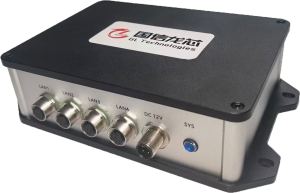
5. iMWB 4G/5G Dual‑Mode Wireless Gateway — building virtual private networks over wide‑area public infrastructure
Dual‑mode gateway supporting both iMAX metropolitan‑area private network and operator public‑network access. Compact footprint and low power draw. Applicable for scattered distributed photovoltaic sites, charging‑station coverage supplementation and IoT terminal access. Built‑in hardware‑accelerated VPN encryption tunnels enable secure virtual‑private‑network overlay atop public networks for remote networking‑management of geographically dispersed assets.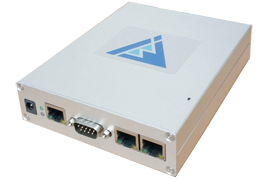
6. BreezeAir Wireless Local‑Area Network — low‑cost on‑site industrial bridges
The BreezeAir W7X industrial‑grade wireless‑LAN series complies with IEEE 802.11be (Wi‑Fi 7), leveraging 2×2 MIMO technology with channel bandwidth up to 320 MHz. Dual 2.5 G network interfaces (electrical plus optical) and standard PoE power supply are implemented, together with wide‑temperature low‑power hardware design and IP67 environmental protection rating.
Deployed at the edge access layer within substation equipment zones, distribution‑network premises and power‑plant production zones. It delivers low‑cost short‑range Wi‑Fi access for smart terminals and sensors, also covering office zones and charging‑station non‑production‑area Wi‑Fi requirements.
7. iMAX‑8000M Multi‑Mode MESH Gateway paired with Medium‑High‑Frequency Leaky Feeder Cable — wireless coverage for confined power‑industry spaces
Purpose‑engineered for long narrow confined spaces such as utility tunnels, galleries, culverts and wind‑turbine towers. The iMAX‑8000M implements multi‑mode wireless capability supporting center‑free MESH self‑organizing networking and multi‑route ring topologies. Single‑device failure will not collapse the full link. It delivers high reliability, strong anti‑interference performance and low latency while withstanding dust and vibration.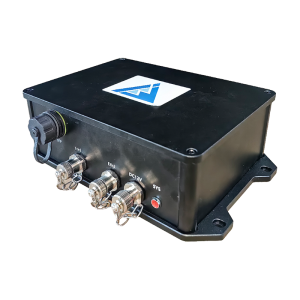
When deployed alongside medium‑high‑frequency leaky‑feeder cables laid along tunnel galleries, radio signals radiate uniformly along the cable path to eliminate coverage dead‑zones. It supports services including robot and unmanned‑vehicle operation, personnel positioning, video backhaul, equipment control and sensor data collection.
The innovative iMAX‑8000M multi‑mode MESH system surpasses conventional low‑frequency MESH solutions with higher bandwidth, larger capacity, superior anti‑interference characteristics and enhanced reliability at relatively moderate cost. Medium‑high‑frequency leaky‑feeder cables constitute a powerful tool for confined‑space private‑network coverage when combined with the dedicated iMAX‑8000M multi‑mode MESH platform.
For full specifications of the seven product categories, please visit the official website “Product Center” or GL Technologies official WeChat public account.
III. Wireless‑Network Solutions for 12 Power‑Industry Scenarios
Digital transformation of power grids is frequently bottlenecked by “the last mile” of communications. Challenges include mountain zones devoid of public‑network signals, metallic‑structure signal shielding, heavy electromagnetic interference, excessive wired‑deployment costs and fiber outages caused by natural disasters, all of which obstruct stable transmission for inspection, measurement‑control, video and dispatching traffic.
GL Technologies product portfolio (iMAX wireless metropolitan‑area network, Huanyou low‑frequency MESH, BreezeAir industrial Wi‑Fi, FibeAir high‑frequency microwave etc.) covers end‑to‑end use‑cases across power transformation, transmission, wind‑power generation, photovoltaic generation, energy‑storage and emergency‑response domains. Below are 12 sets of private‑network solution concepts organized under the logic of Pain Point — Product Selection — Business Value.
Scenario 1: UHV Transmission‑Line Inspection
Pain Points: Lines span hundreds of kilometers, largely across mountain and desert terrain without public‑network coverage. Dispersed monitoring endpoints measure tower icing, tilt and micro‑meteorology, facing connectivity and power‑supply difficulties. Fixed surveillance cameras demand stable networking, while UAV inspection requires real‑time video return and low‑latency remote piloting.
Selection: Construct backbone networks using low‑power‑consumption iMAX‑8000M multi‑mode gateways or iMAX‑6000 backbone‑network systems for ultra‑long‑haul transmission‑line connectivity. Deploy iMAX‑8000H/S‑series hardware for edge‑node aggregation. Large‑and‑medium‑size UAVs carry Flybird1400 Huanyou low‑frequency airborne terminals; Huanyou base‑stations are mounted on transmission towers for relay (10‑30 km line‑of‑sight per base‑station). Where automated UAV hangars are installed, the iMAX‑8000 system delivers centralized hangar networking for UAV control and video transmission. Supplement with iPower solar‑lithium hybrid power supplies for sites lacking grid power.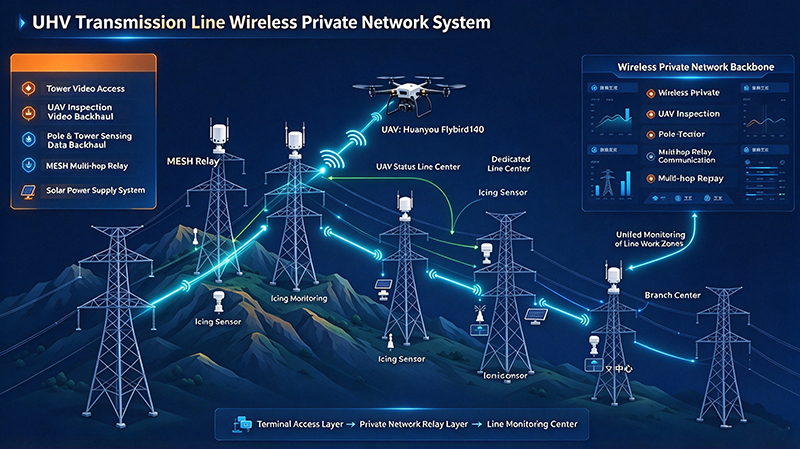
Value: Enables on‑the‑move UAV operation in public‑network‑free zones and round‑the‑clock online tower‑mounted monitoring. Forewarns potential hazards and drastically lowers safety risks for tower‑climbing field personnel.
Scenario 2: Wind‑Farm Wireless Private Network (onshore & offshore)
Onshore Wind‑Farms
Pain Points: Diverse service requirements. Wind‑turbine PLC/RTU control commands require low‑latency high‑reliability transport. Multiple HD‑video streams, group dispatch voice, mobile‑patrol operation‑maintenance staff and perimeter weather sensors must transmit concurrently. Excavation and cable‑laying in mountainous terrain are costly and prone to physical damage.
Selection: Adopt iMAX wireless metropolitan‑area network as primary backbone; hilltop‑sited base‑stations achieve coverage up to 30 km. Deploy iMAX‑ACG600 gateways paired with medium‑high‑frequency leaky‑feeder cables to eliminate signal dead‑zones inside turbine towers and guarantee smooth roaming.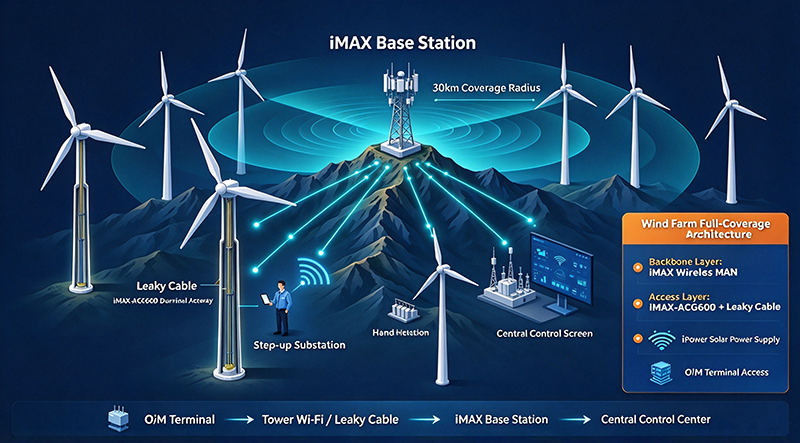
Value: One unified private network carries control, video, voice and inspection traffic. Reduces trenching and optical‑cable requirements, cutting construction and repair expenses and supporting minimally‑attended remote management. Micro‑segmentation or security isolation gateways are added when Zone I‑IV power‑system compliance must be satisfied.
Offshore Wind‑Farms
Pain Points: Submarine cables carry extremely high capital cost with lengthy repair cycles. Turbine measurement‑control, boost‑station monitoring, UAV video, SOV/CTV service‑vessel communications and ocean‑buoy monitoring require redundant backup links so services survive single‑link failure.
Selection: Deploy FibeAir high‑frequency microwave + iMAX dual‑microwave redundant backhaul toward onshore central control centers (point‑to‑point range up to 100 km). Install iMAX offshore base‑stations at sea‑based boost platforms. Use iMAX‑ACG600 / iMAX‑8000M multi‑mode MESH plus leaky‑feeder cables for signal supplementation inside towers and platform compartments. Service vessels carry iMAX‑8000AI multi‑mode CPE or iMAX‑8000M MESH terminals to attach to the metropolitan‑area private network. Add communications‑perception‑integrated units when real‑time positioning is needed.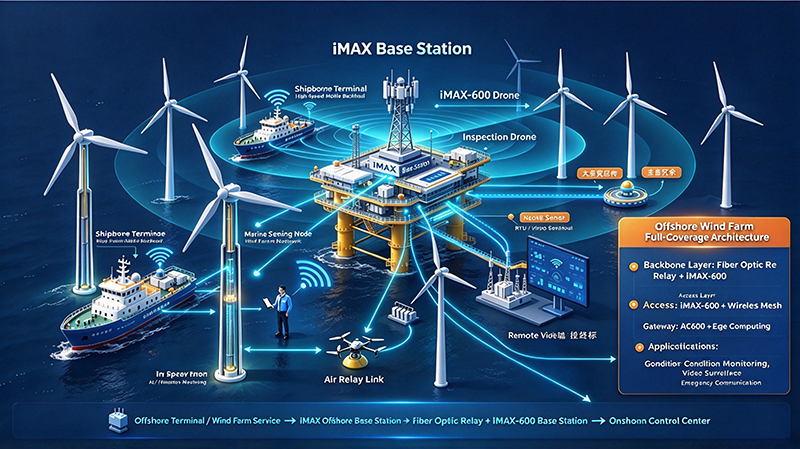
Value: Achieves continuous seamless coverage across sea‑surface zones, turbine towers, platforms and service vessels. Reduces submarine‑cable capital expenditure; dual‑link hot‑standby maintains service stability, supporting offshore unmanned inspection and coordinated vessel scheduling.
Scenario 3: Power‑Sector Utility‑Tunnel & Underground‑Space Networking
Pain Points: Sealed spaces produce strong radio‑wave shielding; wired cabling is labor‑intensive and expensive to maintain. Inspection‑robot video feeds, environmental‑sensor data and personnel positioning demand uninterrupted signal continuity.
Selection: Deploy iMAX‑8000M multi‑mode MESH private‑network base‑stations along tunnel galleries, forming highly‑reliable multi‑ring‑network structures in conjunction with fiber‑optic backbones to realize dead‑zone‑free confined‑space coverage. Robots mount iMAX‑8000AI terminals for smooth multi‑base‑station roaming. Sensors, positioning terminals, surveillance cameras and smart safety helmets access the network via wired interfaces or Wi‑Fi.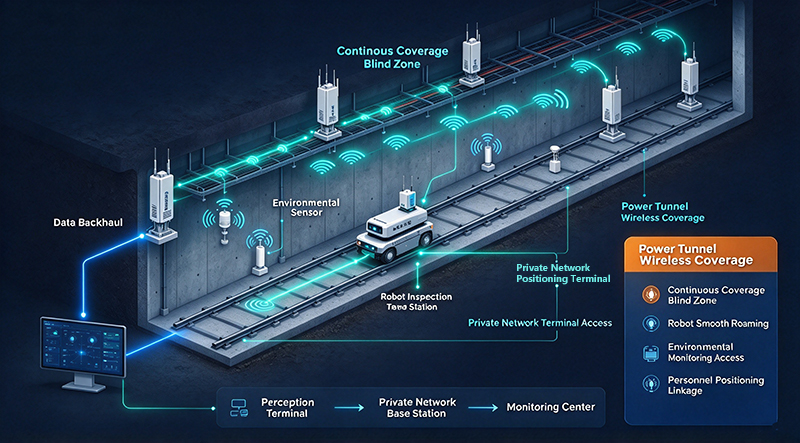
Value: Full‑coverage tunnel‑gallery connectivity with seamless robot roaming, stable return of video and sensor measurements to enable routine intelligent underground‑infrastructure monitoring.
Scenario 4: Distributed‑Photovoltaic & Distribution‑Network Dispatching
Pain Points: Photovoltaic sites and distribution‑network premises are geographically scattered, rendering fiber‑optic deployment economically unattractive. Group coordinated‑control commands demand low‑latency transport and security isolation in compliance with power‑sector governance standards.
Selection: Deploy cost‑effective BreezeAir outdoor APs / wireless bridges at dispersed premises for nearby inverter access. Apply iMAX private‑networks for high‑priority group‑control traffic. Fit iMWB 4G/5G dual‑mode gateways for centralized control of remote sites: private‑network bearer for control flows, public‑network for auxiliary coverage supplementation. 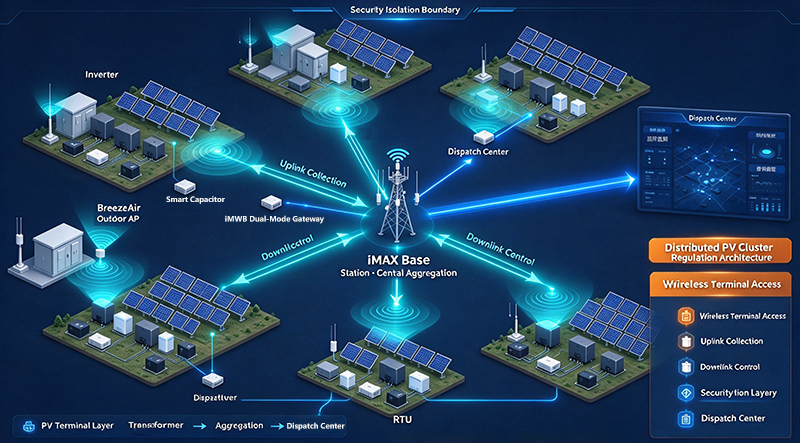
Value: Delivers low‑cost wide‑area connectivity for distributed‑photovoltaic and distribution‑network systems with bounded control‑traffic latency complying with dispatching requirements, enabling coordinated group‑control of distributed energy resources.
Scenario 5: Substation Intelligent Inspection & Secure Access
Pain Points: Dense equipment, metallic obstructions and intense electromagnetic environments inside substations together with inherent operational hazards. Inspection robots, smart helmets, body‑worn surveillance cameras and sensors constitute multi‑endpoint access requirements subject to strict intranet‑security specifications. Reliable connectivity must be guaranteed for video, monitoring data and control commands.
Selection: Combine iMAX wireless‑metropolitan‑area‑network base‑stations and iMAX‑ACG600 dual‑mode gateways. The 2.4 GHz band handles low‑speed sensor traffic; the 5 GHz band transports high‑definition video, confined to local‑LAN operation. Aggregated data is back‑hauled to central control via optical‑fiber or iMAX wireless metropolitan‑area backbone links.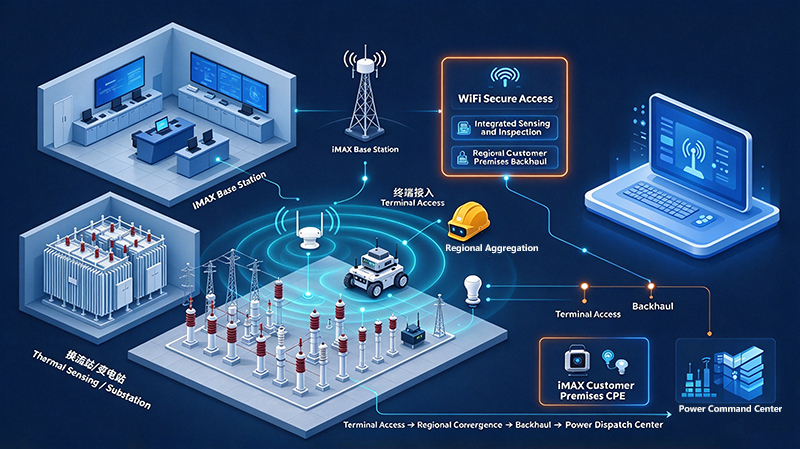
Value: Isolated private‑network environment with full‑site signal coverage and trusted terminal admission. Enables automated robot inspection and mobile field‑maintenance workflows to elevate substation intelligence levels.
Scenario 6: Energy‑Storage‑Station Networking
Pain Points: Dense cabling inside energy‑storage containers; diverse networking contexts for pumped‑hydro energy‑storage plants. Metering and control commands enjoy high‑traffic priority, while video streaming requires rational traffic scheduling.
Selection: Deploy iMAX private‑networks throughout energy‑storage stations. Use iMAX‑8000S terminals or iMAX‑ACG600 gateways to host operation‑maintenance terminals and surveillance cameras. Apply leaky‑feeder cables within culverts and enclosed zones at pumped‑hydro facilities.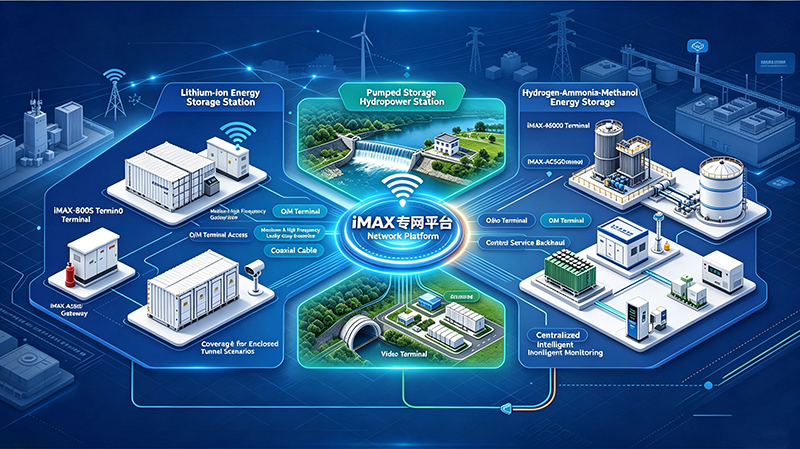
Value: Reduces on‑site cabling workload and construction cost. Guarantees high‑reliability transmission of metering and control‑service traffic, realizing centralized intelligent governance for energy‑storage and charging‑infrastructure assets.
Scenario 7: Power‑Plant Campus‑Wide Wi‑Fi Coverage & Mobile Office
Pain Points: Large‑size plant premises with strict security zoning separating production and office domains. Operation‑maintenance handheld terminals must roam seamlessly across zones while production‑service traffic remains logically isolated.
Selection: iMAX‑ACG600 dual‑mode gateways deliver backbone backhaul plus Wi‑Fi access. Supplement high‑density zones with BreezeAir industrial APs / bridges. Implement traffic isolation at the aggregation layer, with iMAX metropolitan‑area networking enabling cross‑site interconnection.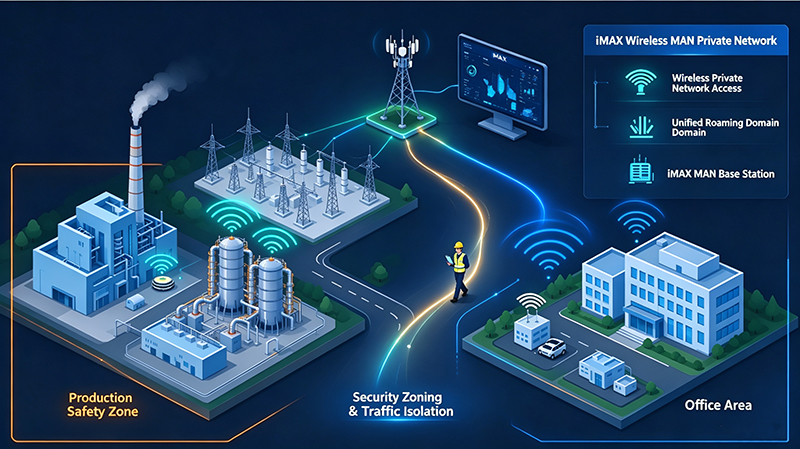
Value: Seamless campus‑wide roaming with security segmentation between production and office domains, concurrently supporting mobile‑field‑maintenance workflows and digital office operations.
Scenario 8: Wide‑Area Remote Virtual‑Private‑Network for Multi‑Site & EV‑Charging‑Station Assets
Pain Points: Geographically dispersed corporate‑group‑owned wind‑farms, photovoltaic plants and substations require consolidated monitoring and production‑data upload to group‑level control centers. Parking‑garage charging‑stations feature dense terminal deployments with high cabling costs.
Selection: Install iMWB‑5GW1000 / iMAX‑4GW300 multi‑mode gateways at individual sites. Utilize VPDN SIM‑cards, SD‑CX cloud interconnection and hardware‑accelerated VPN to construct cross‑domain virtual‑private‑networks supporting private‑cloud, public‑cloud and hybrid‑cloud deployment models.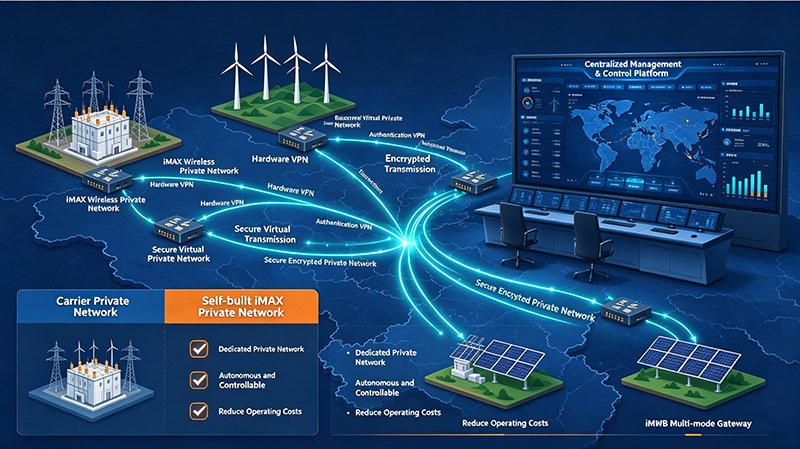
Value: Eliminates requirements for long‑haul optical‑cable deployment. Realizes low‑cost multi‑site data‑to‑cloud transmission and unified group‑level remote supervision, lowering corporate‑group‑wide operation‑maintenance expenses. 4G/5G virtual‑private‑networks deliver cost‑effective alternatives for power‑consumption‑side scenarios with moderate security requirements.
Scenario 9: Wireless Private‑Networks for Power‑Sector Robots
Pain Points: Inspection robots (substation wheel‑mount, rail‑hanging, tracked variants plus RGV tunnel‑gallery robots) impose stringent network demands. Conventional Wi‑Fi suffers handover stuttering and poor anti‑interference performance; public‑networks create security‑isolation risks and lack coverage in remote zones. Robots require end‑to‑end latency ≤ 20 ms, support for 15 km/h mobile speeds and seamless roaming while carrying remote‑control traffic, multi‑channel video, RTK positioning and infrared imaging feeds.
Selection: Deploy Huanyou low‑frequency MESH for long‑range non‑line‑of‑sight mobile‑unit scenarios. Adopt iMAX‑8000AI clients for fixed‑zone robot operation. Use iMAX‑8000M multi‑mode MESH for multi‑robot swarm deployments. Add communications‑perception‑integrated hardware when RTK positioning and attitude measurement are required. Combine iMAX‑8000M plus leaky‑feeder cables for tunnel‑gallery use‑cases.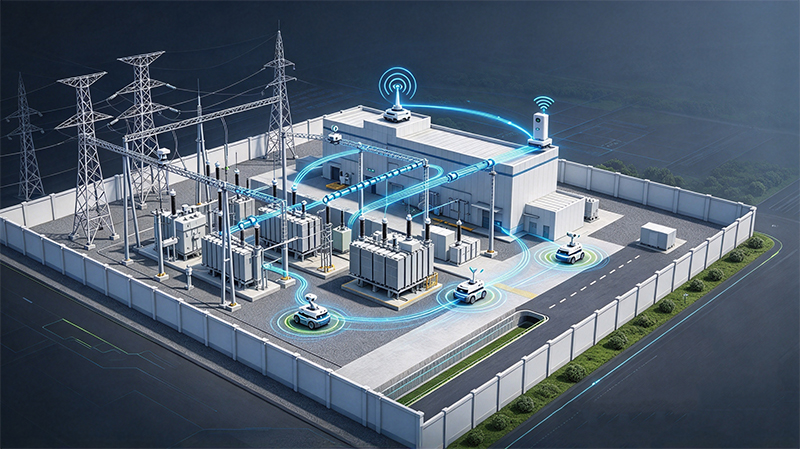
Value: Low‑latency, low‑jitter performance with seamless roaming to satisfy precise robot remote‑control, positioning and image‑return requirements across diverse power‑sector robot‑deployment environments.
Scenario 10: Power‑Sector Construction‑Site Networking
Pain Points: New‑build substations, hydro‑power plants and UHV‑project construction sites feature expansive work‑zones, scattered surveillance nodes and complex exposed undulating terrain in remote locations. Intelligent management safeguards work‑site safety, material‑asset integrity and schedule oversight. Networks serve as temporary infrastructure requiring rapid deployment and tear‑down upon project completion. Connected endpoints include surveillance cameras, safety‑helmet positioning units, two‑way radios, field‑tablet computers and UAVs.
Selection: iMAX private‑network solutions excel for large‑area construction‑site networking. Terminals attach locally to iMAX client units connecting to base‑stations, with backbone‑network links delivering centralized site governance. Add portable relay nodes to extend coverage for nomadic mobile‑surveillance deployments.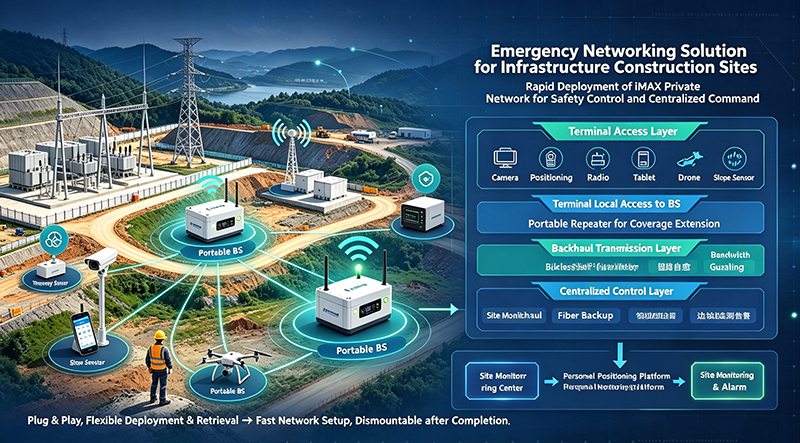
Value: Plug‑and‑play deployments with easy post‑project removal. Satisfies communications needs for work‑site safety supervision, personnel positioning, video monitoring and slope‑deformation measurement.
Scenario 11: Power‑Sector Emergency‑Repair Networking
Pain Points: Typhoons, wild‑fires, ice‑storms and floods frequently disable public‑network base‑stations and fiber‑optic infrastructure. Emergency‑repair sites lack baseline communications. Conventional two‑way radios support only voice; fiber‑optic cables cannot be laid quickly enough; satellite communications incur excessive bandwidth‑related costs. Self‑healing ad‑hoc private‑networks are required to interconnect individual field operators, UAVs, on‑site command posts and back‑office dispatching centers.
Selection: Implement the three‑tier Huanyou MESH architecture: front‑line individual‑soldier backpack units and UAV‑airborne terminals; relay‑layer portable / vehicle‑mounted MESH nodes for chained range extension with self‑healing routing; command‑vehicles / portable command‑boxes for edge‑side traffic aggregation. Up‑link options include iMAX microwave back‑haul to nearby intact sites, with satellite links and encrypted VPN as backup pathways.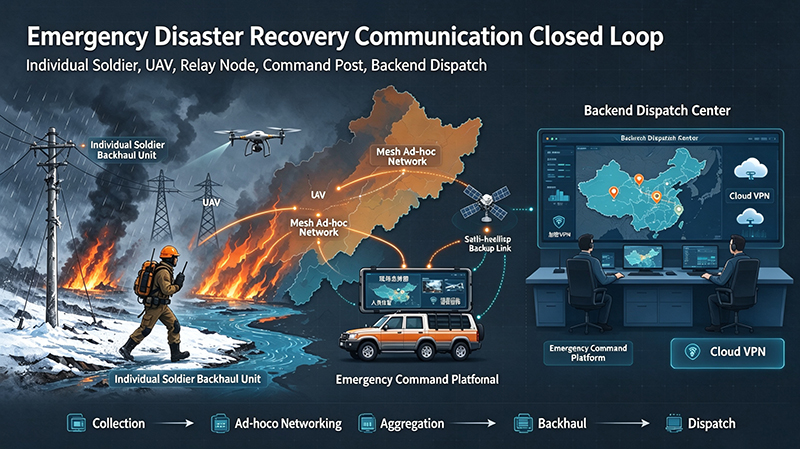
Value: Self‑organizing upon power‑on with link‑self‑healing capability independent of public‑networks or fiber‑optic assets. Supports voice dispatching, video transmission, UAV inspection and personnel positioning, safeguarding mission‑critical communications lifelines during disaster‑response power‑restoration work.
Scenario 12: GNSS‑Based Early‑Warning Monitoring for Landslide‑Induced Displacement / Overturning of Power‑Sector Towers
Pain Points: Long‑term monitoring of tower foundations and hillsides occurs at remote sites without grid‑power supply and subject to radio‑wave obstructions. Wired deployment is impractical. Solutions must concurrently deliver private‑network interconnection, centimeter‑grade RTK displacement measurement and tower‑tilt attitude sensing to provide advance warnings of landslide and structural‑collapse risks.
Selection: Fit communications‑perception‑integrated terminals employing satellite‑based RTK to measure real‑time foundation‑and‑tower displacement. Attitude sensors record structural‑deformation and sway metrics. High‑definition surveillance cameras may be added to visually assess hazard severity. Data is transported over dual‑mode iMAX private‑networks; solar‑lithium hybrid power supplies enable low‑cost all‑in‑one tower‑and‑land‑slide early‑warning monitoring systems.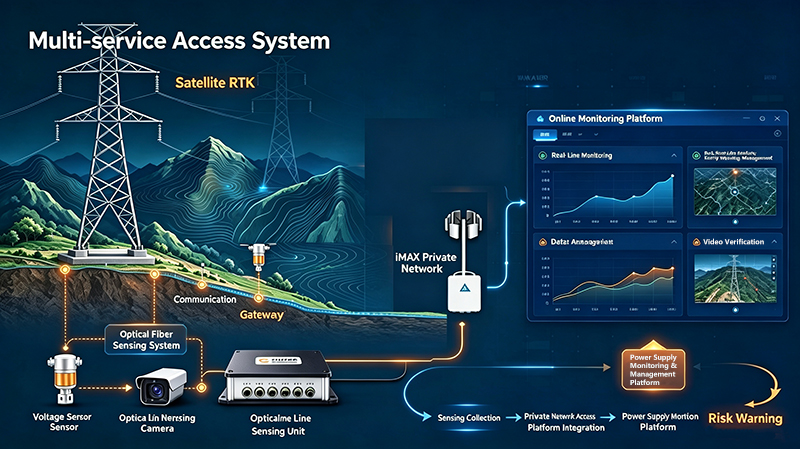
Value: Enables long‑term unattended online monitoring regardless of terrain‑caused signal obstructions. Delivers advance geological‑hazard alerts to secure transmission‑tower foundation integrity.
IV. Summary
Power‑sector networking is far more than simple signal transmission. Production‑control traffic, inspection‑video feeds, emergency‑response command streams and robot‑UAV services exhibit widely divergent business attributes, security classifications, latency constraints and coverage‑range requirements, mandating customized solution design.
There exists no universal‑fit‑all technology or single wireless product for every scenario. GL Technologies’ wireless‑private‑network product matrix avoids one‑size‑fits‑all approaches: deploy iMAX metropolitan‑area‑network systems for long‑haul backbone links; select Huanyou MESH for off‑grid mobile‑emergency‑response; apply BreezeAir for local Wi‑Fi coverage / bridging; use FibeAir microwave for high‑reliability redundancy in offshore‑cable‑linked environments. Wired and wireless pathways may mutually serve as hot‑standby backups and can be combined on demand, covering the full asset lifecycle from routine grid operation‑maintenance through disaster‑time emergency restoration.
From substation premises to thousand‑kilometer‑long transmission corridors, from onshore wind‑farms to offshore platforms, from routine inspection to disaster‑response emergency‑repair, trusted, mobile‑capable and self‑healing wireless private‑networks constitute the digital foundation for smart power grids.
This solution suite encompasses seven categories of wireless‑private‑network hardware to satisfy networking requirements across 12 distinct use‑cases throughout generation‑transmission‑transformation‑distribution‑consumption power‑industry value chains, delivering reliable, secure and regulatory‑compliant communications for power‑sector intelligence, unmanned‑operation and digital‑transformation initiatives. It delivers clear cost‑performance advantages compared with traditional fiber‑optic and operator‑run 4G/5G private‑network deployments and represents a core option supporting power‑sector intelligence, mobility, unmanned‑operation and cost‑reduction‑efficiency‑gain objectives.
Drawing on two decades of extensive project‑delivery experience, GL Technologies tailors dedicated wireless‑private‑network solutions aligned with substation layouts, transmission‑line routing, asset‑point distribution, service requirements and cybersecurity‑compliance rules. End‑to‑end turn‑key services include site surveys, solution planning, hardware deployment, commissioning and after‑sales operation‑maintenance to comprehensively advance intelligence, security and cost‑optimization within the power industry.
Power‑sector end‑users and system‑integrator partners are welcome to submit project‑requirements for custom‑solution consultations.