I. Overview of Requirements for Power Transmission and Transformation Line Inspection System
With the rapid development of China’s social economy, all walks of life have put forward higher requirements for the quality and quantity of power supply. Due to the uncertain operating environment of transmission lines in the power grid, the safe and stable operation of lines has become an important indicator of power grid reliability. The monitoring of power transmission and transformation equipment has always been a key focus of power grid construction and management. With the development and application of various data acquisition and monitoring systems, power departments have gradually realized the integrated real-time monitoring of power grid dispatching by integrating real-time data and information from Energy Management Systems (EMS), Phasor Measurement Units (PMU), relay protection devices, safety automatic devices, fault monitoring and early warning systems, etc. However, transmission lines stretch for tens or even hundreds of kilometers (especially high-voltage and ultra-high-voltage transmission lines with higher requirements for intelligent management), traversing diverse environments such as mountains, deserts, rivers, rural areas and coastal regions. These lines are highly susceptible to geographical and climatic conditions, and are frequently exposed to natural disasters and man-made damage. As a result, annual power grid blackouts are mainly caused by line faults. Guoxin Longxin’s network-connected solution for power transmission and transformation line monitoring systems is specially designed to ensure the safe and stable operation of power systems.
Traditional power transmission and transformation line inspections rely on periodic patrols by operation and maintenance personnel. Although this method can identify equipment hidden dangers, it has inherent limitations: it lacks the capability to monitor special environmental and climatic conditions, and cannot keep track of line conditions during the intervals between patrols. This creates a high risk of line faults occurring before the next scheduled patrol. High-voltage transmission and transformation lines are usually located far away from residential areas. Deploying dedicated maintenance personnel for on-site supervision not only increases operational costs, but also exposes staff to significant personal safety risks during inspections under severe weather conditions. Therefore, online monitoring systems for transmission lines have emerged as a viable solution. These systems utilize wireless transmission technology to conduct real-time monitoring of various parameters, including the environmental conditions of transmission line corridors, temperature, humidity, wind speed, wind direction, leakage current, icing thickness, conductor temperature, wind deflection, sag, galloping, insulator contamination, nearby construction activities, and tower tilt. By monitoring these key parameters, the systems provide early warnings of line abnormalities.
In recent years, building on the implementation of power online monitoring systems, high-definition video surveillance systems have been fully integrated into the framework. Real-time video streams visually reflect the operational status of power transmission and transformation lines, effectively reducing false alarms and faults associated with single-parameter monitoring systems. This integration has further enhanced the scientific management level of the safe and economic operation of transmission lines, and provided essential references for condition-based maintenance of transmission lines.
In addition to transmission towers, the power grid also includes numerous unattended substations. It is reported that the National Electric Power Communication and Dispatching Center has mandated that existing 35kV, 110kV, and 220kV substations should gradually transition to unattended operation, while many newly constructed substations will be designed for unattended operation from the outset. Meanwhile, medium and high-voltage power lines, as critical grid infrastructure, also operate in an unattended mode for extended periods. From a safety perspective, high-definition video surveillance and intelligent analysis and alarm systems are indispensable components for these unattended substations.
1. Fixed Line Inspection System
The integrated online monitoring system for power transmission and transformation lines, which incorporates high-definition video technology, enables operation and maintenance personnel to remotely access status data and on-site images of transmission towers and substations from the central operation and maintenance monitoring center. By conducting real-time analysis, diagnosis, and prediction of line operational status based on the collected monitoring data, personnel can take appropriate measures to eliminate or mitigate potential hazards, thereby ensuring the safe and stable operation of transmission lines.
China’s ultra-high-voltage (UHV) power grid has achieved world-leading standards within less than a decade of development, setting a number of world records. The operation of UHV power grids mandates intelligent management, and online monitoring and real-time surveillance of power transmission and transformation lines are indispensable components of this intelligent framework.
Based on the above analysis, the widespread adoption of online monitoring and real-time surveillance systems for power transmission and transformation lines is imperative. First, we analyze the common components of such monitoring systems, which include but are not limited to the following subsystems:
- High-definition video surveillance system for transmission lines
- Micro-meteorological online monitoring system for transmission lines
- Tower tilt online monitoring system for transmission lines
- Icing online monitoring system for transmission lines
- Insulator leakage current online monitoring system for transmission lines
- Conductor (fitting) temperature online monitoring system for transmission lines
- Wind deflection, galloping and sag online monitoring system for transmission lines
- Anti-theft early warning system for unattended substations
- Operational status monitoring and management system for unattended substations
During the design and construction of the aforementioned information and monitoring systems, the first major challenge encountered is the difficulty of power supply. Power transmission and transformation lines operate at high voltages, making it impossible for low-voltage information systems to directly draw power from them, thus necessitating independent power supply solutions. The second challenge is the difficulty of networking data acquisition points and video surveillance points. Transmission lines wind through mountainous terrain, cross rivers and ravines, and traverse deserts and snow-covered forests. While laying optical cables may be feasible for interconnecting core power stations, deploying optical cables to connect the numerous dispersed information and monitoring points along the lines is neither economically viable nor practically implementable. The dual challenges of power supply and networking have severely hindered the progress of power grid informatization and intelligent construction.
2. UAV-Based Line Inspection System
In recent years, many power transmission and transformation companies have adopted UAV-based inspection methods to reduce the costs of manual inspections and shorten inspection cycles. The data collected by UAVs is further processed using technologies such as video AI, 3D point cloud modeling, and virtual reality, which significantly improves work efficiency.
Multi-rotor UAV systems are widely used in various scenarios, including power line inspections, transmission tower inspections, substation inspections, and cooling tower inspections. Power-specific UAVs equipped with thermal imaging sensors and video cameras enable more in-depth and comprehensive assessments of power lines. UAVs can quickly map an area, navigate through power lines, and avoid towers and other potential hazards. Due to their agility, compact size, and lightweight design, UAVs can be deployed on a large scale in conjunction with UAV ports or nests. Moreover, UAVs not only reduce the frequency of dangerous tasks that expose staff to risks, but also offer numerous benefits such as improved safety, reduced downtime, reliable data output, and enhanced operational efficiency.
Through 3D mapping systems (also known as “3D point cloud” technology), UAVs can determine the most efficient flight routes. They can fly a complete circuit between regions and perform complex data collection tasks, including photography, laser scanning, and infrared scanning. After data recording, data experts or operators analyze the data to identify any potential issues. Typical data and information collected during UAV-based power line inspections include:
- Towers: Tower climbing, deformation, foreign object hanging, missing or loose bolts, and corrosion of tower components.
- Insulators: Severe tilting, heavy contamination, damaged sheds, self-explosion, iron cap cracks, missing locking pins, and abnormal temperature rise of insulators.
- Ground wires, conductors, and jumper wires: Wire breakage, foreign object entanglement, hanging galloping, excessive wind deflection; strand loosening, strand breakage, discharge burns, icing, corrosion, and abnormal temperature rise of conductors.
- Line fittings: Displacement of spacers, displacement or falling off of vibration dampers, deformation of damping wires, fracture of clamps, deformation of spacers; loose bolts on fittings, corrosion of pins, and cracks in fittings such as connecting plates and rings.
- Corridors and other aspects: Corridor inspections, damage or loss of auxiliary devices such as bird prevention and lightning protection facilities, illegal construction and structures; loose leads and bolts of auxiliary devices; fire hazards near power lines.
Thermal imaging and LiDAR can be used to assist in the inspection and monitoring of power line and tower corridors. Compared with ground-based detection methods, these technologies can obtain visual inspection data with higher resolution. Towers can remain operational during inspections without causing downtime. UAVs can collect the necessary data to identify and mitigate power distribution risks in advance; the integration of UAVs with backend AI automated inspection systems can significantly reduce the labor hours and costs associated with inspections.
It should be emphasized that at present, most power utility users employing UAV-based inspections have established dedicated UAV teams, and inspections are performed by pilots manually launching UAVs. In addition to increasing the workload of personnel, the biggest problem with this approach is that UAV images are difficult to obtain in real time, as most data is recorded as UAV video footage. If images cannot be acquired in real time, real-time AI early warning and alarm functions cannot be realized.
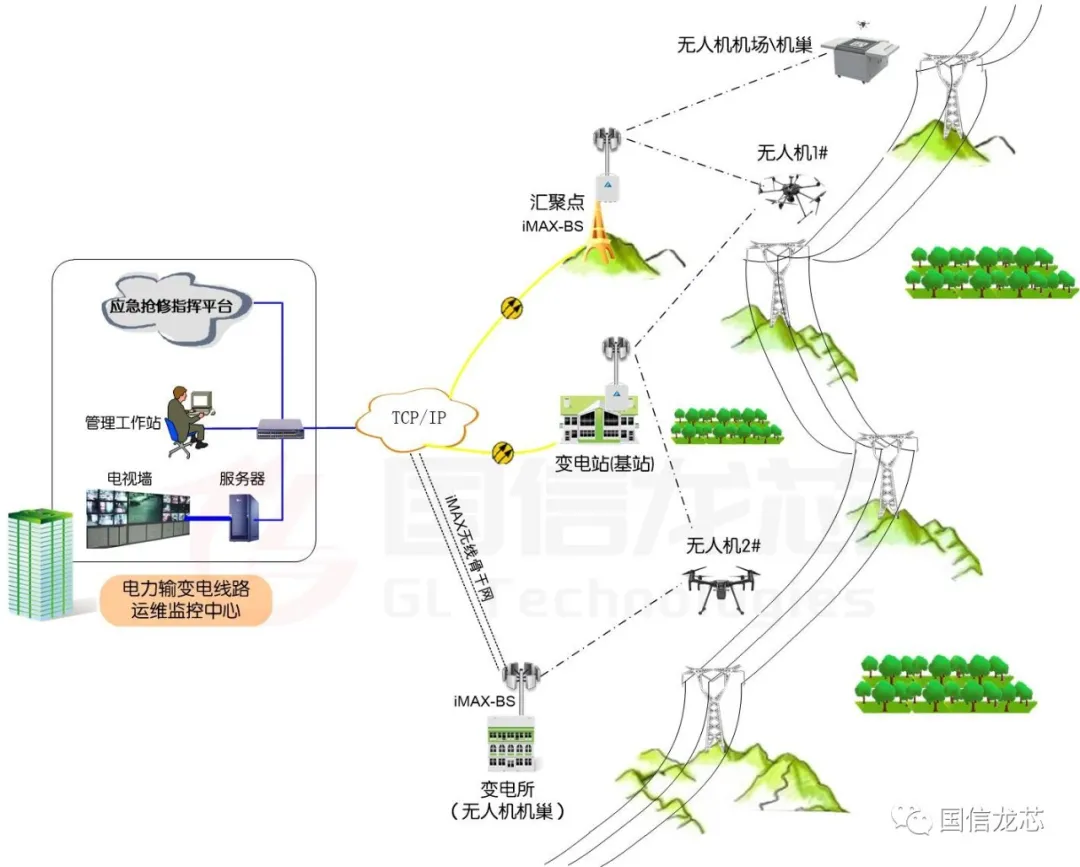
For UAV networking, the inspection of urban power lines can be based on the 4G/5G resources of telecom operators. However, considering the high cost of data packages in the later stage and security requirements (which require connection to an internet platform for relay), the construction of a wireless private network can better meet such needs. In vast rural areas, especially in remote and inaccessible scenarios such as mountains, waters, and forests, telecom operators’ 4G/5G public networks may often have no signal coverage. Therefore, building a wireless private network solution with high reliability, high security, and high availability is the preferred option.
Specifically for the networking of power UAVs (including UAV nests), both Guoxin Longxin’s iMAX Wireless Metropolitan Area Network (WMAN) private network system and the dedicated Huanyou low-frequency wireless MESH mobile communication system for UAVs can be utilized, depending on actual requirements such as application scenarios, communication distance, number of UAVs, and UAV payload requirements.
II. Networking Solution for Power Transmission and Transformation Line Inspection System
What kind of solution can perfectly and appropriately address the networking challenges of power transmission and transformation line monitoring and surveillance systems?
Some solutions in the industry rely on telecom operators’ 4G/5G wireless technologies, which are highly impractical. First, the use of operators’ 4G/5G wireless networks is heavily dependent on operator resources, and field environments are often “blind spots” with no signal coverage. Second, building a power information system based on operator public network platforms or even the Internet makes it difficult to guarantee information security and reliability. Third, the cost of constructing a 4G/5G private network is prohibitively high, making it unaffordable for most utilities. The special nature of online monitoring and real-time surveillance systems for power transmission and transformation lines determines that they cannot adopt 4G/5G public network technologies; instead, a reliable, dedicated private network must be built.
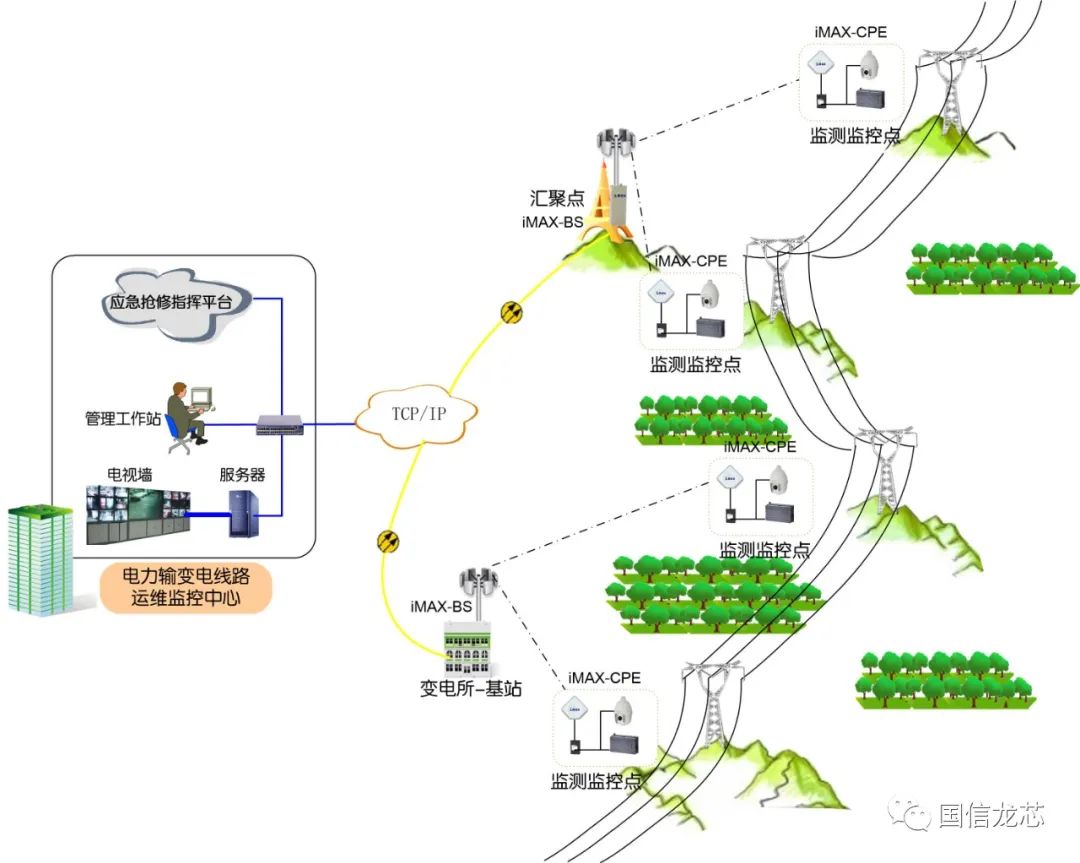
Based on the above analysis, networking relying on telecom operators’ 4G/5G technologies has issues in terms of availability, reliability, economy, and security. Guoxin Longxin’s iMAX Wireless Metropolitan Area Network system and iPower2000 new energy power supply system form a “golden combination” to solve the dual challenges of power supply and networking in the construction of power transmission and transformation line information systems.
The typical topology diagram for private network interconnection of power transmission and transformation line monitoring systems is as follows:
1.Lithium Battery-Solar Power Supply System — Solving the Power Supply Challenge of Off-Grid Monitoring Points
The iPower2000 New Energy Power Supply System is an integrated off-grid new energy power supply system, designed for field environments such as scenic areas. It aligns with the green and eco-friendly construction philosophy of scenic spots, and can address the power supply needs of scattered IT system devices including wireless network systems and video monitoring points in field settings.
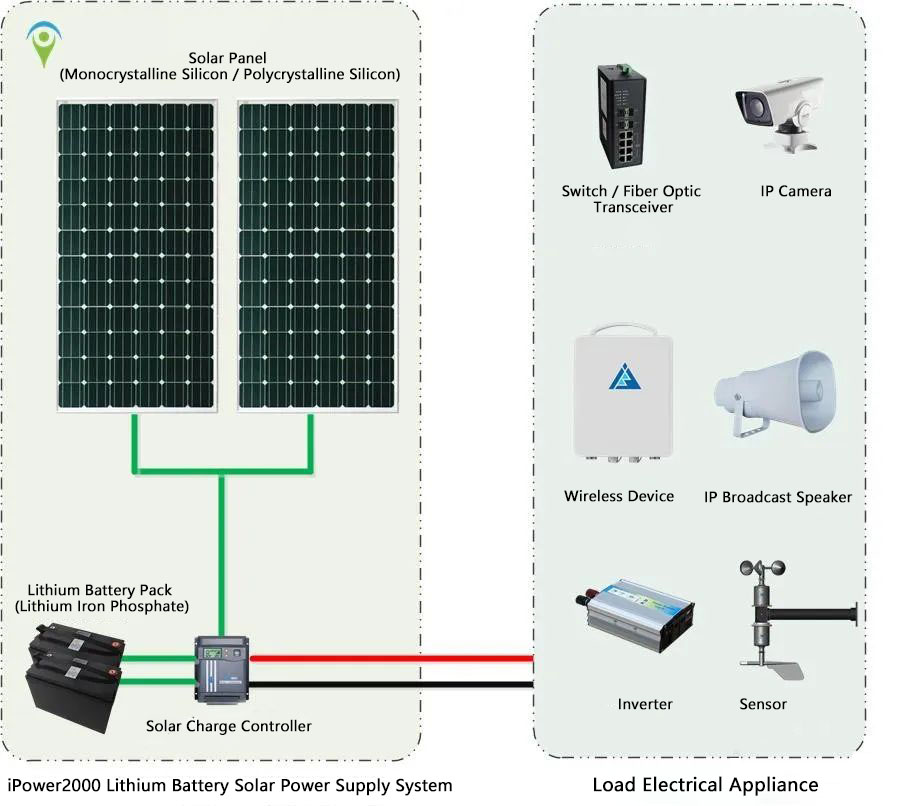
This series of products effectively addresses the long-term or temporary power supply challenges of field video surveillance points and information monitoring points. Based on lithium-ion battery storage and high-performance monocrystalline silicon solar panels, the system boasts advantages such as a simple structure, compact size, light weight and long service life when compared with conventional solar and wind power supply systems equipped with lead-acid or gel batteries. It is an ideal choice for providing long-duration power supply for IT system construction in field environments.
2.iMAX 5G Wireless Metropolitan Area Network (MAN) Private Network System — Resolving the Networking Challenge of Tower Monitoring Points
The iMAX wireless system is specially designed for building outdoor ultra-long-distance, large-capacity private network systems. With its unique technical advantages and outstanding performance — including support for multiple networking modes, IP67 protection standard, and large-capacity high-definition video bearing capacity — it delivers unparalleled benefits over other wireless broadband devices, such as ultra-long-distance networking, high bandwidth, strong anti-interference capability, high reliability, easy installation and convenient maintenance.
The iMAX wireless communication system is engineered to build wireless cities or enable ultra-long-distance network interconnection in outdoor environments, with all product series offering extended communication ranges. Among them, the iMAX-6000 series serves as the backbone network for power line networking, while the iMAX-8000H series functions as the edge access network.
- Communication Distance: Under line-of-sight conditions, even the compact iMAX 5G dedicated communication system with integrated antenna can easily achieve a coverage radius of 10 km in point-to-multipoint mode with the iMAX-8000H; in point-to-point mode, the maximum communication distance can reach 120 km.
- Transmission Bandwidth: The iMAX-8000H is a 600 Mbps point-to-multipoint communication system; the iMAX-6000 is a point-to-point communication system with bandwidth options of 150/300/600 Mbps; and the FibeAIR microwave is a point-to-point communication system supporting bandwidths of 1 Gbps to over 20 Gbps.
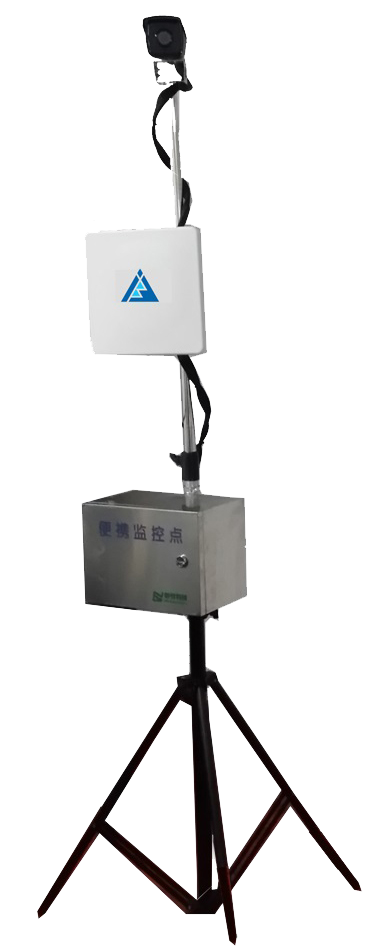
In addition to fixed video surveillance points, mobile terminals (individual soldier, portable and vehicle-mounted devices) are often essential for emergency repair in power line inspections, and the networking of these mobile terminals is heavily reliant on wireless networks. To meet the demand for remote command in emergency repair during the construction of power line inspection systems, Guoxin Longxin has innovatively integrated the iMAX wireless MAN system, lithium battery host and high-definition IP cameras to custom-launch the ground-deployable iPMVS Portable Monitoring Point System, which supports on-demand emergency deployment.