The Internet of Things (IoT) technology is profoundly transforming various industries. “Smart Water Conservancy” has long been a key phrase in the development of the water conservancy sector in recent years and has become an indispensable part of the “new infrastructure” for water conservancy. Building digital twin river basins is a major strategic decision and deployment by the Ministry of Water Resources, which has clearly stated that “digital twin river basins for the seven major river systems will be completed by 2025”, making digital twin a hot topic in water conservancy development. In fact, the realization of digital twins in water conservancy must be based on full – chain intellectualization and informatization. In other words, the IoT serves as the foundation of digital twins, while digital twins can be regarded as a component of smart water conservancy.
Smart water conservancy refers to the application of advanced technologies such as modern communication, computer networks, security monitoring, intelligent acquisition and control, GIS (Geographic Information System), big data, and digital twin systems across the entire water conservancy industry. It fully collects, develops, and utilizes basic information resources related to water, directly providing decision – support services for early warning and disaster reduction, water resource development, utilization, conservation, and protection. This helps improve the scientific management level of water networks and water conservancy projects.
Smart water utilities can be seen as an important branch of the smart water conservancy industry. They are closely interrelated yet have certain differences. Smart water utilities mainly target water authorities and river basin management departments. Their goals include enhancing the management capabilities of urban water supply and drainage networks, urban waterlogging monitoring and early warning capabilities, flood control and drought relief service capabilities, water resource allocation and utilization capabilities, rural water conservancy management capabilities, water conservancy project management capabilities, water ecological environment protection capabilities, and soil and water conservation capabilities. The smart water utility management platform aims to achieve the integration of the “Four Modernizations” in water utilities (digitalized production, collaborative management, scientific decision – making, and proactive services), thereby realizing the intelligent management of the entire industrial chain covering raw water, water supply and drainage, water distribution, and sewage treatment.
During the construction of smart water conservancy or water utility systems, the networking and power supply of edge information nodes, which act as the nerve endings of the entire large – scale system, often become the biggest obstacles to the development of intelligent systems. Many water conservancy system integrators mainly focus on software platforms and tend to shift the networking challenges to end – users or telecom operators. This shifting of responsibilities, along with the high cost or infeasibility of networking, may lead to project failure in the early stages. What’s more, there are numerous cases where projects are left unfinished. This happens when the networking is casually assigned to local telecom operators, but the operators are unable to solve the networking problem due to limitations in optical cable resources and other factors.
Water conservancy and water utility information nodes (such as dams, ditches, pumping stations, rainfall stations, hydrological stations, sluice gates, and flow and velocity sampling points) are mostly scattered, and many monitoring nodes are located in remote, even uninhabited areas. In such situations, solving the problems of power supply and networking is extremely difficult. According to the current development trend of water conservancy informatization and digital twin systems, the information transmitted by edge information nodes is no longer limited to the narrow – band networking requirements of simple switching values and analog values as in the past. Most of this information is typical multimedia data (including data, audio, high – definition video, etc.) that requires real – time networking. Common water conservancy information nodes include high – definition digital video surveillance, water level monitoring, rainfall monitoring, online water quality monitoring and analysis, flow and velocity monitoring, centralized sluice gate management and control, disaster alarm and early warning systems, and network broadcasting and dispatching systems. It is evident that the previous networking methods based on 2G/3G telecom operator networks like GPRS and CDMA can no longer meet the current bandwidth demands. Additionally, although many systems have been deployed using 4G/5G networks from telecom operators combined with public clouds, this approach must be changed. It fails to meet the “level – protection” requirements for network security of government agencies and exposes users to risks of data leakage and cyberattacks caused by unprotected data transmission over the Internet and data storage in public clouds.
Drawing on Guoxin Longxin’s years of industry experience, this solution provides a series of solutions based on typical application scenarios in water conservancy and water utilities. It enables system integrators and industry users in the water conservancy and water utility sectors to effectively address the key pain points of difficult networking and power supply for information terminals.
As mentioned above, the most common challenges in the development of smart water conservancy and water utility systems are the difficulties and high costs associated with power supply and networking. We will analyze these issues one by one and provide recommendations for technical product selection.
In terms of networking, in line with the communication industry trend of “one integrated network and multi – network convergence”, it is inevitable to adopt TCP/IP – based networks for the interconnection of various intelligent systems and IT systems. However, the special environment of comprehensive monitoring for reservoirs, lakes, and rivers makes wired optical networks, which are commonly used in urban networking, unsuitable in terms of economy, reliability, security, and maintainability. The main drawbacks are as follows:
- Difficulties in coordinating with local farmers.
- High vulnerability of optical cables to damage.
- Frequent occurrence of optical cable fusing and abandonment.
- Excessively high construction costs.
- Long construction periods.
Using optical cables in water conservancy informatization projects not only results in high costs and long construction cycles but also hinders post – project operation and maintenance, reducing the overall reliability and availability of the system. In contrast, wireless communication systems have significant advantages, such as short construction periods, easy deployment, low costs, and convenient expansion and capacity – increase. They can fully meet the large – bandwidth and long – distance coverage requirements for real – time transmission of multimedia information in smart water conservancy and water utility systems.
- Stable and Efficient: The equipment inherits the high – quality genes of carrier – class products, ensuring stable and reliable operation around the clock (365 days a year, 24 hours a day). It also offers stable bandwidth and strong anti – interference capabilities.
- Secure and Reliable: It provides multi – level and high – standard network security protection through access control, data encryption, support for VLAN, VPN technologies, and software firewalls. The equipment is of high quality and adaptable to outdoor environments, making it ideal for outdoor applications.
- Cost – Effective: It requires a one – time investment with no subsequent high – cost link rental fees. Compared with self – built optical cable networks, the iMAX 5G system can reduce construction costs to 1/3, 1/5, or even 1/10 of the cost of optical cable networking under the same conditions, delivering exceptional cost – performance.
- Flexible Deployment: The equipment is small in size and light in weight, and can be installed within 1-2 working days. It is also easy to maintain and relocate.
The iMAX wireless communication system is designed to build “wireless cities”. Its various product series boast long communication distances and superior performance compared with similar products. The iMAX – 6000 and iMAX – 8000S/H series are widely used in smart water conservancy projects.
- Communication Distance: Under line – of – sight conditions, the dedicated iMAX 5G communication system can achieve a maximum communication distance of over 50 kilometers. Even with a base station (BS) equipped with a 120 – degree sector antenna and a client using the smallest integrated antenna configuration, it can easily cover a radius of 10 kilometers.
- Transmission Bandwidth: The iMAX – 8000H is a point – to – multipoint communication system with bandwidths of 300 Mbps and 600 Mbps. The iMAX – 8000S is a 100 Mbps point – to – multipoint access network system, and the iMAX – 6000 is a point – to – point backbone network communication system with bandwidth options of 150 Mbps, 300 Mbps, and 600 Mbps.
It is important to emphasize that the iMAX Wireless Metropolitan Area Network (WMAN) system supports a wide range of network technologies including routing, firewalls, and VPN. For reliability, it supports VRRP (Virtual Router Redundancy Protocol), RSTP (Rapid Spanning Tree Protocol), and MESH (decentralized mesh network). It can be deployed in hot – standby redundant networks, ring networks, or even multi – layer ring networks, which is fundamentally different from wireless bridges based on WiFi technology. Moreover, it has strong scalability. It can be expanded with WiFi modules to provide local WiFi coverage and 4G LTE modules to access operator networks. Therefore, the iMAX WMAN system is the best choice for building high – reliability, high – quality outdoor wireless private metropolitan area networks in the water conservancy industry.
In summary, the self – built broadband IP wireless metropolitan area network solution is the most suitable transmission solution for the informatization of the water conservancy and water utility industries. Guoxin Longxin’s iMAX 5G broadband wireless network solution, as the most mature and cost – effective broadband wireless metropolitan area network solution, is undoubtedly the optimal choice.
For power supply, if we adopt the method of pulling commercial power lines, which is commonly used in urban IT system construction, for information nodes scattered across vast areas (especially remote rural and mountainous regions), the construction cost will be prohibitive, and there will also be potential safety hazards. The method of “obtaining power from nearby” residents or farmers near the construction site may work in some areas, but it involves difficult coordination, continuous electricity bills in the long run, and the constant risk of power outages. Therefore, the most suitable power supply method for water conservancy information nodes is to use new energy power supply systems strongly promoted by the state, such as solar power supply systems or wind – solar hybrid power supply systems.
Traditional solar power supply systems often rely on lead – acid batteries, which are bulky, have a short service life, low reliability, are difficult to install, and require cumbersome operation and maintenance. Additionally, the production, storage, and transportation of lead – acid batteries are highly polluting, which brings environmental concerns to the green new energy – based solar power supply method. Guoxin Longxin’s iPower2000 is an off – grid independent new energy power supply system. It is mainly designed to solve the power supply problems of electronic devices such as IoT wireless network systems, video surveillance nodes, and information monitoring nodes in scattered and outdoor environments. It can provide long – term power supply and can also be temporarily set up for emergency use. The iPower2000 system is centered on lithium – ion batteries and high – performance solar panels. Compared with conventional solar power supply systems using lead – acid or gel batteries, it has distinct advantages such as a simple structure, small size, light weight, and an ultra – long service life (with a large number of charge – discharge cycles). It is an ideal choice for off – grid power supply applications in outdoor environments.
Taking the power supply of common video surveillance nodes as an example, lithium – ion solar power supply systems can generate and store solar energy to power wireless metropolitan area network clients and high – definition video surveillance equipment. This greatly simplifies the system deployment process. A schematic diagram of a typical front – end monitoring node is as follows:
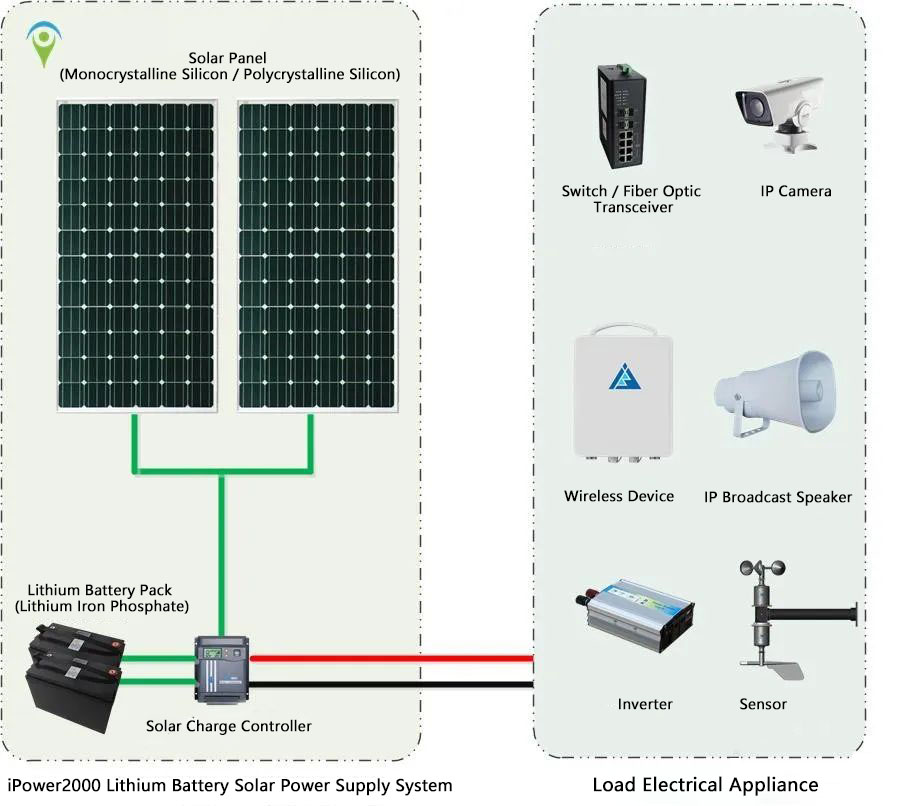
Due to differences in solar resources, working environments and installation conditions across various regions, there are significant variances in its design, installation and commissioning processes.Most notably, for instance, the same equipment (electrical appliances) and operational requirements may require double the configuration and cost when deployed in the sun-abundant northwest compared with the low-sunlight southwest.Another example: the same lithium solar power supply system demands different installation methods for use in the frigid northeast and the vast regions south of the Yangtze River, owing to varying outdoor ambient temperatures.
With the advancement and large-scale application of solar and lithium battery technologies, lithium solar power systems have become increasingly mature. Guoxin Longxin launched its first-generation lithium solar power system in 2014 and has since rolled out four generations of upgrades.Professionalism builds reliability. As a standalone product line of Guoxin Longxin, we will continue to deepen our expertise in new energy storage systems to solve the power supply challenges of outdoor IoT scenarios.
The power supply design for water conservancy information points can be tailored to actual needs based on the equipment’s application region, environment and power consumption, and is relatively easy to standardize and scale for mass deployment, so it will not be discussed in detail here.The following solutions aim to address the more challenging non-standardized networking issues—networking solutions vary drastically with different water conservancy application scenarios, and the appropriate networking method can be selected with reference to the analysis below.
Water conservancy project construction and management can achieve organized administration, intuitive visualization, efficient operation, fair rewards & penalties and evidence-based decision-making for operation and maintenance work through a single asset-resource-document list, a GIS map & visual large-screen monitoring, intelligent alarm, intelligent work order, comprehensive evaluation and intelligent report generation.
Networking for water conservancy project construction and operation management (including construction sites of water conservancy facilities) is characterized by scattered nodes, high bandwidth, large capacity, real-time transmission, temporary deployment and easy relocation, making the iMAX 5G Wireless Metropolitan Area Network system the optimal choice.
Taking the construction sites of reservoir, irrigation canal and pipeline water conservancy facilities as examples, the schematic diagram of typical applications is as follows:
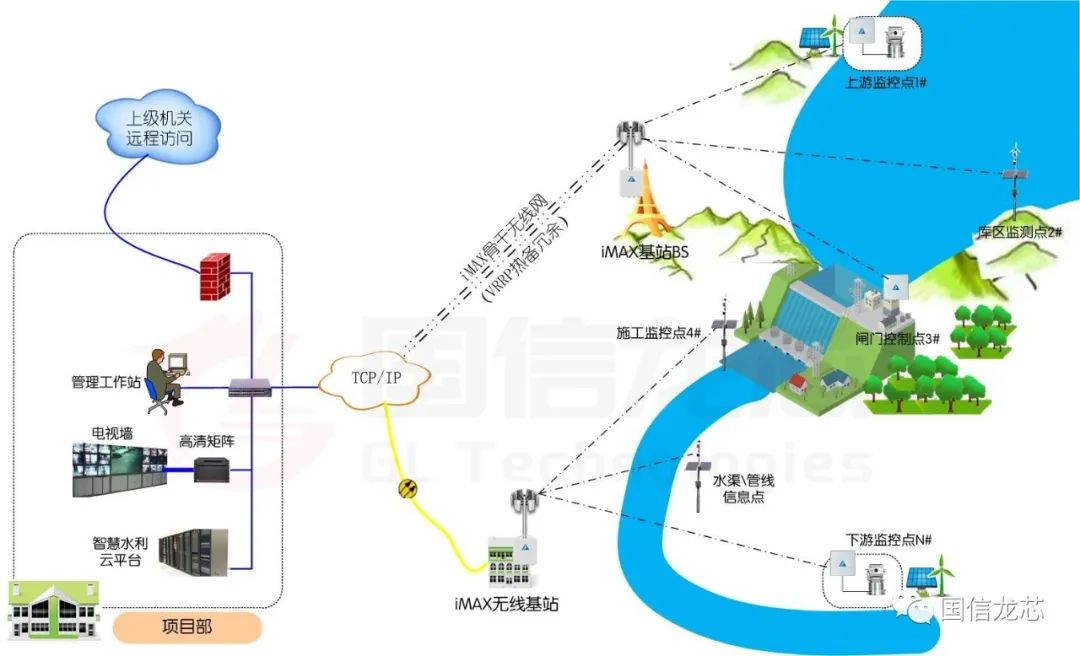
Through the construction of modules including basic ledger, integrated water resources supervision map, total water consumption control, groundwater quantity management, and advance early warning management, we achieve comprehensive supervision of the entire process of water resources withdrawal, utilization, consumption and discharge.
Taking the monitoring along river courses as an example, information points are usually distributed in a narrow and linear pattern along rivers and watercourses. Many monitoring stations operate in harsh unattended environments, and only the iMAX transmission system with high reliability, ultra-long transmission distance and non-line-of-sight wireless transmission capability can meet the operational requirements.
The network constructed with the iMAX Wireless Metropolitan Area Network mainly adopts a two-tier wireless networking architecture (i.e., backbone wireless MAN plus access wireless MAN), or a multi-hop chain networking structure. Taking the river course water resources scheduling and management system as an example, the schematic diagram of a typical application is shown below:
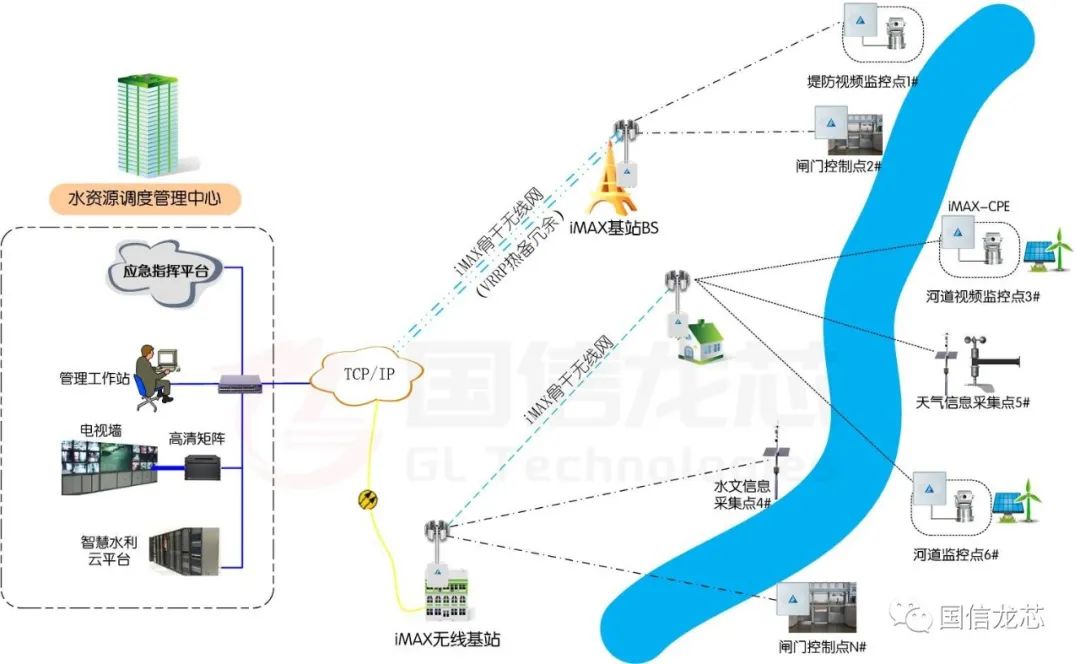
If the number of information points is small and highly scattered, the construction of an iMAX wireless metropolitan area network (MAN) private network may lack economic viability. If the local telecom operators’ 4G/5G networks or wired broadband already cover the operating area, Guoxin Longxin’s SD-CX cloud switching technology can be adopted to build a virtual private network (VPN) through private cloud + hardware VPN end-to-end encryption.
Connecting to the Internet to construct a cloud platform and achieve interconnection via a virtual private network with end-to-end encrypted communication is the optimal solution for scenarios with a small number of scattered points. A schematic diagram of the typical application is shown below:
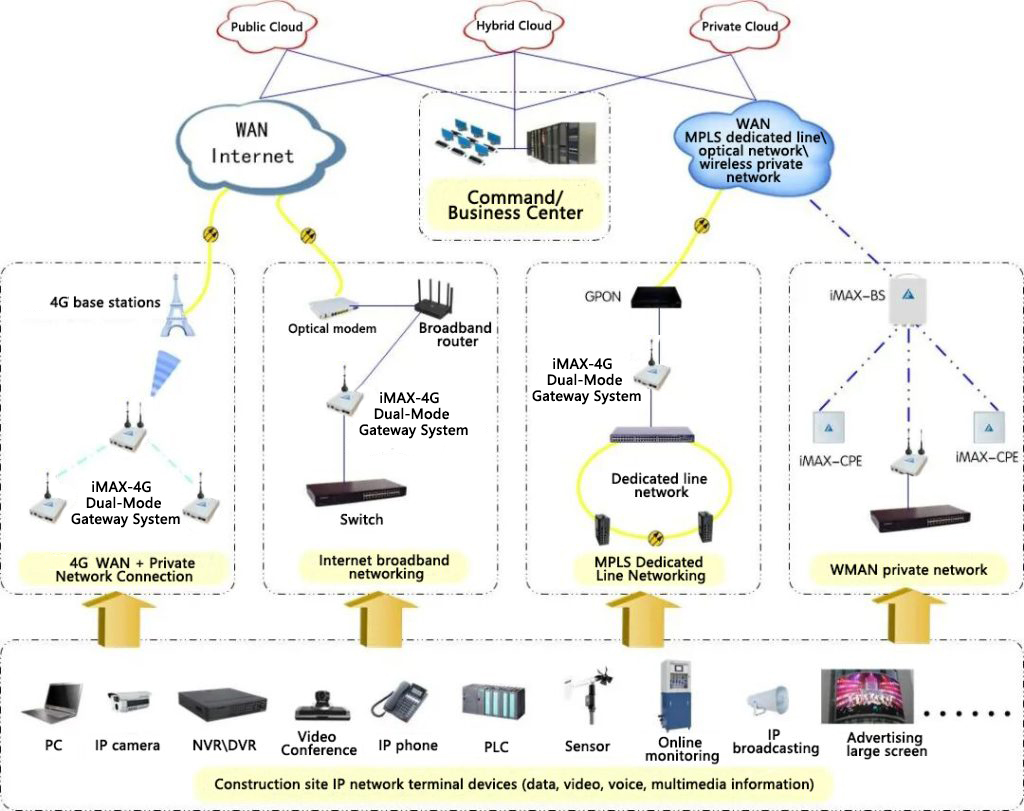
The industry currently adopts a full-chain flood defense system of “forecast, early warning, simulation, and contingency planning”, which takes hydraulic models as the core, intelligent models as the driver, and visual models as the presentation. Through big data algorithms of the multi-model integration platform, it analyzes the disaster evolution process from temporal and spatial scales to achieve all-round, multi-level and three-dimensional regional disaster forecast and early warning, providing crucial support for emergency command and decision-making.
The top priority of flood early warning is to establish real-time, accurate and reliable information monitoring points and video surveillance points at key locations such as the mainstream and tributaries in the upper reaches, to capture first-hand flow data for subsequent big data calculation and analysis. Flood prevention and early warning for a specific river basin can be handled in a hierarchical manner. The application topology of the iMAX wireless private network for a typical flood prevention and early warning system is shown below:
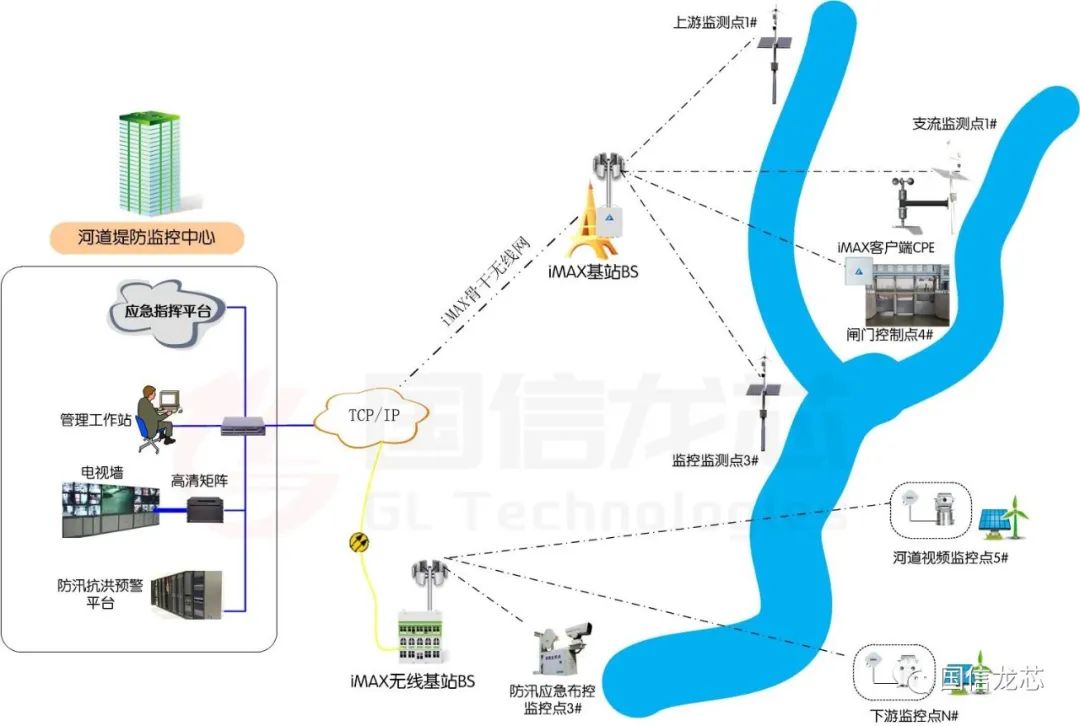
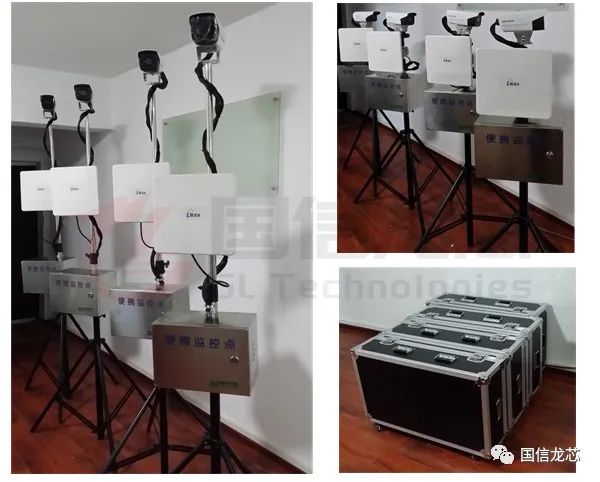
For flood early warning and protection, there is an additional special application requirement in emergency rescue operations: detachable, portable, and vehicle-mounted monitoring points, and even UAV patrol systems. These mobile monitoring point systems can be flexibly deployed and dispatched during flood seasons, effectively filling the coverage blind spots of fixed-point systems and manual inspections, and delivering enormous practical value. Taking Guoxin Longxin’s portable monitoring point system as an example, it adopts a highly customized and modular design concept, with a single point installation time of only about 10 minutes, boasting excellent application prospects.
The iPMVS Portable Monitoring Point System mainly consists of an IP HD video surveillance camera, an iMAX wireless metropolitan area network terminal, a high-performance lithium battery host, and supporting tripods (solar power supply is expandable). Despite its integrated functionality, it can be simply packed into cases and relocated on demand. With a professional integrated design, the system is adaptable to outdoor operating conditions (rainproof, extreme temperature resistance, etc.), and simultaneously addresses HD video surveillance, power supply and IP network connectivity needs. It is an ideal choice for temporary emergency deployment of video surveillance points.
Since its implementation, the River and Lake Chief System has played a vital role in water resource governance and protection. The key challenge of the system lies in the convenience of daily inspections – given the heavy workload of local competent leaders, it is impractical for them to devote excessive time and energy to on-site inspections regularly.
The optimal approach is to adopt diversified monitoring methods including daily video surveillance patrols, UAV patrols and satellite remote sensing for rivers and lakes, and leverage artificial intelligence algorithms to quantify key elements such as difficult and common issues in the “Four Irregularities” in river-lake governance.
Through the integrated application of technological means, the full-process supervision mode for river-lake management – including establishing electronic ledgers, standardizing disposal procedures, rectification and closure of cases, self-assessment and inspection, and verification, evaluation and approval – is constructed to fully standardize the inspection, confirmation, rectification and penalty links of river-lake management, which will greatly improve the efficiency and effectiveness of the River and Lake Chief System.
The integrated monitoring and management system for the River and Lake Chief System consists of the following components by hierarchy:
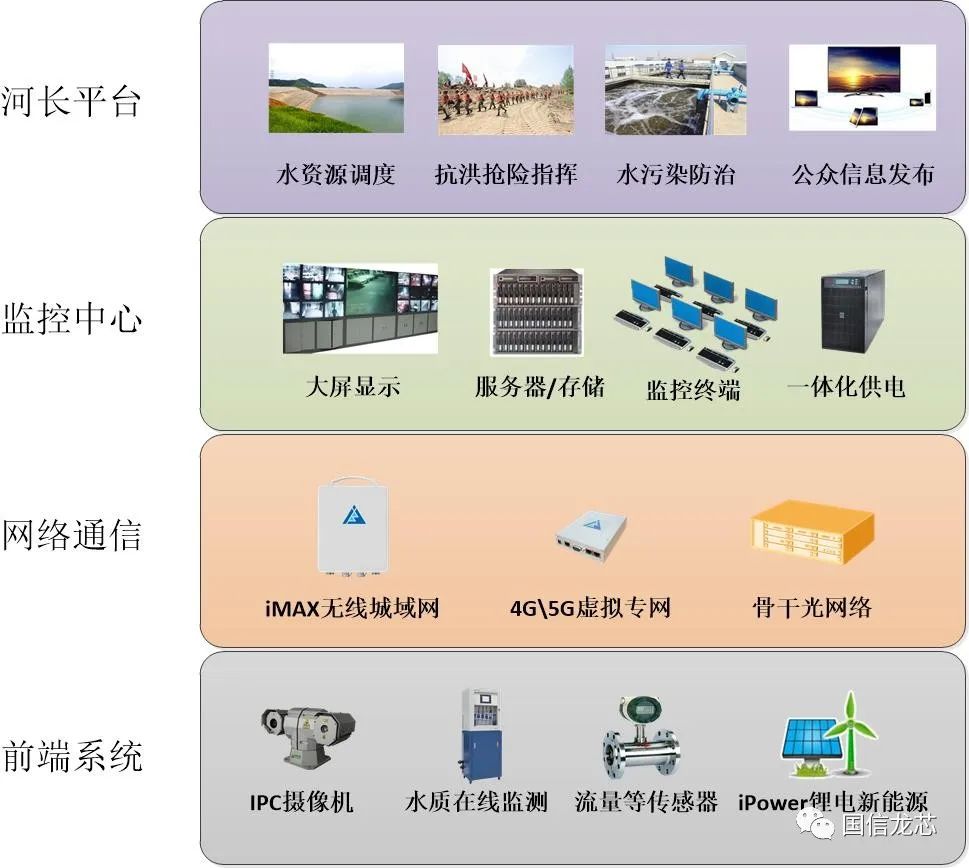
Guoxin Longxin’s iMAX 5G Wireless Metropolitan Area Network system or the SD-CX cloud exchange solution based on 5G/4G LTE, as the most important network communication method here, also plays a pivotal role. Due to varying basic conditions across regions and vastly different scales and requirements for the River and Lake Chief management, the network design for this scenario is more complex and requires targeted customization based on specific networking needs, which will not be elaborated further here.
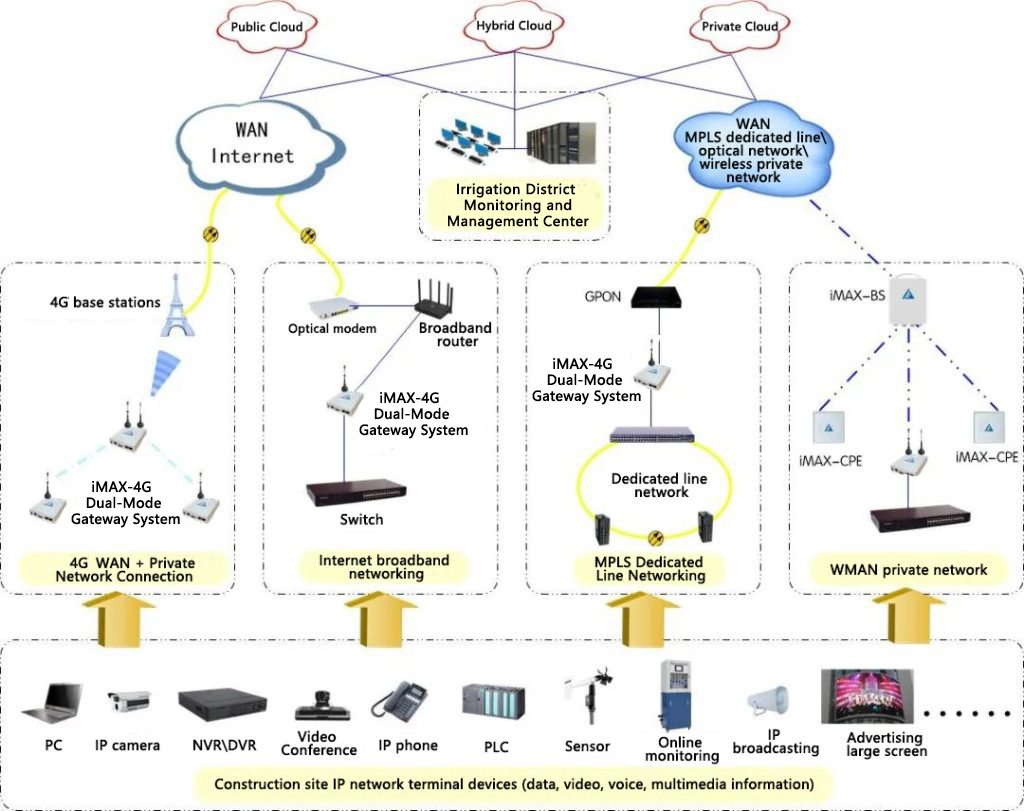
The irrigation district management and control platform is generally built on automated monitoring, metering and control of all water resource elements in the irrigation district. It adopts a variety of irrigation forecasting and scheduling models to provide crop water demand prediction, intelligent irrigation, intelligent scheduling and comprehensive water resource assessment, achieving full electronic coverage of grassroots water management and socialized services. Generally, it covers a large area, making it difficult to connect all information points with a single networking method. This scenario exactly maximizes the advantages of Guoxin Longxin’s SD-CX cloud exchange technology for networking (via private cloud + hardware VPN end-to-end encryption).
Guoxin Longxin’s SD-CX is a cloud platform-based Internet solution that can be deployed on a private cloud, public cloud (e.g., Tencent Cloud) or hybrid cloud. Network interconnection based on cloud systems is referred to as SD-CX (SDN-based Cloud Exchange). Specifically, Guoxin Longxin’s SD-CX solution customizes and integrates the WAN + wireless MAN + LAN + VPN technologies for cloud interconnection, among which VPN technology and cloud interconnection are the core technologies ensuring the solution’s security and stable operation.
The iMWB-5GW1000 is a 5G multi-mode wireless gateway system under the iMWB brand. It supports both 5G WAN (SA&NSA) and WiFi6 wireless LAN coverage (2.4GHz&5.8GHz) simultaneously, and is equipped with 2 Ethernet ports, serving as an edge VPN access gateway for the cloud exchange platform. While leveraging WiFi6 wireless technology to deliver high bandwidth, high reliability and high capacity, it also supports 5G network access to telecom operators’ public networks, providing users with the optimal wireless networking solution in a more flexible manner.
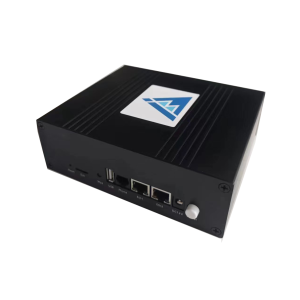
The iMAX-4GW300 is a dual-mode wireless gateway system integrating iMAX Wireless Metropolitan Area Network (WMAN) and 4G LTE under the iMWB brand. It supports both iMAX wireless private network technology and 4G LTE (FDD-LTE & TDD-LTE) simultaneously, and is equipped with three Ethernet ports, serving as a multi-network convergence gateway. While leveraging iMAX wireless private network technology to deliver high bandwidth, high reliability and high capacity, it also supports 4G LTE network access to telecom operators’ public networks, which enhances the adaptability of the system’s wireless networking and provides users with the optimal wireless networking solution in a more flexible manner.
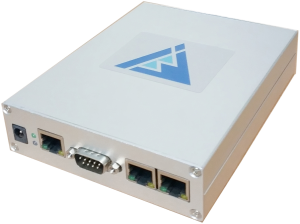
Both devices feature an indoor design with compact size, light weight and low power consumption. They not only enable IoT terminal networking for industries such as environmental protection, port, water conservancy and electric power, but also meet the embedded integration needs of integrated systems (UAV, portable monitoring point, vehicle-mounted, ship-borne, airborne, etc.), making them an ideal choice for high-quality multi-mode wireless communication in the IoT industry.
In other words, based on diverse access methods including LAN interconnection, MPLS leased line access, Internet broadband access, iMAX wireless metropolitan area network private network, and 4G/5G Internet access, these two devices can serve as integrated switching gateways to achieve interconnection of various TCP/IP network devices (e.g., IP cameras, computers, PADs, advertising screens, PLCs, IP phones, IP broadcast speakers, etc.).
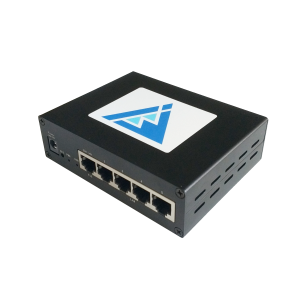
In addition, for users who need to build a private cloud via home broadband wired networking, Guoxin Longxin offers a cost-effective edge VPN gateway option—the Layer 3 routing VPN gateway product iMWB-ROUTE400G. This product is a 5-port intelligent managed routing VPN gateway with full Gigabit interfaces, supporting intelligent network management and Layer 3 routing configuration, and can be used as an enterprise-level router or a VPN access terminal.
Virtual Private Network (VPN) technology enables encrypted communication by establishing a private network over a public network (or an encrypted private network over a dedicated network to enhance security). VPN technology mainly relies on tunnel encryption protocols, with typical ones including PPTP, L2TP and IPSec.Guoxin Longxin’s solution is constructed with an embedded hardware VPN device-centric architecture of “VPN server + VPN gateway”, which undoubtedly delivers superior reliability and security for remote management and maintenance.
This solution is a cloud platform-based Internet solution. Users can opt for a private cloud, public cloud or hybrid cloud, and integrate scattered irrigation district information point networks into a single private network over the wide area network (WAN) via VPN tunnel encryption technology.Moreover, Guoxin Longxin’s solution adopts a dedicated-line private cloud + VPN gateway architecture centered on hardware VPN devices, which undoubtedly ensures higher reliability and security.
The typical application topology of the irrigation district management and control platform networking is shown below:
1)Cloud Type Selection
Irrigation district management systems are regularly used by administrative authorities, and the relevant data constitutes government confidential information, so network security must be guaranteed.
Hosting the system on a public cloud built by a third-party company (open to the public for universal registration and access) with login via username and password obviously cannot ensure security. Meanwhile, the long-term usage costs are extremely high. For example, the annual rental fee for a public cloud with 10 Mbps bandwidth on T Cloud exceeds 40,000 RMB, and a 100 Mbps bandwidth costs over 300,000 RMB per year. In contrast, if we build a private cloud (self-built and self-used by the user), the annual rental cost of the cloud platform for the same 100 Mbps bandwidth is less than 10,000 RMB, delivering significantly better cost-effectiveness.
2)Advantages of Short-Range ConvergenceGuoxin Longxin’s iMAX-4GW300 dual-mode gateway enables direct wireless private network interconnection of information points within several kilometers, which can greatly reduce the account opening and rental fees charged by telecom operators and improve the overall cost-performance of the system.
3)Multiple Networking Options AvailableThe iMAX-4GW300 dual-mode gateway can directly access Guoxin Longxin’s iMAX wireless metropolitan area network (MAN) private network for high bandwidth, connect to the Internet via 4G LTE wireless for convenient networking, and also access the cloud platform through wired methods such as self-built optical cables, leased data dedicated lines, and even home broadband. Such diverse and flexible networking methods offer great convenience for users to build private clouds.
4)Security and StabilityGuoxin Longxin’s SD-CX cloud switching technology achieves interconnection through end-to-end encryption of “dedicated-line private cloud + hardware VPN device”. Without the hardware support of the iMAX-4GW300 dual-mode gateway, no third party can access the network. Even if the iMAX-4GW300 hardware device is obtained, unauthorized access is still impossible as long as the user’s network configuration remains confidential.
This hardware encryption method, combined with a private cloud, greatly enhances network security and stability (and mitigates the issue of unstable Internet bandwidth), ensuring the basic security required for government and enterprise clients. The iMAX-4GW300 dual-mode gateway integrates a software Firewall function, further improving the system’s security and reliability from a technical perspective.
In summary, Guoxin Longxin’s SD-CX cloud switching technology (prioritizing private cloud + hardware VPN end-to-end encryption) is the most suitable networking method for irrigation district management and control systems. However, for scenarios requiring large-capacity real-time video surveillance, the iMAX wireless MAN private network remains the optimal solution.
The drinking water safety system, especially the rural drinking water safety system, is under construction. It covers all links including water intake at water sources, water treatment at water plants, water transmission via pipe networks, end-point water sales, and terminal water use. It supports the government in fulfilling drinking water safety guarantee responsibilities, improving industry supervision capacity and serving people’s livelihoods; it also ensures water quality and quantity for water users, provides auxiliary safety early warning, and delivers convenient and efficient services.
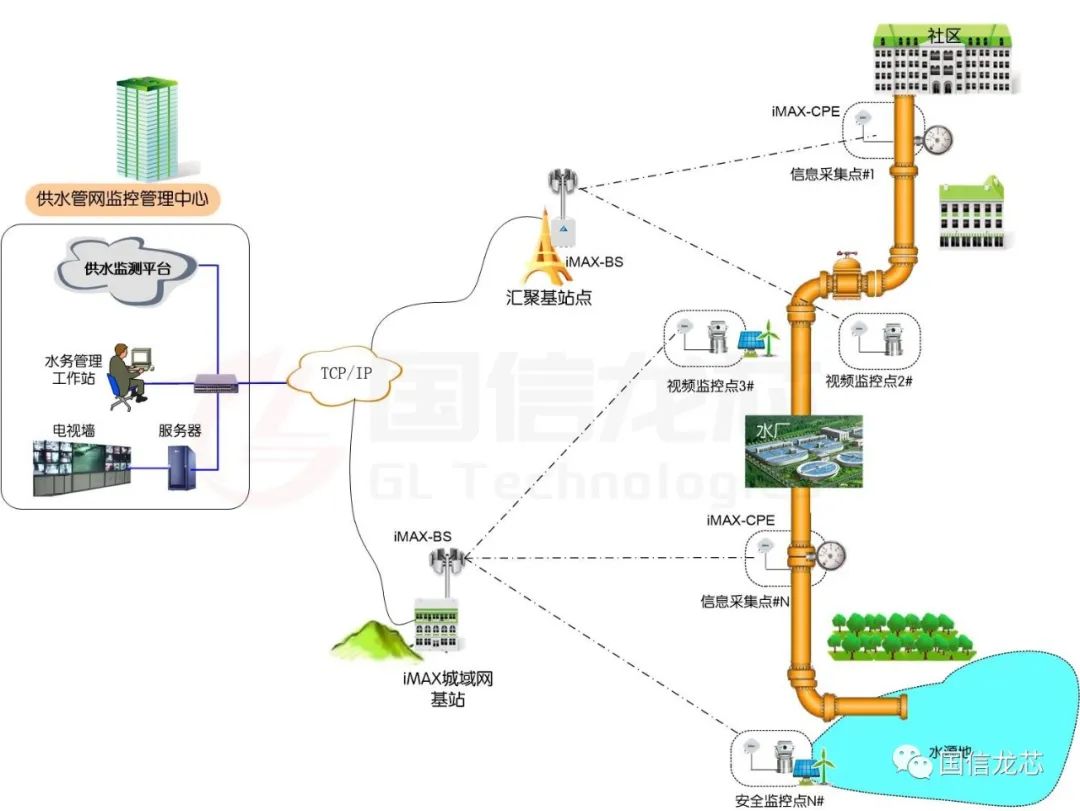
The monitoring system for water supply pipe networks may adopt either the iMAX wireless MAN solution or the SD-CX cloud switching solution, depending mainly on actual requirements (number of points, distribution, bandwidth demands, service types and available resources). The typical networking topology of the real-time online monitoring private network for water supply pipe networks using the iMAX 5G wireless MAN system is shown below:
Due to space constraints, this document does not cover all scenarios and applications of Smart Water Conservancy, such as sewage treatment plant network systems and online water quality monitoring systems. For these applications, the adopted products and technologies are largely consistent with those introduced in the aforementioned scenarios, and reference can also be made to Guoxin Longxin’s dedicated and tailored solutions.
In short, for any challenges of difficult and costly networking in the water conservancy and water services industry, you may consult the technical department of Guoxin Longxin. You will receive reliable product and solution support to ensure the smooth implementation of Smart Water Conservancy and achieve improved performance and efficiency.
The perfect integration of Guoxin Longxin’s wireless network system and lithium solar power supply technology is a golden combination for solving networking and power supply challenges in water conservancy and water services environments. However, both are typical non-standard customized products that must be tailored to the actual needs of specific projects. This document is only intended to serve as a starting point for further exploration.