
Drones are being deployed across an ever‑widening range of use‑cases. IT integrators working on power‑grid inspection, pipeline security monitoring, forest fire prevention and emergency rescue have likely encountered common pain‑points with drone operations: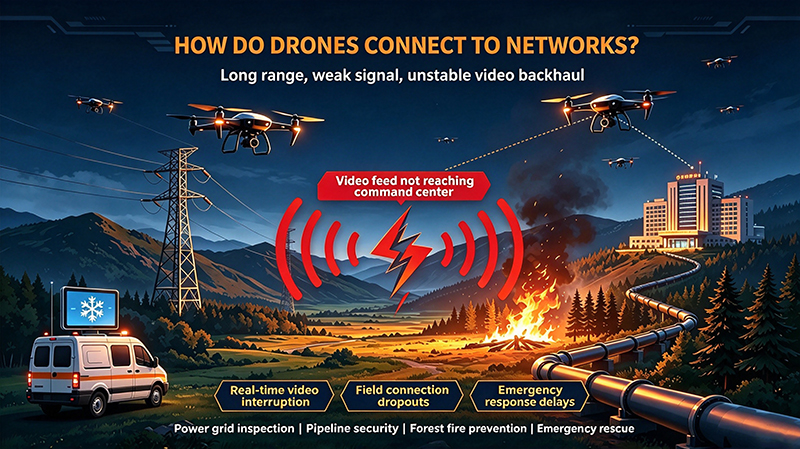
Live video feeds fail to stream back to command centers; frequent connection drop‑outs occur in field environments; exorbitant data traffic charges; inability to centrally manage multiple drone units.
There are two core objectives for any drone network connection: real‑time high‑definition video transmission and reliable flight control.
In total, five mainstream network‑connection approaches are available on the market. There is no universally perfect solution; the best choice depends entirely on application‑specific requirements.
This article breaks down each method in plain language, offering practical guidance for new users, project selection and proposal documentation to help you avoid common pitfalls.
1. Native Remote‑Controller Direct Connection: Free to Use, Yet Limited in Scale and Range
This is the basic network‑connection mode for all drones. The drone connects to its remote controller via built‑in 2.4 GHz or 5.8 GHz frequency bands; some industrial‑grade drones employ low‑frequency proprietary protocols.
Key strengths: Completely free, ready‑to‑use out‑of‑the‑box. No extra hardware or base‑station infrastructure is required. Stable short‑range control is available immediately after purchase.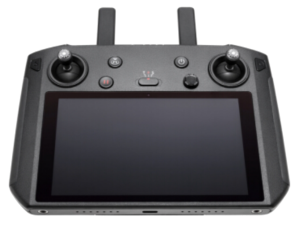
Footage is recorded locally on the controller and later imported into enterprise systems. This workflow presents critical drawbacks for large‑scale government‑enterprise deployments:
- No remote command capability: Pilots must operate on‑site; command centers cannot view live feeds.
- Severe data latency: Footage is only recorded locally and copied for post‑mission analysis, delaying hazard response.
- No support for AI‑driven intelligent analysis: Real‑time detection of faults, fires or safety violations is impossible.
- No multi‑drone swarm operation: One controller manages only one drone; unified multi‑unit scheduling cannot be achieved.
Suitable scenarios: Personal aerial photography, short‑range ad‑hoc urban inspection, ad‑hoc evidence collection. Unsuitable scenarios: Long‑route inspection, regular field operations, large‑scale government‑enterprise projects.
2. 4G / 5G Public‑Network Connection: Fast Deployment, Poor Suitability for Long‑Term Government‑Enterprise Use
Conceptually straightforward: Drones are fitted with 4G/5G modules. Operator cellular base‑stations and public‑cloud platforms relay video feeds back to command centers.
Only advantage: No self‑built base‑stations required. Operations can commence wherever cellular signal exists.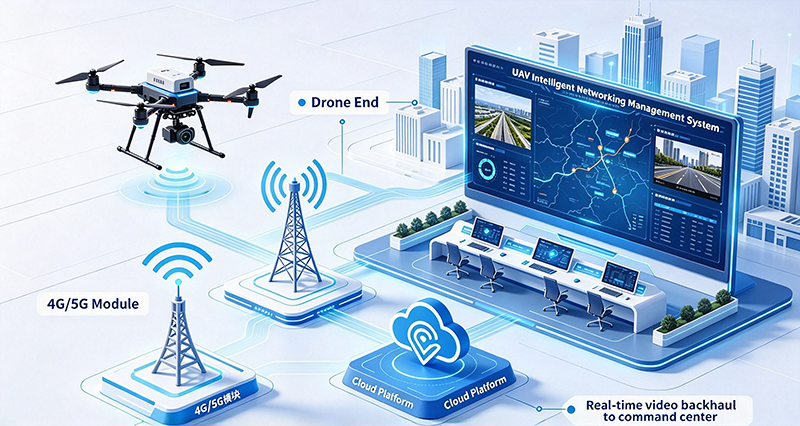
This solution is largely unworkable for regular field‑based operations due to three inherent flaws:
- Extensive signal dead zones in wilderness areas Deep mountains, gobi deserts, pipeline corridors and forest zones are mostly outside cellular coverage, regardless of budget. Network congestion also arises during urban peak‑hours, causing stuttering video and multi‑second latency, raising crash risks.
- Prohibitive data‑traffic costs Take the popular DJI M300 as an example: 3‑4 hours of daily operation can exceed 2000 GB of monthly traffic. A single drone may incur thousands in monthly data fees, approaching nearly one hundred thousand annually. Costs become unsustainable for multi‑drone fleets.
- Compliance‑related security risks and poor reliability Data travels over the public internet, exposing it to leakage and hijacking risks. Police, power‑utility, emergency‑response and similar government‑enterprise entities typically cannot pass network security compliance audits with this architecture. Furthermore, small racing drones lack sufficient payload capacity for external add‑on modules and cannot adopt this solution at all.
Suitable scenarios: Temporary urban‑campus patrols, short‑term non‑classified assignments. Unsuitable scenarios: Field inspection, long‑term projects, classified government‑enterprise missions.
3. Private Wireless Network: Optimal Solution for Government‑Enterprise Drone Operations
This represents the mainstream deployed solution for drones within power, oil‑gas, border‑defense and fire‑service industries.
Centered around the Guoxin Longxin Huayou low‑frequency MESH private network, the system combines airborne terminals with self‑deployed private base‑stations to form an independent network.
Transmission path: Drone airborne terminal → Private base‑station → Dedicated backbone network → Command center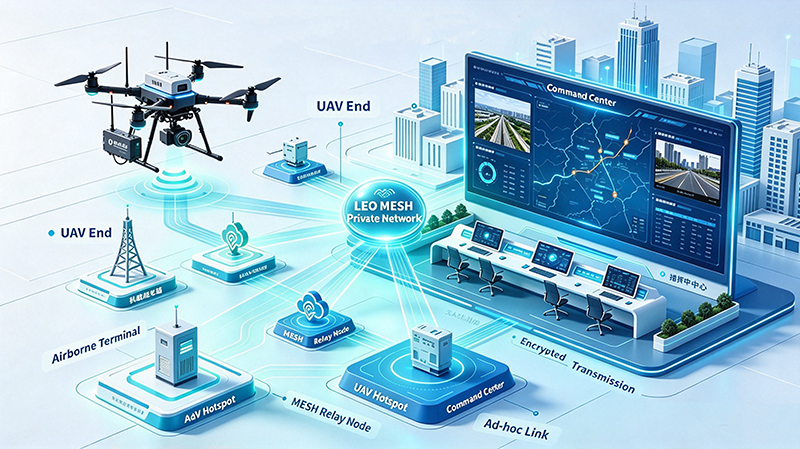
Compared with public networks and direct‑controller links, it delivers substantial benefits:
- Physical isolation for robust security Dedicated encrypted private infrastructure with no public‑internet access eliminates data leakage and signal hijacking risks, fully meeting government‑enterprise cybersecurity compliance standards.
- One‑time capital expenditure, zero recurring operational fees Once base‑stations are commissioned, there are no data‑traffic or annual licensing charges. Multi‑drone long‑term deployments can save hundreds of thousands compared with public‑network alternatives.
- Long‑range transmission supporting long‑route inspection Flight‑control links reach up to 60 km; stable high‑definition video transmission covers 10‑20 km. MESH ad‑hoc networking supports automatic relay. Overlapping base‑station coverage easily satisfies networking requirements for hundreds‑of‑kilometers‑long power‑grid and oil‑gas‑pipeline inspection routes.
- Multi‑drone swarm capability plus real‑time AI analytics One unified platform manages multiple drones with live‑video backhaul. AI automatically detects tower‑structure damage, conductor strand breakage, pipeline defects and fire hazards, enabling immediate remote response dispatching.
- Resilient signal performance across complex terrain Low‑frequency signals offer strong penetration, maintaining connectivity amid obstructed mountain‑forest, canyon and hilly environments.
Since 2023, Guoxin Longxin has implemented the Huayou low‑frequency MESH system for private drone‑network construction and accumulated substantial project experience.
Suitable scenarios: Full‑route power‑grid inspection, long‑distance oil‑gas‑pipeline monitoring, border security, forest‑fire prevention, mine‑site surveillance, flood‑control emergency response and other regular field‑based assignments. Unsuitable scenarios: Pre‑deployment site survey and base‑station construction incur upfront capital costs. Not compatible with small racing drones.
4. Drone Hangar Network Connection: Best‑in‑Class for Large‑Scale Fully‑Autonomous Government‑Enterprise Drone Operations
True full autonomy requires solving both drone power supply and network connectivity, making drone hangars essential for many use‑cases.
A common pitfall: Hangars locally connect to drones via 2.4 GHz / 5.8 GHz links. However, hangars are often dispersed across remote locations, and projects frequently stall due to hangar‑site networking difficulties.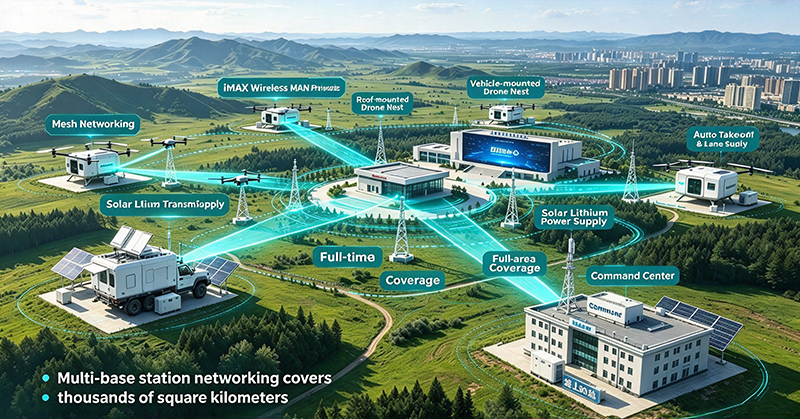
Two traditional hangar‑networking approaches carry significant drawbacks:
- Fiber‑optic leased lines: Field‑trenching is difficult; recurring rental fees are high; deployment is infeasible for remote sites.
- 4G / 5G public networks: Unstable signal, high data‑traffic expense, failure to meet security compliance criteria.
The optimal solution: iMAX wireless metropolitan‑area private network. It addresses all pain‑points for field‑based unattended hangars (including mobile hangars):
- Single base‑station coverage radius starts at 10 km and can extend to 50 km. Multi‑base‑station networking covers operational zones spanning thousands of square kilometers.
- High‑bandwidth converged networking simultaneously carries hangar telemetry, drone video feeds and fixed‑camera surveillance streams.
- Compatible with solar‑lithium‑battery power supply, enabling 24‑hour operation at sites without mains electricity.
- Independent private‑network operation delivers stable security performance with minimal long‑term maintenance costs.
The iMAX hangar‑oriented metropolitan private network serves as a foundational enabler for large‑scale drone adoption. When paired with hangars, drones achieve end‑to‑end unattended operation: automatic take‑off / landing, autonomous inspection missions and real‑time data backhaul.
Essentially, drone‑hangar networking amounts to metropolitan‑area network construction for fixed sites. Drawing on over 20 years of wireless‑network engineering expertise, Guoxin Longxin tailors cost‑optimized private‑network architectures to real‑world end‑user requirements, replacing expensive leased‑line services and helping industry partners accelerate project delivery.
Suitable scenarios: Clusters of fully‑autonomous drone hangars, cross‑regional 24/7 continuous operations. Cost‑performance advantages are especially pronounced for integrated smart projects combining forest‑fire prevention, pipeline monitoring and tower‑asset inspection. Unsuitable scenarios: Inapplicable to small drones without hangar infrastructure.
5. Networking for Small FPV Racing Drones: Lightweight Dedicated Solution
Small FPV racing drones feature compact form‑factors, very limited payload capacity and short flight endurance. They cannot accommodate external 4G/5G or MESH‑network hardware and natively only support short‑range Wi‑Fi links.
For this category of drone, hardware modification is unnecessary. A dedicated networking approach is available: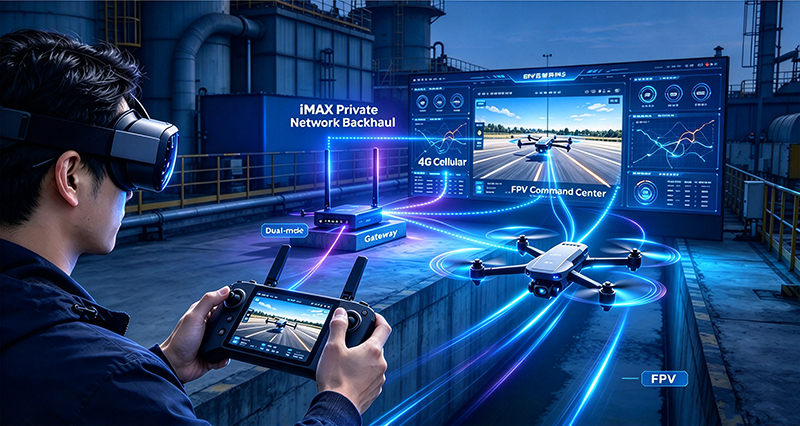
Recommended approach: Deploy an iMAX private‑network plus 4G public‑network dual‑mode gateway to relay remote‑controller video feeds back to the command center. Zero‑hardware‑modification, lightweight implementation preserves racing‑drone agility while enabling remote situational awareness and control.
Guoxin Longxin’s dedicated dual‑mode metropolitan‑area wireless system builds relay architectures supporting 20‑km‑class connectivity: Command Center → Relay Node → FPV Drone Remote Controller, deployable alongside portable monitoring nodes.
Suitable scenarios: Individual‑operator inspection, indoor reconnaissance, short‑range emergency search‑and‑rescue. Unsuitable scenarios: Not ideal for sustained large‑scale drone fleets.
Summary: Quick‑Selection Comparison of the Five Drone‑Networking Approaches
Guoxin Longxin delivers customized drone‑networking solutions aligned with diverse government‑enterprise requirements:
- Remote‑controller direct connection: Zero cost, stable short‑range performance. For ad‑hoc one‑off aerial photography; not fit for large‑scale deployments.
- 4G / 5G public network: Fast roll‑out, no self‑built base‑stations. Restricted to short‑term urban assignments; prohibited for field‑based and classified projects.
- Low‑frequency MESH private network: Long‑range transmission, no recurring data‑traffic fees, swarm‑drone support. First‑choice for government‑enterprise long‑route field inspection.
- iMAX hangar‑optimized private network: Unattended operation, wide‑area coverage, converged multi‑service networking. Standard configuration for fully‑autonomous drone hangar fleets.
- Racing‑drone private‑network relay: Zero modification, lightweight implementation. Dedicated for small FPV racing drones.
Concluding Remarks
Many organizations currently operate “pseudo‑autonomous” drone deployments: pilots must be physically present; footage can only be reviewed post‑flight; real‑time early‑warning is absent; swarm‑drone scheduling is unavailable. The root cause is unresolved stable, secure, long‑lifespan networking and centralized control.
The future of industrial drones lies in large‑scale deployment, network‑connected operation and real‑time data processing. Our assessment: for government‑enterprise clients prioritizing network stability and security, drone networking will be dominated by private networks, supplemented by public‑network private clouds.
Public networks suffer from extensive limitations, security vulnerabilities and high running costs. Direct‑controller links cannot enable intelligent workflows. Only purpose‑built private wireless networks can substantially reduce human‑operator dependency, enabling remote drone dispatching, autonomous missions, real‑time AI‑driven risk assessment and wide‑area swarm‑drone management.
These five architectures represent mainstream options for present‑day government‑enterprise drone projects in power, oil‑gas, emergency‑response and security sectors. Solution design must be tailored to individual requirements. Inquiries are welcome.