
Many people take an ironclad rule for granted: wired communications rely on optical fibers or network cables, with optical or electrical signals propagating inside physical media; wireless communications use electromagnetic waves travelling through open air.
Technologies such as hollow‑core fibers and waveguides are eroding this dividing line.
From a physics perspective, signal carriers — whether laser light or radio‑frequency (RF) waves — are fundamentally electromagnetic waves. The difference lies only in the conduit confining those electromagnetic waves: copper cables, solid glass, hollow tubes, or open‑space radiation.
Wired and wireless are not inherently opposites. Both follow the same underlying logic of electromagnetic‑wave transmission.
This article explains hollow‑core fibers and draws comparisons with waveguide systems. Understanding both gives you insight into the foundational principles of communications.
I. Challenging Established Perceptions: What Counts as Wired? What Counts as Wireless?
Traditional definitions are straightforward. Wired communications trap electromagnetic waves within solid dielectrics for directional propagation along cables, examples being solid‑core single‑mode optical fibers and copper cables. Wireless communications radiate electromagnetic waves into free space for airborne dispersion, as seen in 5G, microwave links and Wi‑Fi.
This classification worked well in the past but breaks down for hollow‑core fibers and enclosed waveguides.
In hollow‑core fibers (anti‑resonant hollow‑core fibers being the most common type), light no longer travels primarily through glass. Most of the interior is air; optical signals propagate mostly within the hollow cavity rather than through glass. It adopts the form, connectors and cabling practices of optical fiber, making it appear “wired”, yet its transmission medium is fundamentally light waves moving through air.
Waveguide‑based wireless systems employ metallic or dielectric pipes to confine RF electromagnetic waves, preventing outward radiation and enforcing directional propagation along the pipe. No optical fiber or network cable is used. While carrying wireless RF signals, the signals remain tightly enclosed without free‑space radiation. This overcomes two pervasive pain points of conventional wireless: blockage and interference, delivering stability matching or exceeding wired links.
To put it concisely: the wired‑wireless distinction no longer hinges on whether signals are optical or RF. Instead, it depends on whether electromagnetic waves are confined within closed or semi‑closed guiding channels.
- Channels made of solid glass: conventional wired communications
- Hollow channels lined by glass walls filled with air: hollow‑core fibers
- Metallic waveguide cavities filled with air: waveguide‑based wireless
- No guiding channels, free‑space radiation: conventional wireless
A large grey zone now sits between wired and wireless.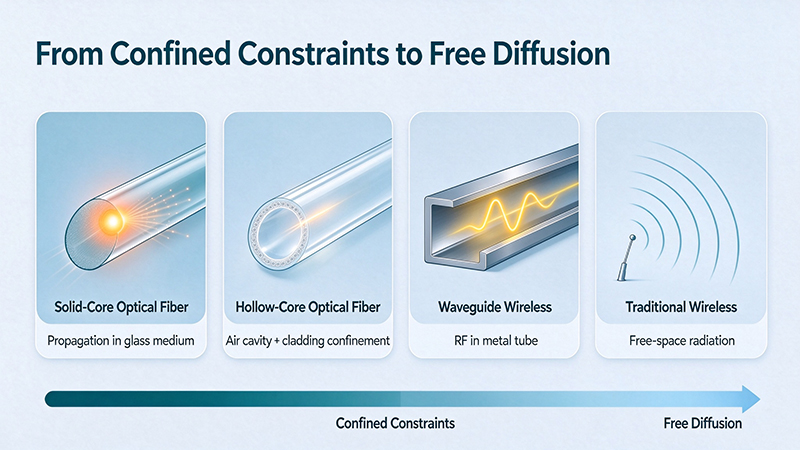
Figure 1 Four transmission regimes ranging from tightly confined propagation to free‑space radiation
II. What Is a Hollow‑Core Fiber?
In conventional solid‑core optical fibers, light propagates via total internal reflection inside a core of high‑purity silica glass. The glass itself introduces attenuation, nonlinear effects and thermal sensitivity, imposing performance limits at high optical power or long transmission distances.
Hollow‑core fibers invert this paradigm. The core region is hollow and filled with air, surrounded by a specially engineered microstructured cladding. Using photonic bandgap or anti‑resonant reflection principles, light is confined and guided forward within the hollow cavity. Air serves as the principal propagation medium.
It retains the full engineering form‑factor of optical fiber: it can be spooled, fusion‑spliced, routed through ducts and fitted with standard fiber connectors. Cabling and maintenance workflows remain largely consistent with legacy fiber. For engineering purposes it is treated as a wired optical cable, yet its underlying transmission mechanism departs from conventional solid‑core fiber. It represents a form of “confined wireless communication”.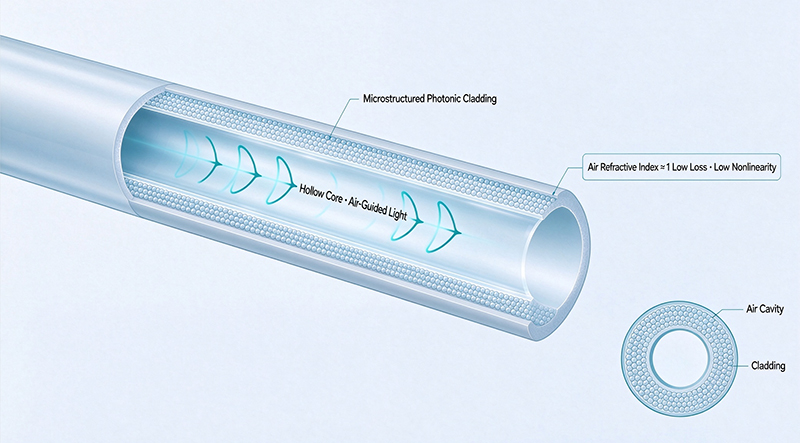
Figure 2 Structure and light‑guiding principle of hollow‑core fiber
Core Advantages of Hollow‑Core Fibers
- Lower attenuation: Air absorbs far less light than glass, unlocking potential for long‑reach transmission.
- Extremely weak nonlinear effects: Light propagating in air experiences minimal signal distortion, making it suitable for high‑power lasers and ultra‑high‑speed broadband signals.
- Stable propagation delay: Air has a refractive index close to unity, yielding very little delay drift caused by temperature variation. Well‑suited for high‑precision timing synchronization, radar and integrated sensing‑and‑communication services.
- Enormous bandwidth potential: A single fiber supports ultra‑high aggregate data capacity.
- Radiation‑hardened performance: Glass darkens and degrades under intense radiation; hollow‑core fibers suffer far less degradation, fitting for specialized operating environments.
Drawbacks of Hollow‑Core Fibers
- High manufacturing complexity: Fabricating the microstructured cladding is technically demanding; costs greatly exceed standard single‑mode fiber.
- Stringent splicing and bending requirements: Excessively tight bending disrupts optical confinement and sharply raises loss.
- Immature industrial ecosystem: Limited availability of supporting components and optical transceivers.
- Risk of air‑cavity contamination: Dust or moisture ingress inside the hollow cavity directly degrades performance.
Typical Application Scenarios
High‑bandwidth trunk lines, high‑precision synchronization links, high‑power laser delivery, aerospace, high‑radiation industrial environments, low‑jitter sensing links.
III. What Is Waveguide‑Based Wireless?
Also known simply as waveguide communication in industry parlance, waveguide‑based wireless transports RF (rather than optical) electromagnetic waves. RF signals propagate inside enclosed metallic or dielectric pipes, which contain wave energy and suppress outward radiation.
Although it carries wireless RF signals, it differs fundamentally from ordinary microwave or mesh radio systems. Conventional wireless radiates energy diffusely through open air and suffers from blockage and interference. Inside waveguides, RF waves travel directionally with energy tightly contained.
No optical‑to‑electrical conversion is required. RF signals are directly coupled into the waveguide at the transmitter end and extracted at the receiver end. Microwave and millimeter‑wave signals can both be conveyed. Physically it takes the shape of metallic tubing that may be deployed through tunnels, mine roadways and utility corridors, transporting spatial RF waves within its hollow interior.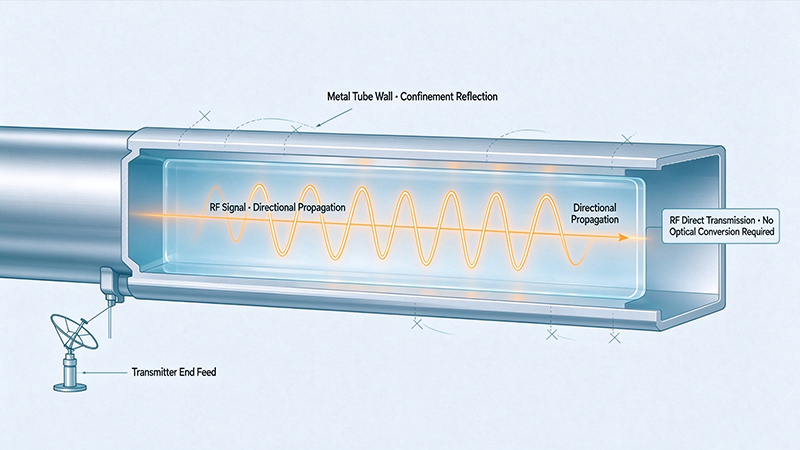
Figure 3 Structure and propagation principle of waveguide‑based wireless
When intentional slits are cut along waveguide walls, signals leak progressively outward. Closely spaced mobile antennas running parallel to the waveguide maintain bidirectional network connectivity. This technology is known as slotted‑leaky waveguide. (For further technical background refer to Analysis of Waveguide Communication Technology and Its Applications.)
Core Advantages of Waveguide‑Based Wireless
- Strong electromagnetic isolation: Signals remain largely trapped inside the pipe with negligible external radiation; external interference barely couples inward.
- Robust stability: Consistently low delay and jitter with service‑level‑agreement‑compliant performance approaching wired links.
- Diffraction‑adapted propagation: Excellent fit for long, narrow enclosed spaces such as mine roadways, metro tunnels and utility tunnels.
- Reduced base‑station density requirements: Continuously‑laid waveguides deliver uniform signal coverage along their entire run.
- Persistent mobile‑terminal access: Trains and mining vehicles moving alongside the waveguide maintain steady connectivity.
Drawbacks of Waveguide‑Based Wireless
- Bulk and weight: Waveguide physical dimensions scale with signal wavelength. Low‑frequency waveguides become impractically large; mid‑to‑high‑frequency implementations are more feasible. Millimeter‑wave waveguides are compact and widely standardized.
- Demanding bending and joint workmanship: Poorly finished joints cause signal leakage and excessive loss.
- Lower bandwidth ceiling compared with optical communications: Single‑link capacity lags significantly behind hollow‑core fiber systems.
- Costly RF hardware: Long‑distance cascaded deployments add system complexity.
Typical Application Scenarios
Aerospace, underground mine roadways, metro tunnels, unmanned overhead‑crane control, shield‑machine communications, millimeter‑wave private networks for enclosed utility corridors.
In unmanned and remote‑controlled heavy‑lifting cranes (rubber‑tyred gantry cranes, rail‑mounted gantry cranes and overhead travelling cranes for instance), reeling or trailing fiber‑optic cables degrade mechanically and are prone to damage. Contact‑free waveguide‑based systems avoid the interference and blockage plaguing conventional over‑the‑air wireless. In such use‑cases waveguides deliver superior stability, reliability and service life compared with optical‑network alternatives. (For expanded discussion see the technical brief Waveguide‑Communication Applications for Intelligent Heavy‑Machinery Control.)
Beyond waveguide tubing itself, critical system elements include dedicated waveguide base stations, client units and antennas. Guoxin Longxin supplies the iMAX‑8000W system purpose‑built for slotted‑leaky‑waveguide deployments.
Side Note: What Are Mid‑to‑High‑Frequency Leaky‑Coaxial‑Cable Systems?
Guoxin Longxin also offers mid‑to‑high‑frequency leaky‑coaxial‑cable solutions. These can be viewed as a “downgraded variant” of waveguide systems. The principle converts over‑the‑air wireless signals into guided propagation inside coaxial cables; wireless terminals then receive signals leaking through periodic slots along the cable to establish end‑to‑end data connectivity.
Why classify leaky coaxial cables as a downgraded variant? In the 2 GHz‑6 GHz mid‑high‑frequency band, leaky coaxial cables exhibit relatively high attenuation. Furthermore each individual leaky cable can carry only limited RF streams, yielding substantially lower aggregate bandwidth capacity compared with MIMO‑capable waveguides.
Field‑proven use‑cases for mid‑to‑high‑frequency leaky coaxial cables include wireless coverage for overhead‑crane unmanned‑operation networks, narrow‑space wireless networking inside tunnels, utility conduits and mine galleries, and coverage within metal‑enclosed spaces such as offshore platforms and ship compartments.
Further details are available in the solution brief Mid‑to‑High‑Frequency Leaky‑Coaxial‑Cable Private Wireless‑Network Solutions. Much like waveguide deployments, leaky‑cable system design is highly custom‑tailored. The most vital component is not the cable itself but the accompanying purpose‑built wireless system: the iMAX‑8000M multi‑mode routing MESH platform.
IV. Hollow‑Core Fiber vs Waveguide‑Based Wireless
表格
| Comparison Item | Hollow‑Core Fiber | Waveguide‑Based Wireless |
|---|---|---|
| Signal Carrier | Optical lightwaves | RF / millimeter‑wave signals |
| Confinement Principle | Microstructured photonic cladding traps light inside air‑filled cavity | Metallic‑wall reflections contain RF waves inside hollow cavity |
| Conventional Engineering Classification | Wired optical cable | Wireless RF transmission system |
| Primary Propagation Medium | Air | Air |
| Upper Bandwidth Limit | Extremely high; single‑fiber ultra‑high‑rate capability | Moderate; significantly below optical carriers |
| Delay Stability | Excellent, minimal temperature‑induced drift | Excellent |
| External Radiation | Practically zero | Minimal leakage under properly engineered installation |
| Mobile‑Terminal Support | Limited; optimized for fixed point‑to‑point links | Strong; supports continuously connected moving endpoints along the route |
| Optical‑Electrical Conversion | Mandatory optical‑transceiver hardware | RF‑native; no opto‑electrical conversion required |
| Physical Cabling Form | Flexible optical cable, spoolable | Predominantly rigid metallic waveguide tubing |
| Primary Workloads | High‑speed data, high‑precision synchronization, laser power delivery | Tunnel‑resident mobile private networks, underground‑railway communications, millimeter‑wave on‑the‑move connectivity |
Distilled distinction: The hollow‑core fiber is an optical‑carrier wired conduit optimized for ultra‑high‑bandwidth fixed links. Waveguide‑based wireless provides an RF‑carrier guided conduit focused on mobile wireless coverage within confined elongated spaces.
Shared trait for both: electromagnetic waves propagate through air‑filled cavities, their direction enforced by surrounding structural boundaries to suppress free‑space dispersion. This phenomenon is exactly what blurs the historic wired‑wireless boundary.
- Traditional wired: signals propagate immersed within solid dielectric media.
- Hollow‑core fiber & waveguide systems: signals propagate immersed in air; outer structures enforce directional confinement.
Hybrid networking is feasible: hollow‑core fibers may serve as high‑capacity backbones feeding waveguide‑based segments for railway communications.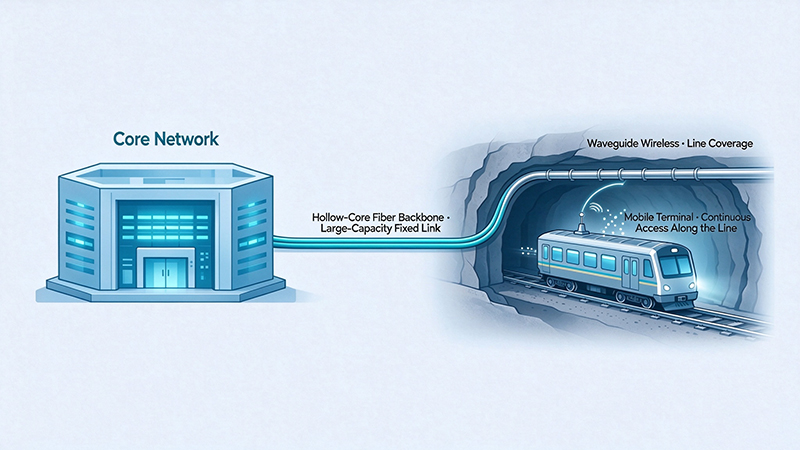
Figure 4 Hybrid‑network architecture: hollow‑core‑fiber backbone interconnected with waveguide subsystems
V. What Shifts Follow the Blurring Boundary?
- Revised network‑design selection logic. Previously link‑selection began with a binary wired‑versus‑wireless choice. Future decisions will be service‑driven. Deploy hollow‑core fiber for ultra‑high‑bandwidth fixed backhaul. Adopt waveguide‑based systems when sustained connectivity is required for terminals moving repetitively along defined physical paths. Both deliver high stability and interference resilience; binary wired‑or‑wireless categorization loses decision‑making relevance.
- Converged equipment architectures. Hollow‑core fibers can transport radio‑over‑fiber signals, so one fiber cable acts both as transmission backbone and wireless‑signal distribution medium. Waveguide‑based systems are inherently RF‑pathways that can interface directly with specialized RF units.
- Updated security and electromagnetic‑compliance considerations. Conventional wireless systems raise well‑known concerns regarding signal interception, eavesdropping and interference with adjacent equipment. Hollow‑core fibers and properly installed waveguides achieve extremely strong signal confinement with security properties approaching wired infrastructure. Security evaluation methodologies for classified and industrial private networks will need revision.
Network security does not originate from transmission medium alone; it depends on cybersecurity controls and technical safeguards. Fiber‑optic links are also vulnerable to intrusion, while mature private wireless‑network stacks incorporate comprehensive security features fully satisfying government‑enterprise security requirements. The greatest information‑leakage risk for networks stems from interconnection with public internet. High‑security deployments must therefore implement isolated intranets and private networks.
(Refer to Public Networks versus Private Networks: A Complete Primer for explanation of public‑ and private‑network concepts.)
True network security ultimately relies on physical isolation — above‑all disconnection from the public internet — together with dedicated private‑network operation. (See Network‑Security Risks Must Not Be Dismissed: Consequences Are Severe.)
- Stereotypes break down: “wired equals stable, wireless equals flexible”. Hollow‑core fiber takes a wired physical form‑factor with exceptional stability yet relies fundamentally on “air‑propagated light”, embodying traits conceptually associated with wireless. Waveguide‑based wireless transports native wireless‑format RF signals yet in certain mobile‑operation scenarios achieves availability and reliability exceeding conventional wired cables. Stability and flexible networking are increasingly decoupled from simplistic wired‑wireless labels.
VI. Summary
Recent Hollow‑Core‑Fiber Milestones
In September 2026, Yangtze Optical Fibre and Cable Joint Stock Limited Company (YOFC) released its hollow‑core‑fiber product featuring attenuation of 0.032 dB/km. China Telecom demonstrated co‑transmission of quantum and classical data over a single hollow‑core fiber.
Researchers from China Telecom Research Institute, YOFC and ZTE jointly completed real‑time bidirectional transmission validation across 1007.48 km of hollow‑core fiber. Single‑wave 800 Gb/s (PCS‑16QAM modulation) bidirectional transmission was achieved across extended C+L bands on one fiber, delivering an aggregate capacity of 128 Tb/s.
Guoxin Longxin has multiple field‑deployed waveguide‑system reference cases for remote crane‑control applications.
The original wired‑wireless dichotomy was an intuitive simplification suited for legacy copper‑cable, solid‑core‑fiber and free‑space‑microwave systems.
Hollow‑core fibers convey light through air‑filled cavities while retaining the physical outer shell of wired optical fiber. Waveguide‑based wireless locks RF energy inside hollow tubing: it carries native wireless‑format signals yet is contained within a “wired‑style” physical enclosure that governs electromagnetic‑wave propagation. Both escape the old classification framework:
- Electromagnetic‑wave propagation inside solid media is not the sole definition of “wired”. Equally, electromagnetic‑wave radiation through open air is not the sole definition of “wireless”. Presence or absence of physical guiding‑confinement structures constitutes the new dividing criterion.
- Hollow‑core fiber excels in bandwidth for fixed backbone links. Waveguide‑based wireless features native RF‑operation and good mobile‑terminal support, suiting applications requiring connectivity along elongated linear motion paths.
Future high‑reliability remote‑control and unmanned‑industrial private networks, plus underground roadway deployments, will increasingly adopt hybrid schemes: hollow‑core fibers furnish high‑bandwidth backhaul; waveguide‑based systems provide distributed RF coverage along routes, with seamless interworking. Under such conditions debating whether an individual link qualifies as “wired” or “wireless” becomes largely academic.
For end‑users of network systems, three practical metrics always matter most: adequate bandwidth, steady latency, and reliable terminal connectivity — in short: network stability, reliability and security.
The fundamental physics of communications transmission is always the same: information is encoded onto an electromagnetic wave of a specific frequency. That guided electromagnetic wave travels from point A to point B, where the original information is recovered. As innovative technologies gain deployment traction, the boundary separating wired and wireless communications continues to fade away.